Showing posts with label Goddess Kali. Show all posts

March 05, 2013

Kankaleshwar Kali Bari, Bardhaman


After traversing through the small lanes that make up the Kanchanpara locality in Bardhaman, Bengal, I came across a wide swathe of open land in the center of which a motley group of boys played a cheerful game of cricket. With no wickets, a single bat & a torn ball, the game progressed as naturally as it would have on the grounds of Eden. The boys, with not a care in the world & immersed in their revelry, were used to the ancient structures that stood around them & once again reminded me that we humans do not value what we have close to us. As Rabindranath Tagore put it in vernacular, "we travel far & wide at great expense to see the mountains & the oceans, but fail to appreciate the beauty of the dew drops glistening on the ear of the corn at our doorstep". Bardhaman is an ancient city, with structures & spots even older – here was I, a guy from Delhi, documenting the architectural heritage of the city & enjoying the game of cricket played by the boys who were ignorant of their temple’s history but were easily impressed by the flash of a camera. The temple that I was looking at is one of its kind in the country. Dedicated to Goddess Chamunda, a form of Kali, the Hindu Goddess of death & destruction, the temple is locally known as Kankal Bari (“House of the skeleton”, pronounced "Kon-kol-Bari") or Rakta tola (“Temple of blood”) – the name could not have been more suited.


"Blood Temple"


Kali has always been depicted in terrifying forms – her red tongue sticking out of her mouth, eyes glaring, bosom naked, a neckpiece of human skulls & a waist band of severed hands being her only modesty. She is death incarnate, the symbol of destruction, blood lust & sex. But here this depiction is carried forward to the next level – the black stone idol has eight hands & is carved in such a manner so that most of the major bones & the arterial veins of the Goddess’s body are visible. It is said that the idol was found from the bed of river Damodar after the devastating floods of 1923 (although many accounts say the temple itself was built around the year AD 1700). Belief is that the idol’s conception was influenced by the concept of “Tantra”. 


Kali - The mistress of death


Set in a square courtyard, the small temple has three tiny rooms – the central one houses the said idol, while the other two house Shivalingas (phallus symbol of Lord Shiva, the Hindu God of death & destruction & Kali’s significant other) & tridents (“trishul”, Shiva’s heavenly weapon). The shrine is entered from three arched entrances, each of which faces one of the three rooms. The temple was under renovation when I visited it, artists & laborers were at work on its roof as well as the shrine. The president of the temple managing committee was there too & so was a lady who made me believe that she held some important post in the management team. She downright refused to let me photograph the shrine, no amount of coercion could make her budge, until the president himself intervened on my behalf when I told him I would write about the place. The laborers were more than happy to have me amongst them as I proved to be a change from their daily monotonous schedule. The temple is topped by nine spires in tradition Bengali style of architecture. The front of the temple is profusely decorated with terracotta panels displaying sages, kings & mendicants. In fact, these panels are what make the Bengali temples so mesmerizing – they tell so many stories & present an entire lore through numerous scenes!! In the courtyard surrounding the temple are several smaller Shivalingas, & in one corner is a small building that houses the management committee’s office. The temple, though small, is an extra-ordinary structure - peaceful, enthralling & tranquil. 


Under renovation..


In the ground next to the temple complex, the boys had stopped their cricket game to observe me & scrutinize my activities. In one corner of the ground stands another small temple dedicated to Vishnu (the Hindu God responsible for creation & nourishment of the universe). Topped by five spires, this temple is even more brilliantly decorated with terracotta panels than the Kali temple itself. However it is relatively less known & not many people visit it. Three arched entrances lead into the shrine, each arch is bore by strong pillars betrayed by their gentle curves. 


The Vishnu Temple


The arches are decorated with panels that depict scenes where groups of monkeys have climbed up buildings (perhaps temples, given pyramidal roofs topped by flag masts), birds fluttering around & flowers blooming in the skies. The bigger panels are surrounded by numerous smaller ones that depict sages, kings with bows & arrows, monkey-men carrying maces & mountains (Are the larger panels depicting a scene from the Hindu epic Ramayana -  the welcome given to King Rama (one of Vishnu’s many incarnations) by his monkey-men army when he returns to India after sacking Ravana’s capital?? I don’t know – there are no sources that I could trace that detail the temple’s history or construction). 


Carved with precision!! 


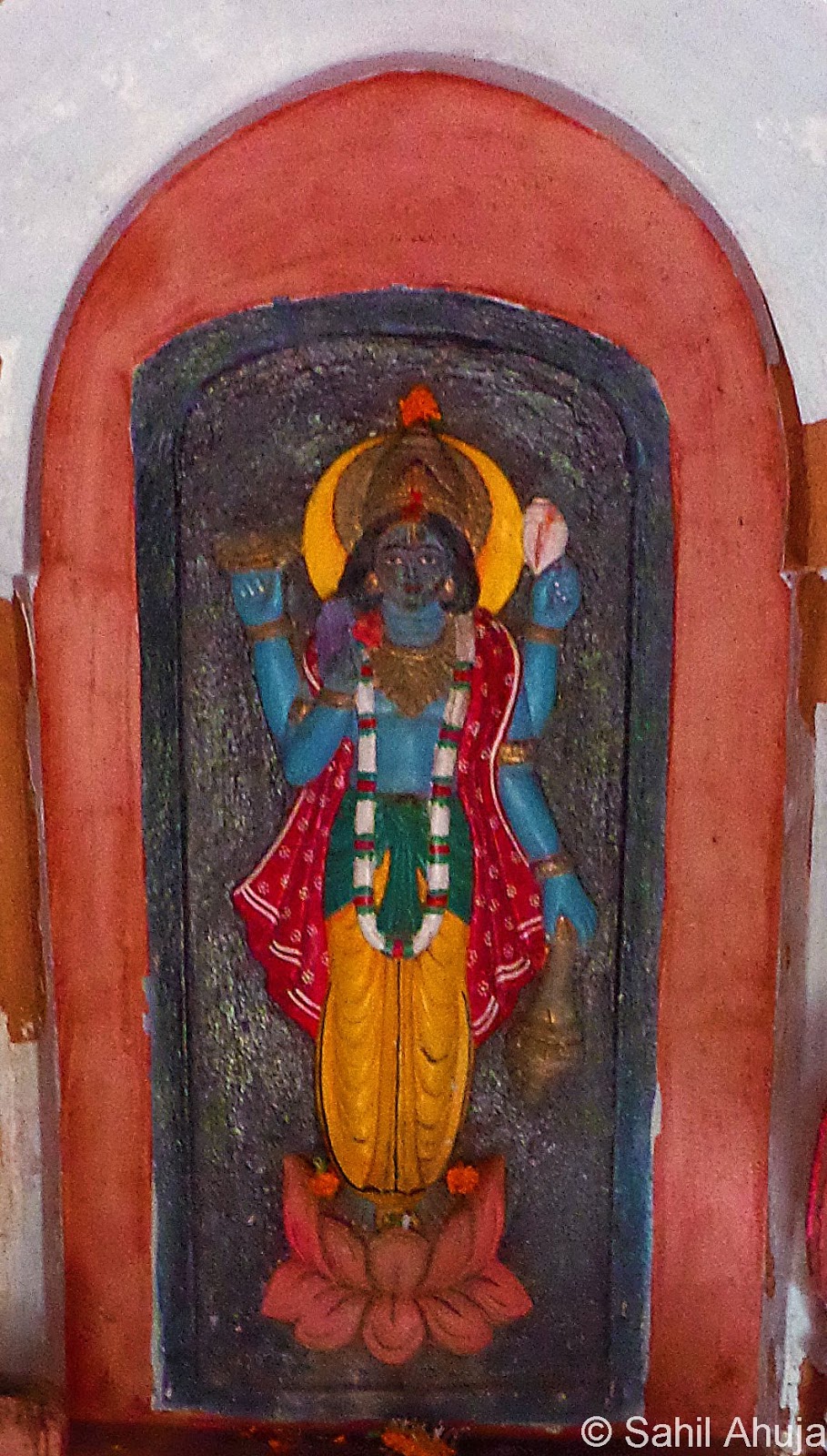
In both the temples, what I found worth-mentioning is that the terracotta panels ornament only the front face of the temple, the embellishments stop as soon as the front wall ends & the other three walls are simply painted over with no decorations but only very small windows breaking the continuity. The single shrine within the Vishnu temple is barred by a grille, the gate of which is locked. I had to be content with photographing the shrine from the outside. The inner entrance too is ornamented with more terracotta panels, though owing to the lack of space there are no other decorations except for three big panels. The shrine consists of a depiction of Vishnu painted on the wall, the offerings are but simply holy water & a few marigold flowers. A few bronze utensils are scattered around the figurine – broken platters, lamps & an elongated spoon for burning clarified butter (“ghee”), thus completing the image of a temple where the same traditions & practices are being followed that were being performed several millennia ago. The paint itself is peeling away & flaking to reveal the temple’s ancient history. In dire need of a restoration, the temple has become blackened with time as a result of the action of the elements. I do hope the managing committee of the Kankal Bari do spare some time & effort for this temple too. 


Vishnu - The master of the universe


As I step outside, I notice an old beggar come & spread his coarse mat expecting visitors to spare him some alms. He told me that if I wait here half an hour, the priest might come & open the grille to the sanctum. However there isn’t anything in the sanctum which I haven’t already seen from between the bars of the grille. I take my leave from the Gods, for the first time I feel sorry for leaving!! The place, remarkable & yet depressingly secluded, makes my heart cry out. The silence & the serenity invoking passive emotions & commanding me to stay some more. I feel bliss, I feel happy for having stepped out & traveled to Bardhaman. Forgetting the travel fatigue that had gripped me a few days back, I feel eager again to travel throughout India to witness these forgotten structures & write their splendid stories. 

Location: Kanchanpara, Bardhaman (aka Burdwan)
How to reach: From the Bardhaman Railway Station, take a bus till Kanchanpara. From there ask for directions to Kankalbari (pronounced "Kon-kol-bari"). You will have to walk a lot from there, it is quite a trek actually (you encounter bridges enroute too!!) away & no rickshaws are available here.
Entrance Fee: Nil
Photography/Video Charges: Nil. But prior permission is required.
Time required for sightseeing: 30 min
Relevant Links - 
  1. Pixelated Memories - Kali Puja

October 23, 2012

Navaratris


The festive season is here again. Navratris have already started, a few days from now it would be Durga Puja & Dussehra, & soon it would be time for one of my favourite festivals, Diwali. & sadly, like the past two years I would not be in Delhi to celebrate Diwali, but would be struck in Durgapur where Diwali (or any other festival except Durga Puja) is never celebrated with much pomp. But I am in Delhi right now, & shall be here for a week more, spending all my time travelling & writing, much to the anguish of my parents & friends who think I spend more time on the road than I do at home!! That’s not true, just so you know. I decided to halt the series about Durgapur (why write about Durgapur when you aren’t even in Durgapur) & write about the celebrations in Delhi. I shall try to incorporate more of festivals & celebrations in this blog. Just for the sake of some of those who don’t know anything about these Indian festivals & for those who would like to learn more, here is a small gist about these celebrations & their significance to let you know what is to follow on this blog’s posts in the coming few days–

Literally “Nine nights”, Navratris herald the beginning of winter festivities, each of these nine nights is dedicated to a form of the Hindu Goddess Durga, the consort of Lord Shiva (the God of Destruction). Although the festival of Navaratri is traditionally celebrated five times/year, the most important of the celebrations are reserved for the advent of winter (September-October) & summer (March-April). It is said that the festival of Navratris is being celebrated since way before the time of the ancient Hindu king Rama. Rama, an ideal son-husband-brother-friend-king-warrior-who-knows-what-else, invaded Lanka (many believe the Lanka in scriptures is the present day island of Sri Lanka) to rescue his wife Sita who was abducted treacherously by the demon king Ravana, the lord of Lanka. Unable to get an upper hand in the long war that followed, Rama prayed to Goddess Durga for several days & she finally blessed him on the eighth day. The eighth day is called “Ashtami” & is celebrated in every household by inviting young girls & a young boy & worshipping them with the belief that Goddess Durga & Lord Shiva reside in each of these girls & the boy respectively. This ritual is called "Kanjak". The women of the house wash the feet of these girls with water & tie red-coloured threads (“Moli”) on their hands & place a small vermillion mark on their forehead. They are then fed with puris (unleavened Indian bread, made after deep-frying wheat flour batter), chole (chickpea), boiled rice, halwa (confection made with flour, condensed butter & sugar), coconut & occasionally chocolates & soft drinks & given small gifts & money. The festival has gained so much popularity in north India, especially Delhi & Haryana, that hordes of impoverished girls & young boys from villages visit the cities early morning in anticipation of the food & money they would collect – many can be seen returning home in the evening carrying large polybags filled with puris. Women wake up very early in the morning to prepare all these delicacies, & toil hard for the blessings of these little living Goddesses. I for one love this festival as I too get to eat these delightful dishes that my mother cooks, & then I can bargain with her for the amount of money I shall be getting!! When I was younger, I used to be called to my neighbors' houses for the prayers & the procedures, & it used to be amusing for us kids to count & boast about the total money we collected that day. It usually continues till noon, since not all ladies can feed the kids early morning, many working women even tend to give fruits & eatables to the kids in the evening.


The Kanjak fare


On the same evening, the Bengali communities celebrate Durga Puja (“Pujo” as Bengalis call it, literally “worship”). Huge idols of the Goddess are bought & established several days (usually on the sixth day of Navratris - Shashti) in advance in the households, or community buildings, & temples. Prayers & prasad (ceremonial offerings of sweets, milk, occasionally fish & meats) are offered every day to this seated Goddess, the places where these idols are housed are covered with tents (“pandals”) & stalls selling all sorts of eatables & mini-idols, devotees gather in large numbers, especially in Delhi’s CR Park locality, for prayers, dances & idol-shopping, making it one of the best nights for gourmets, photographers & heritage-lovers. & of course, you get to see so many beautiful girls all night long in the pandals!!

The Gujarati community too celebrates Navaratris with great pomp & gaiety - the people take part in communal meets & perform the traditional "Garba" dance with each other, irrespective of any social or economic distinctions.


Durga idol - 2012, Janakpuri Kalibari (Kali Temple)


The tenth day “Dashami” is also called “Vijay Dashami” or “Dussehra”. It is said that Rama killed Ravana on this particular day. Hindus believe that Rama was an incarnation of Lord Vishnu, the God of Life & Preservation. In full disclosure, I don’t actually believe that Rama was an incarnation or Ravana was a demon (I am an atheist) – Rama may be a model king, but not a God. Ravana may be a villain, but not a demon, just a man blinded by his lust & power. Ramayana, the book of the story of Rama, composed several millennia ago, talks of Ravana as one of the most learned men in the world, son of a mighty sage, himself a sincere devotee of Lord Shiva & blessed with several boons & weapons, a composer of spiritual texts & also a mighty warrior capable of bringing his foes to their knees. But there is no stopping the believers, since eons they have been burning effigies – big or small, depending on their budget – of Ravana (& his brother Kumbhakaran & son Meghnad) in almost each & every community ground & park (refer Pixelated Memories - Tatarpur, New Delhi). This burning of effigies is seen as the symbolic act of destroying the evil from the world, but I won’t get into a discussion about the merits & demerits of this effigy-burning ritual, or the qualities & character faults of Rama/Ravana – somewhere deep down I too like these festivities – a mode of passing along the stories & belief systems of the ancient culture down the next generation via prayers, singing, dramas & communal gatherings, that’s what Dussehra is about. The Bengalis celebrate Dashami by drowning the ceremonial idols of Durga down some source of flowing water – such as a river or some small stream.


Ravana Dehena - The ritualistic burning of effigies of Ravana & his relatives

May 26, 2012

Kalighat Temple, Calcutta


Before I commence this post, some dedications and thanks are due. This article is especially for Yashika Katyal, who has been a constant support in my life, in times good and bad. In fact, this article wouldn't even have been possible in this form without the motivation, admiration and constant criticism she provided me with. Following her specifications, I have tried to experiment with the writing style and include more of my experiences about the place than write exclusively about history and cultural/architectural significance. This is how I'll be trying to write from now on and hence the posts are going to be slightly lengthy when compared to the past ones. Please bear with me about the same. Suggestions and constructive criticism are always appreciated.

XXXXXXXXXXXXXXXXXXXXXXXXXXXXXXXXXXXXXXXXXXXXXXXXXXXXXXXXXXX

"The ordinary daily practices of the cult (Hinduism) are sufficient to place it beyond the pale of civilization.. A twopenny tram will take you from the centre of Calcutta to the "Kalighat", from which some suppose that the city takes its name, where you may see, in the slimy, swarming precincts of the temple, the ground crimson with the blood of sacrifices, while in a filthy but very sacred backwater of the Hooghly men, women and children not only bathe in their hundreds, but drink the yellow ooze in which their bodies and their garments have been steeped. Hinduism has, indeed, a marvellous gift for extracting bad effects from good intentions, actual ugliness from potential beauty. It is always washing and never clean; some of its practices have probably been hygienic in their origin, yet it is innocent, and often bitterly resentful, of sanitation; it professes a superstitious respect for animal life, but it raises no finger to check the most callous cruelty to animals. It is, in short, the great anachronism of the modern world."
– William Archer, "India and the future" (1917)

Possibly amongst the most revered shrines in the city, visited by millions of tourists and devotees (both Indian and foreigner alike) every year, the ancient Kalighat temple, on account of being one of the most poorly managed and organized temple complexes I have visited in my entire short life, failed to register both a spiritually and mentally soothing effect and a visual and architectural inspiration on my mind and the minds of the friends who accompanied me there. Though certainly I would not contend that the complex is not to my liking – obviously because even being shoved by people and struggling against a tremendous wave of unruly, ritual-crazed humanity rushing and pushing others in order to just witness a stone idol for a fraction of a second is also a unique experience! Even now, when I remember the scene, the entire range of emotional confusion and physical struggle automatically comes rushing back to me. So if undisciplined and angry crowds are your thing, read on! Of course, propelled by the popularly imagined mysteriously magical boon-bestowing capabilities of the complex, friends who are residents of Calcutta are totally in awe of the shrine and are especially intrigued by the practice of "Bali" (ritualistic animal sacrifice) that is still observed here to propitiate Goddess Kali (the primordial Hindu Goddess of universal feminine force, sex, death and destruction) who happens to be the presiding deity. Warnings and words of advise about the do's and don'ts had already trickled down to me prior to visiting the complex from friends who had already been there seen that and I would share the same during the course of this article for the benefit of readers who might not be aware of how things function in some of these temples, especially in those that exist in the eastern part of the country.


Kalighat - The abode of the fearsome mother


But first the elaborate history and cultural significance of the complex – the temple is regarded as one of the 51 "Shakti Peetha" ("Seat of Primordial Feminine energy"), that dot most of the Indian subcontinent including Pakistan and Nepal, whose perplexing origin has its convoluted roots in ancient history's numerous tales where myths and legends conspire alongside hard facts to generate a picture of inexplicable phenomena and locations. I copy verbatim the entire legend from the blogpost about Kamakhya Temple (refer Pixelated Memories - Kamakhya Temple, Assam) where I have already recounted the same – Hindu legends recall the ritualistic sacrificial worship (“yagna”) commissioned by the mythological emperor Daksha in which his own angelic daughter Sati (Shakti) and her husband Shiva, the Hindu God of death and destruction, were unwelcome. Sati, though requested not to go by Lord Shiva but persuaded by an unremitting love for her father and maternal family, nonetheless reached her father’s abode only to be faced with an unrelenting onslaught of merciless abuses and insults heaped upon her all-powerful husband, as an anguished consequence of which she committed suicide by jumping into the ceremonial fire; dangerously enraged and unnervingly grief-struck, Lord Shiva picked up Goddess Sati’s lifeless body in one arm and his frightening trident in the other and began the frenzied “Tandava Nritya” (celestial dance of destruction). The entire world was on the brink of irrevocable destruction when all the Gods and deities collectively invoked Lord Vishnu, the Hindu God of life and preservation, who used his “Sudarshana Chakra” (spinning disc weapon) to cleave Sati’s body into 51 parts since an infuriated Shiva had vowed not to stop his terrible dance till Sati’s body existed. Each of the sacred spots where these 51 hallowed parts fell came to be sanctified as an auspicious “Shakti Peetha” where an intent worshiper channeling the said energy would be endowed with immeasurable intellectual and spiritual prowess. The mutilated toes of Sati's right foot are said to have fallen on the exact spot where the temple presently exists (though some state only one of the toes fell here).


Once upon a time - The temple complex with the adjacent bathing ghats, AD 1887 (Photo courtesy - Puronokolkata.com)


The present temple is said to have been commissioned by Raja Mansingh I of Amber (Jaipur) who, as a vassal of Mughal Emperor Akbar (ruled AD 1556-1605), officiated as the Governor of the eastern territories of Bengal, Bihar and Orissa from AD 1594-1606; it was afterwards modified with additions and transformed into the present complex some 200 years back around the year 1809 by the renowned and financially affluent Sabarna Roy Chaudhary Zamindar family of Calcutta. But the shrine's history is said to revert back several centuries and it's antiquity could be gauged from the discovery of coins originating during the reign of Chandragupta II (AD 380-413/15) and the fact that it even finds mention in early 15th-century Bengali religious texts – prior to Raja Mansingh's interventions, it existed as a nondescript shrine housed in a mere meager hutment on the banks of the river Hooghly and surrounded by dense forests incorporating in their territories ferocious wild animals and massive branched trees. The river has since diverted its course and the temple has been assimilated within an indescribably dense concrete jungle in lieu of the ancient fearsome natural forest; only a small artificial canal referred to as "Adi Ganga" ("Adi" translates to "natural/initial") now slithers alongside the shrine. It has also been argued that the anglicized word "Calcutta" has its roots in "Kali kutta", meaning the "Abode of Mother Kali". Devotees believe that the area demarcated as "Kalikshetra" ("Realm of Kali") is teeming with such an immense amount of spiritual energy that it absolves the pious of all their previous sins and guarantees relief from bad karma and an entrance to heavens to all those who breathe their last here. Eons ago, the densely forested area played host to terrifyingly powerful tribal Tantric mendicants whose chants of the Goddess' name would reverberate throughout the night through the gruesome foliage, especially on nights when they'd mercilessly sacrifice humans to appease her, thereby prompting travelers and fishermen to give the region a wide berth, especially during night hours. The temple and the area surrounding it also lend their name to the Kalighat school of Bengali folk painting that once, with its vivid hues and bold brush strokes, proved irresistible to the devotees thronging the temple complex and were quickly devoured by doting patrons; sadly however, the tradition met an unavoidable death at the hands of cheap printed posters and imitations and can now only be witnessed in museums and art galleries.

The "Mahanta" system, where the chief priest chooses one of his disciples as the next chief, is still followed in the temple. Bhubhaneshwar Giri, one of the chief priests, married an illegitimate woman known as Yogmaya and together the two had a daughter whom they christened Uma. When Uma reached a marriageable age, the Goddess appeared in Bhubhaneshwar Giri's dreams and asserted that she no longer wished to be worshiped by ascetic priests and urged him to marry Uma and declare her husband as the next Mahanta – Uma was thus married to Bhabanidas Chakraborty who assumed the position of Mahanta after his father-in-law handed him the entire Kalighat complex as dowry and since then all the "Sebayats" (Goddess' priests) have continued to be married householders.


Commodification of faith and religion


The present state of affairs – The temple is huge, but larger still is the area around its periphery that has been overtaken by shops, both permanent and makeshift, trading in materials required for worship like vibrant flowers and vermillion and religious souvenirs such as trinkets, conch shells, sanctified bangles and small sculptures and photographs of the Goddess and the temple. Engulfing the entire immediate locality are several small shops, predominantly owned by priests ("Pandas") supposedly officiating in the temple complex, selling sweets like peda (thick, semi-soft sweets composed of dried milk by-product, sugar and cardamom flavoring) – visitors are supposedly required to remove their footwear at one of these shops, after payment of a particular sum of money, and walk barefoot from thereon to the shrine. Swarming around these shops are several fraud priests who promise visitors to take them inside the shrine, offer prayers for them and help negotiate the unimaginably crowded interiors, of course for a price that has to be bargained beforehand – not affiliated with the temple but highly organized into a powerful union, most of these priests are charlatans who aggressively ask for large religious payments ("dakshina") and very few of them are actually soft-spoken knowledgeable guides. It is indeed difficult to get into the perennially crowded shrine, but the priests aren't always helpful either – they would take the devotees' money and push them in the crowded sanctum or instead take them to the "Natmandir" (congregation hall) located some distance away from the shrine and ask them to pray from there only. Besides, most of them are pretty greedy and one has to haggle with them to reach a suitable charge. This unbelievable and unforeseen commercialization of religion and the unsurpassably horrible behaviour of so-called priests proved to be a total turnoff and made us want to leave the place immediately. These Pandas continue to harass visitors and earn their livelihood this way, even though their very presence within the temple premises was outlawed several years ago by Kolkata High Court – but like most other laws and regulations in the city, this ruling too is rarely – if ever – enforced. Similarly, animal sacrifice (considered deeply spiritually enriching and minimally agonizing by the officiating priests on account of the single stroke of scimitar employed to finish off the struggling animal) within the precincts as a form of appeasing the deities too was outlawed eons ago, but still continues uninhibited – I might as well add that being a hardcore non-vegetarian who abhors vegetarian food even under duress, I am not really against animal sacrifice as long as the meat is consumed (it is in the temple) and not allowed to waste or rot.


A labyrinth of associated shrines and shops (Photo courtesy - Famoustemples.net)


Instead of paying one of the priests, one of my friends Sunil, who like me is an atheist and detests visiting religious shrines, decided to sit in one of the cubbyhole shops and safeguard our shoes. But the treacherous priests continued to follow us like hordes of irritating flies and deceived us by stating that one isn't allowed within the shrine without a personal priest, which we later found out to be an obliquity – falling for their words, we eventually acceded to hire one for Rs 50 to assist with the worship and supply us with the sweets. Our feet burned as we walked the scorched cemented road towards the main shrine (located quite a walk away from the shops) and some minutes later, the bloody priest disappeared!! Had it not been for Sunil who had decided to stay at the cramped shop, we wouldn't have even got our sweets at the end of the day! Left to our own devices, we reached the shrine, but by now another group of priests had begun following us, trying to impose their unwarranted services. We had already been warned to not let priests accompany us anywhere within the precincts nor assent to their assisting us with the worship, otherwise they would perform some ceremony/prayer that we had not even asked for or even sacrifice an animal in the sanctum in our name and then demand additional money. There are two modes of worshiping the deity ("darshan") here – the first is done from the "Garbha-Griha" (sanctum sanctorum) which encapsulates the idol within its periphery, while the other is essentially from a viewing gallery, known as "Jor Bangla", running around the Garbha-Griha. To our dismay, we noticed that the entry of devotees to the Garbha-Griha is also controlled by priests who would demand money in lieu of letting people in. It is advisable to not tell any of the priests one's name or profession otherwise they would read some prayers in one's name and not allow one to leave without paying up especially exorbitant amounts! And there is no point in arguing with these goons since they would only gang up and create difficulties for the poor visitor who had come seeking spiritual enlightment and mental serenity. For a foreigner visiting the complex, it becomes even increasingly tough and exploitative! With the priests busily engrossed lying to and looting the faithful, the latter were not organized into queues and created quite a ruckus, making it enormously difficult to enter the narrow passageway and even more difficult to protect oneself from the crushing and milling crowds that, themselves eager and impatient to view and worship the fearsome idol, continue to push one around in their bid to have their way even though they too, in the end, are only able to stand in front of the idol for less than a minute before being pushed away themselves! One of my friends Neeraj, a rather weak fellow who had accompanied us to the temple, had more troubles in store for him – the crowd simply carried him out of the sanctum and to the other side of the passageway!


Notice the floral motifs adorning the shrine roof and the numerous cubbyholes shops being run immediately outside. Forgive my bad photography, I don't yet possess a camera.


The Goddess' silver-encapsulated image as depicted in the shrine, possessing three huge eyes painted a terrifying shade of brilliant orange and a thick, excessively long protruding tongue coated with layers of gold, is visually unique and fiercely terrifying, though unlike my friends I somehow found the massive depiction interesting and the dreadful appearance appealing – after all, Kali, despite the alternative projection as the benign mother Goddess granting bliss and blessings to her faithful, is supposed to be the terrible Goddess of death, the primordial feminine punitive deity, dark in color and fearsome in appearance, with disheveled hair, necklaces of severed demonic skulls and a tongue reddened by the quenching of her bloodlust with sacrifices and slaying of demons! The idol, said to have been sculpted by two priests officiating in the temple itself, is said to have been rendered incomplete by them in its original form and the four hands, also made of gold, two of them respectively depicted in aspects of blessing and guidance and the other two holding a scimitar and the severed head of a demon known as Shambhu, were later additions. A small enclosure underneath the sculpture is said to contain the toe fragment of Goddess Sati that fell here and have since fossilized to stone but were said to emit brilliant light when they were discovered in an associated natural lagoon (now transformed into a stepped rectangular water tank) by some saints traversing the area. Many of the female devotees make a shrill cry, called "Hudhudi" and said to the battle cry of Goddess Kali with the considerable ability to bestow feminine fertility and energy to the devotees, with their tongues within the sanctum and I found the incessant shrieking quite horribly ear-piercing till later when some of my Bengali friends explained about it to us.


Those eyes! (Photo courtesy - Wikipedia.org)


The temple is famed for the fine examples of terracotta art it boasts of, or rather boasted of since a lot of it has been ravaged by the vagaries of time and nature. The curved, double-layered Bengali-style roof of the central shrine and the associated temple clusters, with their numerous intricate bands of colored pattern work and floral motifs, appear visually enchanting but I couldn't photograph them to my heart's content primarily because photography is prohibited within the complex. Stepping outside the sanctum, there wasn't much for us to do – the extraordinary crowds made us feel intensely claustrophobic and the pushing and shoving wasn't pleasant at all, especially for the womenfolk. The complex offers several additional smaller shrines with their own individual histories, but we neither visited them nor even spotted them, given that every time we stepped in any direction or proceeded towards any feature that even closely resembled a separate shrine, the horribly deceitful priests would begin yelling at us to not go there or not do something, forcing us to leave the premises at the first opportunity.

Some time back, taking into account the damage to and littering of the shrine with flowers, religious materials and earthen oil lamps as well as the allegations of extortion and thievery leveled against several officiating priests (who, on numerous instances, even stooped to the extent of stripping foreign nationals to their underpants when they were unable to pay the exorbitant sums demanded as prayer money!), the honorable High Court at Calcutta decreed a ban on the entry of devotees to the sanctum. But owing to the pressure exerted by millions of faithful and priests, the Supreme Court had to turn the ruling down. One cannot really take a position on this, matters of faith being subjective to say the least especially in a country as endowed with religious and spiritual fervor and multi-dimensionality – an enforced ban might bring order to the otherwise chaotic shrine, but then if the devotees themselves, most of whom behave rather uncivilly within the shrine and yet claim to be at the mercy of the duplicitous priests, are against it, then what can one possibly do? One cannot of course send police down to threaten or chase the priests out – apart from the constitutional and ethical dilemma raised by it, the latter would simply resort to stating that they exist because the devotees demand their services – supply equals demand in economics! Nonetheless, it is gratifyingly heartening to know that the courts are sincerely concerned about the mismanagement and hooliganism that goes on in these temples and also about the spiritual and emotional well-being and physical security of the hundreds of millions of devotees thronging these shrines.


Talk about eclectic lightning! (Photo courtesy - Seetheworldinmyeyes.com)


Festivals like Kali Puja, Navratris, Durga Puja and Poila Baisakh (Bengali New year) are observed with enormous fervor at the shrine and witness unparalleled crowds of devotees who travel long distances to worship the mother Goddess and offer her their humble tributes. Hundreds of foreigners too visit the temple complex to understand the reason behind its renown and also to try to fathom why Hindus so earnestly pray to the Goddess of death and refer to her as Mother at the same time. It is another matter that many of them return with bitter-sweet experiences (predominantly bitter!), especially relating to the high-handedness of priests and unofficial authorities that is so readily accepted as a norm here. Such undesired commercialization of religion and the violence perpetrated in its name is one of the worst things that could have existed in our peace-loving, spiritual and ethic-conscious country and definitely contribute to tarnishing the country's and the shrine's name and also labeling the holy complex with all sobriquets that a temple ideally shouldn't be.

What occurred to me while leaving was that it is indeed regrettable that none of the visitors even look in the direction of, leave alone making philanthropic contributions to, the Hospital for the Dying and Destitute that was set up by Mother Teresa immediately opposite the sacred temple complex and presently exists in an unbelievably decrepit condition. Wouldn't it have been better if visitors to the hallowed shrine performed community service and donated at the hospital instead of paying the greedy and exceedingly vociferous priests? All I can hope is that someone will be, after reading this article, propelled to visit the temple complex to witness the explosive cocktail of religious frenzy, chaotic disorder and uninhibited greed but will afterwards find themselves tracing their steps to the hospital and make voluntary contributions there. Amen.


Souvenirs


Open: All days (Tuesdays, Saturdays, Sundays, Navaratris and Diwali are special days of worship and witness impossibly heavy crowds)
Timings: 4 am – 2 pm and 4 pm – 11 pm
Nearest metro stations: Jatin Das Park and Kalighat stations are equidistant.
How to reach: Buses, taxis and metro can be availed from different parts of the city.
Entry fees: Nil
Photography/Video charges: Nil
Precautions: Avoid paying touts and priests who might approach one in the name of offering prayers in one's name or getting one into the sanctum. Do not carry heavy wallets, excessive cash and other precious items since pickpockets and thieves are active in the crowds. Preferably keep currency notes of smaller denominations separately so that if one is forced to pay any priest one doesn't have to reveal how much cash one is carrying.
Relevant Links -
  1. Pixelated Memories - Kamakhya Temple, Assam
Suggested reading - 
  1. Archive.indianexpress.com - Article " SC stays HC ban on entry into Kalighat temple's sanctum sanctorum" (dated May 21, 2012) 
  2. Artnewsnviews.com - Article "Kalighat Pat, a Protomodern Art Tradition?" by Pranabranjan Ray 
  3. Hindubooks.org - The Kalighat temple 
  4. Kalibhakti.com - Shakti Pith #19: Kalighat Kali Mandir  
  5. Telegraphindia.com - Article "The goddess of light " (dated Nov 09, 2007) by Soumitra Das 
  6. Thehindu.com - Article "Calcutta High Court restricts entry into Kalighat temple" (dated April 21, 2012) 
  7. Thehindu.com - Article "Kali Mandir of Kolkata" (dated May 09, 2003) by S. Balakrishnan 
  8. Wikipedia.org - Kalighat

March 09, 2012

Dakshineswar Temple, Calcutta


"The innumerable gods and goddesses of the Hindu religion are the human aspects of the indescribable and incomprehensible Spirit, as conceived by the finite human mind...As long as a man is bound by his human limitations, he cannot but worship God through human forms. He must use human symbols...But the name ultimately leads to the nameless, the form to the formless, the word to the silence, the emotion to the serene realization of peace in existence."
– Swami Nikhilananda of Sri Ramakrishna Math, commenting upon the sculptures and ritualistic objects within Dakshineshwar Temple complex


Sacred symmetry - Dakshineshwar temple and the associated Shiva temples


An interesting legend associated with the commissioning and construction of Dakshineshwar temple, one of the most renowned and spectacularly splendid shrines in the city, credits its construction to Rani Rashmoni of Janbazar, an assiduous philanthropist and a steadfast devotee of Kali (the primordial Hindu Goddess of universal feminine force, sex, death and destruction), who is said to have dreamt of the Goddess just a day prior to embarking upon a pilgrimage to the ancient holy city of Benaras where she meant to worship her and seek divine blessings – the divine mother instructed the queen to build a majestic temple dedicated to her on the banks of the sacred river Ganga in her own territories and install a sculpture of her therein, promising to manifest herself in the image and accepting the queen's unwavering devotion. Beginning AD 1847, it took 8 years and Rs 9,00,000 to complete the construction of the beautiful temple complex against the opposition from several leading upper-caste Hindu Brahmin families (who frowned upon Rani Rashmoni's lower caste and considered it beneath their dignity to visit a temple or bath at a ghat commissioned by her) and eventually the Goddess' idol was installed on May 31st, 1855 amidst grand festivities and celebrations with Ramkumar Chattopadhyay as the head priest.

The handsome shrine, spread over 25 acres (including within it land that was originally a graveyard – considered auspicious for the tantric worship of Kali) on the eastern bank of the river Hooghly, reveres the Goddess in her "Bhavtarini" form which is said to liberate devotees from the ocean of existence and cycle of reincarnations – the massive temple complex is also celebrated for its association with Ramakrishna Paramhansa (lived 1836-86), the renowned 19th-century Bengali mystic and master of Vedanta who formulated and propagated the theory of universal harmony of all religions. Ramakrishna, as Gadadhar Chattopadhyay, took over as the chief priest of the complex following the demise of his elder brother Ramkumar the very next year after the temple's inauguration and soon thereafter began contemplating upon the Goddess' sculpture thereby becoming immersed in religious metaphysical thoughts and ecstatic supernatural divine visions. The renunciate saint continued to live and preach from the temple complex till his own demise thirty years later.


Dominating


We reached the temple complex after taking a ferry across the river from Belur Math (refer Pixelated Memories - Belur Math), which is located diagonally across a few kilometers away, and were immediately awestruck by the sheer immensity of the central temple and its associated shrines and the breathtaking symmetrical visual composition they invoke. Indeed the river front presents the most evocatively impressive view of the complex. The small stretch of land intervening between the imposing bathing ghats and the hallowed complex is overtaken in its entirety by numerous makeshift shops and vendors squatting on the ground offering for purchase garlands of brilliant red hibiscus flowers and offering baskets consisting of sweetmeats, small sachets of vibrant vermillion ("sindoor"), fragrant incense sticks, colorful flowers and red "chunari" (netted veil for draping Goddess' idols). Following the ascent up the steps of the bathing ghat, one reaches the temple complex after going through very nominal security procedures and here one witnesses the colossal size of the courtyard, enclosed by lines of small chambers that function as officiating quarters for the temple staff, in the center of which sits the magnificent triple-storied central temple, surmounted by ridged roofs and nine pyramidal, stepped spires ("Navaratna"), ornamented with miniature decorative alcoves, floral medallions and arched bands of plasterwork and hued sunlight yellow with touches of brilliant red puncturing the overall monotony.


Intricately patterned - The congregation chamber/"Natmandir"


Along two of the sides of the central temple are smaller rectangular buildings, similarly hued and adorned with floral medallions and flourishes and supported upon rows of pillars while the extensive third side is dedicated to a row of twelve smaller temples exclusively dedicated to the worship of Lord Shiva (the Hindu God of death and destruction and the consort of Goddess Kali) and possessing curved Bengali-style roofs. In a corner prior to entering the hallowed compound exists a smaller shrine, set within its own landscaped garden, possessing an exceedingly elongated, tapering dome and painted white fringed with soothing sky blue, commemorating the life and achievements of Rani Rashmoni (her life story's bewitchingly fascinating – one incident recalls her blocking the river traffic with bulky iron chains tied shore to shore to bring around arrogant British ferry owners whose fast-cutting boats were damaging the fishing nets and therefore the livelihoods of fishermen entirely dependent on the river Hooghly for sustenance and financial well being!). In another corner, flanked by palm trees and located on an enormous heap of boulders, stands a brilliant gold-glistening life-size statue of Swami Vivekananda, one of the foremost disciples of Ramakrishna Paramhansa and amongst the most exemplar and learned saints India ever produced, dressed as a monk complete with shaved head and ochre robes representing renunciation and seeking of religious knowledge.


Commemorating Rani Rashmoni


Seated on a high plinth of its own, the central temple rises over 100-feet high and is the most dominating architectural and visual feature of the landscape and yet is very beautifully framed by the two identical rectangular buildings, one of which is a temple dedicated to Krishna, a legendary king-statesman-playboy-strategist-philosopher-warrior said to be an incarnation of Lord Vishnu (the Hindu God of life and nourishment) and the other is a music hall ("Natmandir"). One has to stand in an extremely long slithering queue that slowly snakes its way to the sanctum where the devotees make their pious offerings – indeed, the humongous crowds make it nearly impossible to even gaze for more than a moment at the gold-encapsulated sculpture of Goddess Bhavtarini, leave alone photograph it! (Photography is prohibited within the shrine but nobody follows the dictate) Afterwards, one can settle down for a brief rest from the scorching sun and exhausting queues in the Natmandir where most devotees can be spotted either silently contemplating upon life and its purposes while adoringly gazing at the central shrine, while others sit down in groups and chant hymns invoking the Goddess' divine blessings and mercy.


Ground plan (Photo courtesy - Dhyanacentre.org)


Wandering around, we climbed one of the staircases in a corner near the Shiva temples and reached Sri Ramakrishna's modest room where most of his personal belongings are still displayed reverentially, including his and his disciples' photographs, on and around the original bed that he used. Entry to visitors within the beautifully-kept, light yellow painted room is restricted and one has to contend oneself with looking at the chamber through grilled doors.

Returning back, yet again one comes face to face with the commodification of religion in the form of merchandise and memorabilia for sale outside famed religious complexes – on offer, especially on the side of the temple complex that adjoins the road leading to it but also not nonexistent on the ghat side, are rosary beads, souvenirs featuring printed photographs of the temple and Sri Ramakrishna, small mass-produced sculptures of Hindu deities and similar collectibles. The temple, being a prominent shrine in the city, is definitely advisable for a visit, if just for the sake of its unparalleled grandeur and magnificence, especially from the riverfront from where one can actually claim to experience pure transcendental bliss while contemplating upon the ridges of the spires and the brilliance of the colors.


Framed - Ramakrishna Paramhansa's meager worldly possessions


How to reach: Local buses, autos and taxis are readily available from different parts of the city. One can also avail the services of a boat/ferry from the various ghats dotting the riverside.
Timings: October to March: 6 am to 12.30 pm and 3 pm to 8:30 pm; April to September: 6 am to 12.30 pm and 3:30 pm to 9 pm
Entrance fees: Nil.
Photography/Video: Strictly prohibited.
Time required for sightseeing: About 1 hr
Relevant Links - 
  1.  Pixelated Memories - Belur Math
  2. Pixelated Memories - Kalighat Temple
Suggested reading - 
  1. Dakshineswarkalitemple.org - Rani Rashmoni  (Official website of the temple complex)
  2. Eng.vedanta.ru - The Kali Temple at Dakshineswar and Sri Ramakrishna
  3. Hinduism.fsnet.co.uk - "Introduction - Kali Temple at Dakshineshwar" by Swami Nikhilananda