Showing posts with label Canopy. Show all posts

December 13, 2013

Lodi-era Canopy Tomb, Mehrauli Archaeological Park, New Delhi


Mehrauli, which is the oldest continuously inhabited area in Delhi (it was apparently named “Mihroli” after King Mihr Bhoj who reigned several millennia back), is nowadays famous for the largest archaeological space in the city – the Mehrauli Archaeological Park. More of a necropolis spread over several acres that boasts of tombs, baolis (“step wells”) & wall mosques, the Archaeological Park also houses a lone canopy tomb not unlike many others seen in different parts of the city. Blackish in hue & retaining much of its original ornamentation, the canopy tomb dates back to the reign of the Lodi Dynasty (AD 1451-1526) & consists of a umbrella dome resting on twelve pillars. It stands next to Rajon ki Baoli, one of the finest step-wells that exists in the city; but sadly the local population, possessing but little education & being largely unaware of the heritage spreading over several millennia strewn around them, have condemned both the baoli & the tomb to the fate of a pig sty – filth (black as tar & equally thick), thorny outgrowth dense enough to prove non-negotiable & a large population of four-legged beings comprising equally of dogs & pigs & consisting of a few cows too that call this sewage & polythene filled pit their dear home are what lie in store for a visitor curious enough to brave the curving track of the Archaeological Park to reach this particular point.

Shrouded by foliage


If you still haven’t got the bigger picture, let me assure you that the path leading to the tomb is perfectly fine – a simple mud track cleared of debris & vegetation; in fact even on nearing to a certain extent the scene is pristine – the ruins of the semi-octagonal bastions at the corners of the wall that makes up the perimeter around the plinth on which the tomb stands give the appearance of a miniature fortress, a stone stronghold forgotten in this dense vegetation meant to guard the graves assigned to it for safe keep. The honks of cars & the chatter of humanity is lost on the way to this virgin corner; modernity is left behind; brilliant red birds, big black ants & vividly-colored butterflies are company here. Occasionally one might come across another person who would be as surprised on seeing you as you are on seeing them in this distant corner...
It is the stench that first reaches the visitor - the decay around cannot be ignored, not even if you put all your attention into photographing the structure!! Next comes the sight & sound – pigs grunting at you would not have been so terrifying if they were not so large & not accompanied by dogs that bared their teeth at the slightest pretext!! The pristine, virgin monument turns out to be part of a desolate, forsaken corner. Rubble from collapsed & collapsing structures is strewn around the tomb; the double staircase leading up to the plinth level is surrounded by this downpour of debris - at some places, the only way to reach the plinth is to leap over heaps of rubble collected on/around the stairs.


Protected by bastions


The dome of the tomb rests on an eight-sided drum (base) & is ornamented with leaf motif emerging from the lotus finial. The drum too displays leaf motif though of a different design while the roof of the tomb is marked by a row of kanguras (battlement-like decorative pattern). The pillars that support the dome are simplistic rough, rectangular blocks possessing ornamentation only along their top where they mutate into four-pronged brackets to support the weight of the dome. The inside of the dome reveals floral artwork in incised plaster directly underneath the finial – it appears that once the design must have encompassed most of the dome but it was lost with time & subsequent restoration work limited it to the present state. At each point where the pillars meet the dome, the brackets take a decorative form resembling a lotus bud with more curves sprouting out of it topped by an intricate design; a row of ornamental arched alcoves inlaid within rectangular niches & flanked by floral plasterwork moves around the inside of the dome dividing it into two halves horizontally - but not all the alcoves & lotus brackets are the same - many are simply shorn of all decorative features that their counterparts proudly flaunt, perhaps some conservation artist thought its better to have a plain plaster surface than display remnants of the original artwork.


Adorned by lotus brackets


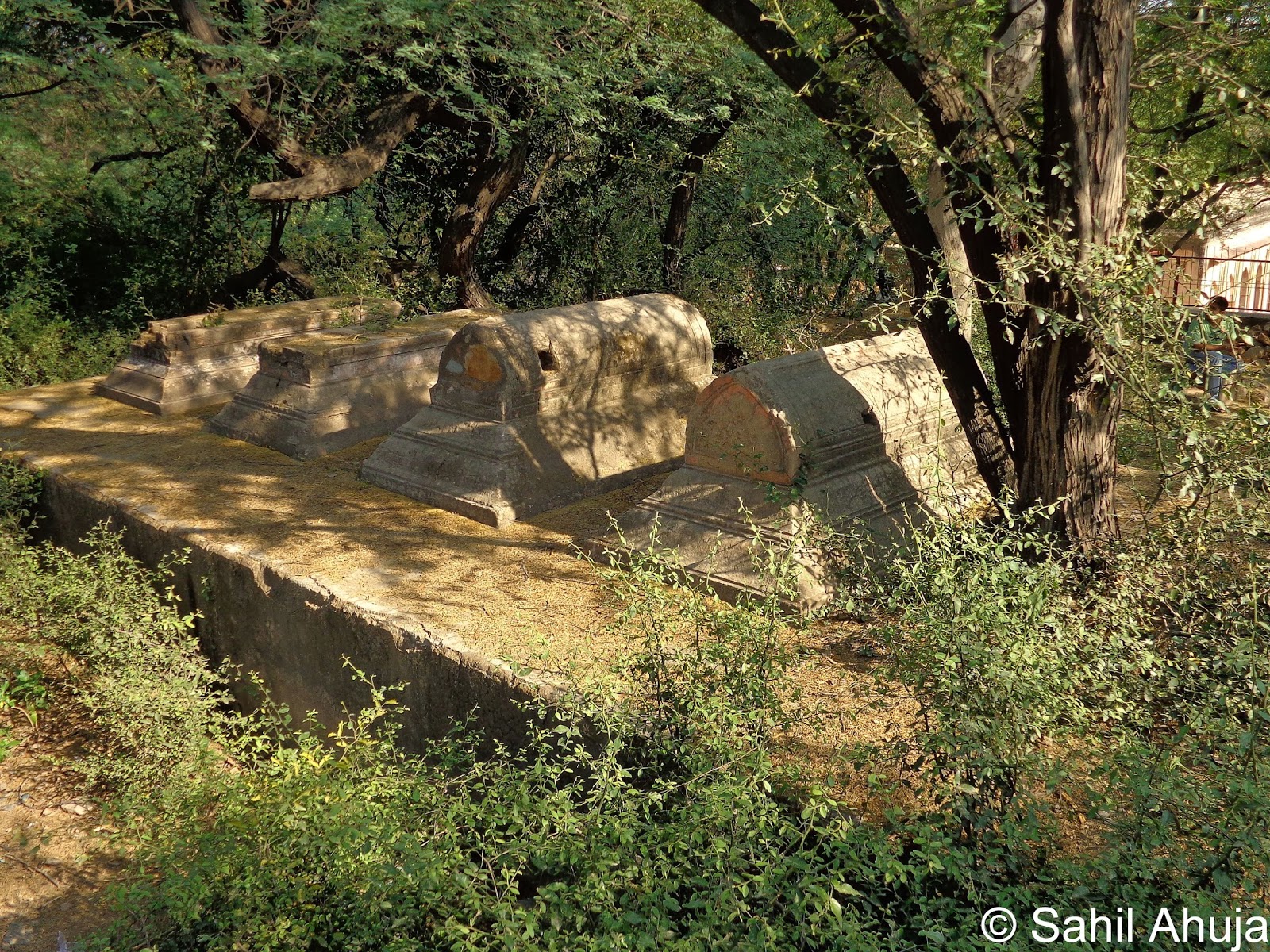
Several graves are scattered underneath the canopy, more surround it, covering both the plinth & the ground around the tomb with a carpet of dead & their mausoleums – some of these are in perfect conditions with their rounded tops & sharply-defined edges, others are broken & crumbling, some even have grass sprouting through their broken faces. There must be at least a score graves here – the canopy seems to be a favorite burial spot at the time!!


Surrounded by graves


The red-sandstone plaque installed by INTACH (Indian National Trust for Art and Cultural Heritage) close to the tomb reads –
“The colonnaded tomb stands on a rather large plinth over which are several graves. In a ruinous condition, the staircase to the plinth leads from each side of an arched opening that leads to a flat domed chamber. The corners of the plinth are emphasized by semi-octagonal bastions. Towards the east of the tomb canopy are remnants of another similar building.”

I assume it’s not just me but every heritage enthusiast-photographer who feels a strange thrill, a sudden rush of adrenaline at discovering a hitherto hidden & largely forgotten structure such as this tomb. No matter how debilitating the stench around it is, or how dangerous those big, bad dogs appear, there is a beauty in such structures that defies their surrounding & the condition they have been subjected to. If only the whole of the Archaeological Park is landscaped & beautified (much like the unbelievable conversion by Lady Willingdon of the erstwhile Khairpur Village to the splendid stretch now known as Lodi Gardens) so that more people can behold the architectural gems that the Park houses.


Framed by ruins


Some heaps of debris scattered right & left only adds to the charm of these centuries-old monuments!! Be there to see for yourself! (& while you are at it, you can also spare some time for the other monuments in the park, am adding the links at the end of this post)

Location: Mehrauli Archaeological Park
Open: All days, Sunrise to Sunset
Nearest Metro Station: Saket
Entrance Fee: Nil
Photography/Video charges: Nil
How to Reach: After getting down at Saket Station, one can walk to Lado Serai bus stop. Buses are available from different parts of the city for Mehrauli & one can alight from the bus at Lado Serai stop itself. The unmarked entrance to the Archaeological Park is through an iron gate opposite Ahinsa Sthal (situated couple of hundred meters away from Lado Serai, refer Pixelated Memories - Ahinsa Sthal)
Time required for sightseeing: 20 min
Note – There are no facilities (toilets, food & drinking water) available within the Archaeological Park. While you can avail food & refreshments at one of the restaurants at Lado Serai, you can only find toilets at the shopping malls close to Saket Metro Station, almost a kilometer away.
Other monuments within the Archaeological Park -  
  1. Pixelated Memories - Balban's Tomb
  2. Pixelated Memories - Jamali Kamali Complex
  3. Pixelated Memories - Khan Shahid's Tomb
  4. Pixelated Memories - Metcalfe's Chattri
  5. Pixelated Memories - Metcalfe's Ziggurats
  6. Pixelated Memories - Ruins, Mehrauli Archaeological Park
  7. Pixelated Memories - Quli Khan's Tomb

June 18, 2013

Sea Ip Club, Calcutta


Relegated to a corner where it can be conveniently forgotten amidst the bustle & noise that defines a regular day in the life of a Calcuttan, & accompanied by the ruckus raised by hundreds of vehicles that ply close to it, the din raised by the forever-chattering passer-bys, the peddlers trying to make some extra rupees & a heavy smoke that emanates from the vehicles as well as the smoldering piles of garbage heaped close by, the Sea Ip Club is unique – as a structure it is relatively young compared to many of its counterparts in this old (nay, ancient) city, as a relic of a culture it belongs to the Chinese community who are almost marginalized in the city that has been the bastion of Hindus, Muslims & the British, & as a symbol of faith it is referred to as a church/temple only by those who are not very intimate with its history (it is a “Quan Ti” or a men’s club, & not a church/temple even though it is used for congregational purposes by the Chinese community who have called Calcutta their home for almost two & a half centuries).


Sea Ip Club


As the Chinese poured into Calcutta when it was modeled by the British into a colony, they began constituting clubs & groups catering to the social & cultural needs of the different demographics that formed the bulk of the recent immigrants. The community built a niche, an enclave for itself, complete with traditional architecture, customs, language & practices - there were dragon & lion dances to be seen, dragon motifs all around, paper lanterns embossed with Chinese characters, brilliantly painted homes, signposts & doorways. Chinese food with its unmistakable aroma & flavors became the most famous item, closely followed by the celebration of Chinese festivals – the New Year, Rice Pudding Festival & the Moon Festival. One of the largest groups that settled in Calcutta & became an inseparable constituent of its homogenous identity were the Sea Ip (“Si-yi”, literally “Four Districts”) who hailed from the Guangdong Province in China, spoke Cantonese & were exceptional carpenters. Members of the community set up the Sea Ip Club for recreational purposes with donations raised from amongst them in the year 1905. The Sea Ip Club is one of the largest of the Chinese Clubs in Calcutta, though not as large as the Nam Soon Club about which I have done a previous post here – Pixelated Memories - Nam Soon Club

Spread over two floors of a small red-colored building that looks more like a shop than a club or a religious structure, the Club boasts of a meeting place on its ground floor & a shrine dedicated to Kwan Yin, the Chinese Goddess of war, mercy & love (isn’t writing war in conjugation with traits like mercy & love an oxymoron??). It is the shrine that interested me when I chose to visit the Club on a chilly February morning a few days before the Chinese New Year. As I had feared, the Club was closed for some much-needed repairs & a cleanup drive as a run up to the upcoming celebrations. Thankfully, some of the local men of Chinese descent were present in the Club, discussing matters of family & daily life when I reached the Club. Following much persuasion, I was allowed to visit the shrine under the watchful gaze of the caretaker & cleaner of the Club (I think her name was Kamala, nonetheless apologies for forgetting not remembering it clearly).

The shrine consists of an idol of the Goddess seated within a much larger ornamentative frame that is crafted exquisitely & painstakingly in traditional Chinese style. Next to the larger frame is a smaller one in which sits another idol. However the idols are not alone in their placement – though they take up the prime center space within their respective frames & catch the eye almost immediately, the central idol shares space with several smaller porcelain idols of other deities while the idol in the adjacent frame is flanked by traditional Chinese porcelain vases.


Kwan Yin, the Chinese Goddess of war, mercy & compassion


More eye catching than the idols are their large, impressive frames that are carved with vegetation, dragons, humans & several species of birds & are decked with brilliant red Chinese lanterns & wind chimes. A large, golden canopy hangs in the front portion of the sanctum & beneath it rests a small table on which are placed more idols, candle-holders & a metallic joss stick holder. Except for the two idols within the shrine that look like they are made of metal, all the other idols in the sanctum are made of porcelain & painted in vibrant reds, blues & yellows. Near one of the walls stands a large cupboard stuffed with several more of the porcelain idols (there are “Laughing Buddhas” here too!!) that can be viewed through the glass display window. The walls are decked with several traditional ornamentations & hangings, including metallic plates that are surmounted on poles & marked with heads of metal reindeers, spears, fish motifs & bands of cloth embroidered with Chinese characters. Though the ceremonial red candles (“Lap Chok”) & the fragrant joss sticks (“Siang”) have all fizzled out even before they could burn properly, the sanctum is filled with their fragrance. The cleaner lady throws buckets full of waters on the windows to get the dirt off & inadvertently wets me too (thankfully no harm to the camera, though my wet socks ensure my feet are shriveled up & have turned pink by the end of the day!!).


Close up of the frame that encloses Kwan Yin's idol


On closer inspection, the idols within the frames look more Hindu than Chinese – wrapped up in pink clothes, a garland of marigolds & another of rupee notes round their necks, headgear resembling the traditional Hindu “mukuts” & LED panels to top the headgear which remind one of the peacock feather that Krishna (said to be an incarnation of Lord Vishnu, the Hindu God of life, sustenance & preservation) donned on his headgear. Are the Chinese trying to blend in with the local population?? Perhaps a better question would be why should they try to blend in & not preserve their unique & beautiful culture.


Sophisticated!!


There isn’t much to do except photograph the shrine, one can go out in the balcony that overlooks the space outside, but then except for a few hand-rickshaws stacked next to each other, the occasional beggars & the peddlers, & the steady stream of traffic that flows like a never ending stream next to the Club, there isn’t much to see here too. The cleaner lady asks me to get out of her way unless I wish to be soaked wet again. I humbly follow orders. Her wide smile enters her glistening eyes when I look terrified at the thought of being drenched with pails of cold water again. I realize that we are quicker in our movements when we are afraid (as in my exit from the shrine) than when we are excited (as in my clambering up the stairs to reach the shrine).


The plethora of porcelain idols that grace a side cupboard in the sanctum


The crowd of the old men gossiping downstairs has thinned, though it wasn’t even a crowd when I came in, I could have counted them on my two hands. Perhaps that says something about the Chinese community & their steadily diminishing numbers in Calcutta following migration in search of greener pastures such as Australia & Canada & a bid to avoid humiliating persecution & deportation during the Sino-Indian War of 1962. Today only about 3,000-4,000 Chinese are left in Calcutta, at one time there were more than 20,000. Though we Indians pride ourselves when it comes to ours being a secular, all-encompassing & all-accepting society, we haven’t been fair to the Indians of Chinese descent (they are Indians, as naturalized as me or my grandparents who came to India from Pakistan in 1947), a case that can also be made by looking at the sad state of the Sea Ip Club. Dejection often makes us look at the brighter side of things, I couldn’t find any except the hope that my article brings to light the state of a marginalized community & their places of congregation/worship to the notice of many who might be in a position to do some good. Amen!


Scene marked on one of the panels in the sanctum


Location: India Exchange Place (Extension), close to the Kolkata Improvement Trust (KIT) Building, Tiretta Bazaar Area (Pronounced Tiretti Bazaar)
Open: Sunrise to sunset
How to reach: From St. Andrew’s Church in BBD Bagh Area (refer post Pixelated Memories - St. Andrew's Church for identification), ask directions for Poddar Court, it lies straight ahead into one of the roads that emanate from the Church. From Poddar Court, ask for KIT Building, Sea Ip is next to it.
Entrance fee: Nil
Photography/Video charges: Nil
Time required for sightseeing: 30 min
Relevant Links - 
  1. Pixelated Memories - Nam Soon Club
  2. Pixelated Memories - St. Andrew's Church
Suggested Reading - 
  1. Academia.edu - pdf download "The Chinese of Calcutta" by Sipra Mukherjee
  2. Jawharsircar.org - pdf download "The Chinese of Calcutta"
  3. Rangandatta.wordpress.com - Chinese Temples of Tiretta Bazaar
  4. Themeridiansociety.org.uk - pdf download "The Chinese from Bengal"
  5. Wikipedia.org - Chinese community in India
  6. Wikipedia.org - Siyi dialect

December 28, 2012

Rectangular Canopy, Mehrauli Archaeological Park, Delhi


Seated ungracefully and asymmetrically adjacent the monumental mausoleum of Prince Muhammad “Khan Shahid” (refer Pixelated Memories - Khan Shahid's Tomb) which unarguably overshadows its mere presence, a rectangular pavilion structure, an unusual kind of “Barakhamba” (“twelve-pillared construction”), composed thoroughly of unmalleable grey Delhi quartzite stone and surmounted by a pyramidal roof, exists within the beautifully desolate Mehrauli Archaeological Park which overlooks the massive Qutb complex where are located some of the foremost specimens of early Indo-Islamic architectural and artistic heritage (refer Pixelated Memories - Qutb Complex). Perennially ignored and subjected to a state of forgotten existence underneath a canopy of enormous trees with gnarled branches and lush foliage, the structure, itself not very different from a canopy, could have originally functioned as a mausoleum or a guardhouse or a resting pavilion – it is no longer known why it was constructed nor who commissioned it or when – while some historians classify it as Mughal-era (AD 1526-1857), others conjecture it to be the tomb of Maulana Majduddin Haji (died AD 1233), a 13th-century Islamic cleric who was a disciple of the famed Sufi mendicant-saint Sheikh Shihabuddin Suharwardy and held religious discourses and imparted judicial instructions during the reign of Sultan Iltutmish (ruled AD 1211-36).


The Heart of Darkness


Impressed by the Maulana's command over jurisprudence and religious decrees, the Sultan conferred upon him the position of "Wazir" (Prime Minister) from which however he subsequently requested to be relieved of following two diligent years in office. He was renowned far and wide for the several pilgrimages he undertook to Mecca (believed to be no less than a dozen in number!), but is said to have stayed aloof from his contemporary Hazrat Qutbuddin Bakhtiyar Kaki (regarded as the foremost in line of the Chishti sect of Sufi saints who graced Delhi with their hallowed presence, refer Pixelated Memories - Hazrat Kaki's Dargah) since he possessed little regard for musical assemblies and congregations as a mean of divine reverence which the latter however was extremely passionate about.

The structure must have indeed been evocatively spellbinding in its former elegant state when it still possessed in its entirety the considerably beautiful calligraphy inscriptions and geometric patterned artwork painted on the undersurface of its diminutive roof. In stark contrast to the unornamented, unchiseled pillars, the obstinately well-preserved patterns, envisaged within plasterwork framework embossments, are some of the most astonishingly splendid that exist in Delhi and yet few visitors, if any, stop by to explore and observe them. The sad state of affairs is that even the archaeological authorities have come to accept that when a city is literally littered with over a thousand monuments and relics from its ancient civilizational history, why bother with a single, inconsequential structure, and thus while the larger, historically important monuments nearby are being restored and chemically treated, it has been forgotten once more. One can only hope the status quo won’t be for long.


Delhi's best kept secret


Location: Mehrauli Archaeological Park
Nearest Metro station: Qutb Minar
Nearest Bus stop: Lado Serai
How to reach: The Archaeological Park's entrance is immediately opposite Lado Serai bus stop at the intersection of Mehrauli-Badarpur and Badarpur-Gurgaon roads. Walk/avail an auto from Qutb Minar metro station or avail a bus from Saket metro station. Sandstone markers indicate the routes to different monuments inside the park.
Photography/Video charges: Nil
Time required for sightseeing: Approx. 20 min
Note – There are no facilities (toilets, food or drinking water) available within the Archaeological Park. While you can avail food & refreshments at one of the restaurants at Lado Serai, you can only find toilets at the shopping malls close to Saket Metro Station, almost a kilometre away. The park remains deserted in the evenings and is best avoided then by female enthusiasts.
Other monuments within the Archaeological Park premises –
  1. Pixelated Memories - Balban's Tomb 
  2. Pixelated Memories - Chaumukh Darwaza 
  3. Pixelated Memories - Gandhak ki Baoli 
  4. Pixelated Memories - Jamali Kamali Complex 
  5. Pixelated Memories - Khan Shahid's Tomb 
  6. Pixelated Memories - Lodi-era Canopy Tomb 
  7. Pixelated Memories - Lodi-era Tomb 
  8. Pixelated Memories - Metcalfe's Chattri  
  9. Pixelated Memories - Metcalfe's Ziggurats 
  10. Pixelated Memories - Mughal Tombs and Choti Masjid Bagh wali  
  11. Pixelated Memories - Rajon ki Baoli  
  12. Pixelated Memories - Settlement ruins  
  13. Pixelated Memories - Quli Khan's Tomb
Other monuments/landmarks located nearby - 
  1. Pixelated Memories - Ahinsa Sthal 
  2. Pixelated Memories - Azim Khan's Tomb
  3. Pixelated Memories - Hazrat Kaki's Dargah
  4. Pixelated Memories - Moti Masjid
  5. Pixelated Memories - Qutb Complex
  6. Pixelated Memories - Unmarked Ruins

December 21, 2011

India Gate, New Delhi


"An axis so spacious as the King's Way, leading to an architectural complex of such size and splendour as the Viceroy's House (President's House/Rashtrapati Bhavan) and the Secretariats, demands an ostentatious beginning. The height of the arch is 138 feet; but this is increased optically by the system of steps on the roof and the utter flatness of the surrounding plain. Its chief characteristic derives from the fact that the arch of the main opening, although 75 ft. high, springs from a point less than half way up the whole building; so that the arch, as an arch, has something to support, and is therefore invested with a kind of life, a quality which the Arc de Triomphe, for example, lacks. Close above the key-stone of the archway runs a decorative bands of rayed suns, carved flat, but with sufficient emphasis to break the hard line of shadow from the cornice above. The cornice is thin and prominent – unusually so for a monument of this kind. But it is precisely this shelf-like quality which brings it into harmonious relation with the mass of masonry, 40 ft. above it. This mass takes the form of three irregular steps, the topmost and deepest of which has its narrow ends interrupted by heavy, concave recesses. On top of this rests a small flat dome, finished with a convex eye, slightly moulded...its eventual function will be to emit a huge panache of memorial smoke, which the Public Works Department, slightly despairing, hopes to achieve by means of gas and electric fans...The whole arch stands on a low red base. The sides are pierced by two lesser openings, each 54 ft. high, and decorated with stone pineapples above the doorways at the bottom."
– Robert Byron, The Architectural Review "New Delhi"

Our second stop on the HOHO tour of Delhi, the majestic India Gate, originally known as All India War Memorial and designed by Sir Edwin Lutyens, stands 42 meters high and is inspired by the Arc-de-Triomphe in Paris. The memorial, bearing the names of 13,516 British and Indian soldiers killed in the Northwestern Frontier in the Afghan war of 1919, commemorates 90,000 brave Indian soldiers who lost their lives in the period 1914-19 fighting for the British Army during World War I and Third Anglo-Afghan War. The foundation stone of the monument was laid by His Royal Highness, the Duke of Connaught in 1921 and it was dedicated to the nation 10 years later by then Viceroy Lord Irwin.

The colossal, eye-catching memorial stands on a base composed of red Bharatpur stone and rises in stages to a massive moulding which has both its faces inscribed with the legend INDIA, flanked by the Roman numerals MCMXIV (1914, left) and MCMXIX (1919, right). The shallow bowl surmounting the structure was intended to be filled with burning oil on anniversaries but this is not done now.


Memorial to the Unknown Soldier


Located reverentially as a shrine under the arch of India Gate since the Indo-Pak War of December 1971 is a graceful black marble cenotaph surmounted by a rifle propped on its barrel and crested by a soldier's helmet. Serving as the "Tomb of the Unknown Soldier" with each of its face inscribed in gold with the words "Amar Jawan" ("Immortal Soldier"), the cenotaph itself is placed on an edifice which has an eternal torch perpetually kept alive on each of its four corners. To remind the nation of soldiers who laid down their lives in the war, this "Amar Jawan Jyoti" ("Flame of the Immortal Soldier") burns perennially day and night.

The towering flags represent the three arms of Indian military (Army, Navy and Air Force) and soldiers drawn from one of the forces guard the shrine on a rotating daily basis in coordination with the usual retinue of policemen and armed personnel thereby contributing to the consideration that the area is one of the safest and most militarized in the city. In a solemn ceremony observed every Republic Day, the Prime Minister along with the three Chiefs of the armed forces pays homage to the fallen soldiers before joining the annual parade at Rajpath.


The "Amar Jawan Jyoti", "Tomb of the Unknown Soldier" (Photo courtesy - Wikipedia.org)


Not surprisingly, not many people are aware that before the British took over the area and had it landscaped, a dilapidated tomb known as "Hijre ka Gumbad" ("Tomb of the Hermaphrodite") existed in the immediate vicinity of the location of India Gate! The tomb was destroyed in its entirety and no trace of it survives today except for the entry made by Archaeological Survey surveyor Maulvi Zafar Hasan when he documented Delhi's architectural heritage in his remarkable tome "Monuments of Delhi" (1919). The same goes –

"The dome and the arches are brick built. A portion of the dome has fallen, but the building still presents a picturesque appearance. There is no trace of any grave now."

One wonders what Delhi's landscape and cartographic existence would have appeared like if the tomb belonged to a deceased Emperor or was an architecturally/artistically splendid monument. Would the axis of British capital New Delhi, that is defined by the India Gate at one extremity, have spatially or angularly existed elsewhere? What then of nearby located Rashtrapati Bhavan and Parliament House that exist in relationship with it? Fascinating that a single, non-existent structure could throw up so many fantastical questions!

Its emptiness symbolic of British retreat from India, a vacant canopy made of sandstone is located immediately behind the India Gate memorial – also designed by Lutyens, it is inspired by a 6th-century Mahabalipuram (Tamil Nadu) pavilion and originally housed a realistic sculpture of King George V (later removed to Coronation Park with other statues).


King George's umbrella


Vehicles are prevented from coming near the memorial arch by means of police barricades and venturing close to the structure is prohibited even for pedestrians. Surrounding the imposing structure is an immense expanse of lush green lawns which, despite these severe restrictions and the commemorative nature of the monument, prove to be a popular picnic spot. Hardly any tourist to Delhi gives the structure a miss. Numerous vendors gather to sell their wares and one can purchase fruit chaat, bhel puri (puffed rice tossed with onions, fried gram flour noodles, sweet tamarind chutney and coriander leaves), potato chips, ice cream, candy floss and aerated drinks. There are photographers for hire too who would click and quickly develop one's photo with the memorial in the background at a nominal charge of Rs 30-40 (of course, they badger one more by repeatedly prompting to have several photos printed). If the sheer numbers of cars, auto rickshaws and two-wheelers lining the boulevard leading up to the monument are any proof, the best time to visit is after sunset when the majestic structure is floodlit and the fountains located nearby are also illuminated with colored lights to add further resplendence to the ambiance.

Location: Secretariat area
Open: All days, round the clock
Nearest Metro Station: Central Secretariat
How to reach: Walk from the metro station. Autos and buses are also available from different parts of the city.
Entrance fees: Nil
Photography/Video Charges: Nil
Suggestions: The area is notorious for pickpockets and child kidnappers. It is advisable to be prepared against such eventualities.
Other monuments/landmarks located in the neighborhood -
  1. Pixelated Memories - Connaught Place
  2. Pixelated Memories - National Museum
  3. Pixelated Memories - Parliament House
  4. Pixelated Memories - Presidential House
  5. Pixelated Memories - Secretariat Blocks
Suggested reading -