Showing posts with label Esplanade. Show all posts

August 11, 2014

Metropolitan Building, Calcutta


“That magician whom I brought from Rangoon is a clever fellow. He has toured all over India as a circus conjurer. The bullet-proof jackets were bought at Whiteaway & Laidlaw’s stores, one rupee eight annas each. They are costing me a pretty penny, I can tell you.” 
– U Po Kyin, a Burmese character in George Orwell's "Burmese Days"

The graceful but poverty-stricken existence and existential conditions of the massive, palatial Metropolitan Building, architecturally and artistically one of the most prominent and underrated of Calcutta’s iconic landmarks, at the corner of Esplanade Square has for the past few years become a concurrent theme for the city’s heritage enthusiasts’ unwavering devoted adoration and unequivocal criticism over lamentable governmental neglect and unsound conservation and maintenance principles – recently given a bright coat of dazzling white paint with glittering golden highlights for its numerous Victorian features, the handsome building that started out as one of the most well-renowned of colonial-era structures in the subcontinent couldn’t have seen worse days – portions of it, including the stained glass atrium, have collapsed and the striking structure has been declared unfit for human occupation while simultaneously being subjected to ever-deteriorating standards of maintenance with the removal of its original exorbitant Italian marble, damage due to water seeping to the expensively replaced woodwork and modifications in the interior layout – the only aspect that has probably remained unchanged in its history thereof is that the majestic structure has always housed a departmental store except for a brief interlude in recent past – it is a little known fact that the building began as Asia’s biggest departmental store in the form of headquarters of the famed Whiteway, Laidlaw and Co., dealers in the latest in English fashion apparel and renowned among the European community of the entire subcontinent (and the Anglicized native population who professed to an unabashed attraction towards European-style fine dressing), today it houses on its huge ground floor the Big Bazaar store, a retail outlet with branches in almost every Indian city promising to inundate the domestic lives of customers with cheap daily-use accessories as well as hundreds of thousands of billboard and print promotional advertisements. 

Regally spread over two massive floors and custom-built by Calcutta-based contractors Mackintosh Burn Ltd. for their clients Whiteway, Laidlaw and Co., the building’s stately Victorian appearance is completed by the presence of three domed cupolas at the corners with clocks embedded in them, tall Corinthian pillars and impressive triangular facades mounted in the center of each face – at present the majestic domes, the ornamental urns that define the rooftop and the Acanthus leaves surmounting the pillar capitals have been drenched in a coat of glistening golden paint that contrasts with the dazzle of the rest of the building’s understated white to create a flamboyant appearance that in no way appears to be unharmonious to my untrained eyes – yet great hue and cry was raised, to no effect, when the visual modification was first perpetrated over the erstwhile all-white color scheme of the structure. Just as it might seem difficult to imagine the Esplanade square without the building majestically seated at its present prominent location, it has become equally difficult to imagine the building now without its glittering highlights. Having glossed over old photographs of the building, I find the present color scheme more heartwarming than the original grey-white monotonous appearance. I just earned several enemies in Calcutta’s heritage circle by confessing so! Nonetheless, as Mr. Ratish Nanda who heads the Aga Khan Trust's much-appreciated conservation-restoration work at Delhi's Humayun's Tomb complex once pointed to me – the purpose of restoration is not to enforce a color scheme or add features that you see fit, but to return to the original design and artwork after removal of such modifications and additions to go back to the artist/architect's original conception. Though I adore the new appearance and find it in general more attractive and eye-catching than the original, I cannot, in any case, support this highlighting on a heritage building since it goes against all laid-down principles of restoration and might well be equivalent to opening a Pandora's box with conservation and landscape architects giving free rein to their own wills of fantasy and beliefs regarding the monument/structure's appearance and layout.
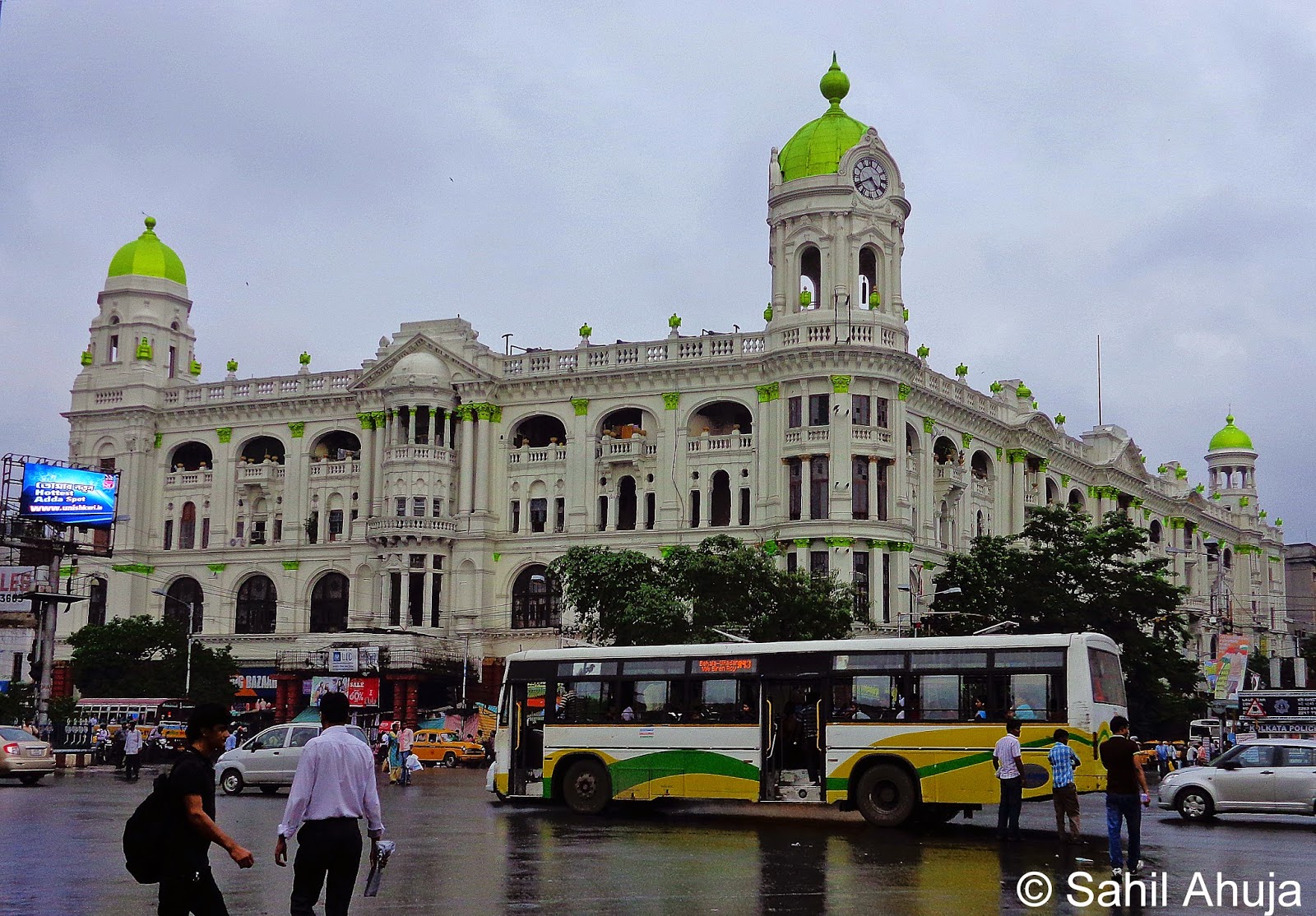

Calcutta's pride


Jocularly christened as “Right-away, Paid-for and Co.” over its principle of not lending credit, Whiteway, Laidlaw and Co. derives its name from the two enterprising Scotsmen who started it in 1882 and ran an impressive business conglomerate with merchandise outlets at Calcutta, Shimla, Madras, Lahore, Burma and Shanghai; the much glossed over Calcutta outlet was the most popular one stop shopping center for British soldiers and administrative officers posted anywhere in south-east Asian colonies and was considered uber-posh and classiest amongst all the centers; the Co. was one of the first pioneers of the concept of "sale days" and introduced "Rupee Friday" in its Indian branches were customers could purchase several items each for one rupee; the accounts however began to dry up after India gained independence following the long and tenuous freedom struggle and the Co. was forced to shut shop and sell the beautiful building to Metropolitan Life Insurance Co. which explains the present nomenclature. At present, the building is owned by the Life Insurance Corporation of India (LIC) and the Big Bazaar operates out of the ground floor and the upper floors, referred to as Victoria Chambers when they housed Whiteway, Laidlaw and Co.’s administrative and official staff, have been quartered and given over to numerous tenants. Imagine my surprise when I first arrived at Calcutta by bus and deboarded at Esplanade (which happens to be one of the largest state bus terminals and an important metro station) and came face-to-face with this striking architectural specimen that most Calcutta residents have come to take for granted – never having read about it since it isn’t generally included in the list of important colonial-era landmarks and not understanding what such a princely structure is doing in the midst of the city, I ended up asking the passer-bys about it, most of whom themselves knew little or nothing! My eyes might have almost popped out of my head due to utter astonishment and surprise on learning that the handsome Victorian building is “just” another Big Bazaar store – thankfully my friends brought me out of my contemplation and we explored the entire area in much detail and observed all the happenings almost all day long. Since then, I have been to Calcutta numerous times and almost every single time end up clicking the building – usually the same shot over and over again – somehow the building, because of its antiquity, gracefulness and immaculately magnificent appearance despite all the loathsome modifications it has been subjected to and the irreverent maintenance conditions that have been heaped on it, attracts me to itself – in its miserably forgotten and ignored state full of gloominess and dejection over its future existence, and yet possessing an air of unparalleled stately splendor and unmatched glamour, the building represents Calcutta – antiquated, much modified from its original pristine state and struggling against its existence in a world that has galloped far ahead in times and yet claiming its fair share of admirers and enthusiasts who are forever willing to wage battles if their beloved is subjected to a single modification – be it the addition of the golden highlights to the building, or the enforcement of the white-blue color scheme for the city. 

Though there isn’t much info available about Mr. Whiteaway, I did chance upon some interesting trivia about Mr. Robert Laidlaw who happened to be a philanthropist and a Member of the British Parliament and donated profusely to charitable establishments and schools throughout the country. He funded and helped maintain numerous World War I relief operations being run by Red Cross and several other charities.

Location: Esplanade (Coordinates: 22°33'48.8"N 88°21'05.9"E)
How to reach: The building is immediately opposite Esplanade bus stop and at a stone's throw from the metro station. Buses and taxis can be availed from different parts of the city.
Timings: Sunrise - 9 pm
Entrance fees: Nil
Photography/Video charges: Nil
Other landmarks located nearby - 

October 07, 2012

Sacred Heart Church, Calcutta


When you are sitting in a class, being bored to death, almost everything else seems interesting – the colors of the leaves outside the classroom, the various bird songs being played out, the behavior of people around yourself & such. Thoughts come floating into mind, unfettered like clouds, memories come flashing, you think, you feel & occasionally you start writing (or doodling, as in my case). This time it was different, I had just returned from Calcutta, & was lost in thoughts about the places I visited, the photographs I took, the people I met. I reminisced about John, the organ player at St. John’s Church (see http://pixels-memories.blogspot.in/2012/09/st-johns-church-calcutta.html for more details & photographs of St. John's Church), about the policemen at Writer’s Building (see http://pixels-memories.blogspot.in/2012/09/writers-building-calcutta.html), & also about the foreigner priest at Sacred Heart Cathedral. Soon my thoughts drifted to Sacred Heart. The church, looming over one of the most crowded areas of Calcutta, & yet isolated from its surroundings – one of those places that somehow become invisible to passer-bys & tourists alike, not many people tread its peaceful grounds, & yet the church boasts of a hospital & a basketball court. In fact the only signs of life in here were the patients flitting in & out of the hospital, & the kids playing a lively game of basketball (all of whom stopped to stare at yours truly who was perhaps intruding upon their peaceful lives by bringing a camera in their midst). The courtyard first led to the charitable hospital & then the church. Two statues – one of Jesus & the other of “Mother of Sorrow” (referring to Virgin Mary), both placed in small enclosures (European-style chattris they might be), demarcated the pathway from the basketball court.


Sacred Heart Church


The Sacred Heart Church was established by one Mrs. Pascoa Barettoe Souza in fulfillment of a vow of hers. The construction of this Gothic building took 2 years to complete, & it was thrown open as a Roman Catholic Church for the native Portuguese community in 1834. The church was renovated in early 1970s. I walked in the church, the prayer chamber is separated from the outer chamber by a grille & a door. When I reached the priest was leading a prayer, there were only two nuns & three devotees singing along with him. The prayer was sung very melodiously, the tenor rising & falling alternatively, the high bass of the priest’s voice merging with the sweetness of the nuns. I waited in the outer chamber for the prayers to end, observing the customs & manners all this while. Small benches & some chairs were the only furniture in the small outer chamber, several idols adored the walls & medallions depicting the life & struggle of Jesus hung from nails around the room. In the end, the priest closed his prayer book & kept it adoringly in a small curtain-covered cupboard in the wall behind the altar, the nuns went individually to each devotee, they seemed to know each other personally since the nuns called the visitors by name, & placing a hand on each person’s head they recited small couplets.


One of the statues & the medallions in the outer chamber


The priest was quick to grant me the permission to photograph the interiors, provided I was discreet about it. Soon I was left alone in the prayer chamber on the priest’s orders. I had a quick look around & started composing my pictures from different angles. The prayer chamber too was very small, rows of benches were placed in straight lines.


Altar view..


A golden cross & several candles & incense rested upon the stone altar. The altar itself was emblazoned with designs & patterns. Soon the caretaker returned & started packing the cross & the silks to be kept in a side room. After a few more minutes, I stepped out into the outer chamber, allowing the caretaker to lock the door.


The Cross


I had company now. A visitor came & sat in the outer chamber, praying reverentially with head bowed & hands clasped. Soon it was time to go, I step outside to again come face-to-face with the chaos & humdrum of Calcutta.


& the visitor


The kids still played basketball, the patients & their relatives still moved in & out, & the guards still sat lazily next to the gate – only no one stopped this time as I again entered their quite lives, with my camera pointed towards the statues of Jesus & “Mother” lining the courtyard, & also towards the hospital’s foundation stone, set in the wall next to its entrance. The hospital had come to life now, the church had closed. But to a true believer, can a church actually close??


The church is closed..


Location : Sidho Kano Dahar Street, near Esplanade Bus Terminus
How to reach : One can simply walk from Esplanade Bus Terminus  - walk straight away  the Oberoi Hotel & towards the golden-domed Metropolitan Building, at the first intersection on the right, the church stands close to Tipu Sultan Mosque (see http://pixels-memories.blogspot.in/2012/09/tipu-sultan-mosque-calcutta.html for more details & photographs). Taxis & buses can be availed from different parts of the city.
Open : All days, Sunrise - sunset
Entrance Fee : Nil
Photography/Video Charges : Nil
Time required for sightseeing : 30 min

April 02, 2012

New Market (S.S. Hogg Market), Calcutta


“There was something about Calcutta in the 1960s and 1970s – a once-glorious city found itself torn by the Naxalite movement. Revolution and history were being staged at every street corner. But nothing had shaken the historic New Market since its illustrious beginnings in 1874, not the World Wars, not the struggle for Independence; the market thrived no matter who was in power.”
– Jayant Kripalani, “New Market Tales” 

According to my friend Kshitish, who claims to be in love with the city of Calcutta and is a self-proclaimed, considerably knowledgeable authority on having good times in the city, New Market is one of the best shopping centers in the city. Contrary to its popular nomenclature, the market, built originally to cater to the needs of the resident British colonial population, is amongst the oldest shopping complexes in the city. Opened in 1874 and otherwise known as S.S. Hogg Market (though very few people call it by this name), it was designed in a prominently Gothic style by architect R.R. Bayne and christened after Sir Stuart Hogg, the Municipal Chairman of Calcutta at the time of its construction. The colossal, sprawling maze-like interiors provide an incredible shopping experience offering for purchase almost everything imaginable – jewelry, clothes, traditional attires, antiques, curios, footwear, groceries, flower bouquets, electrical appliances, meat, poultry, daily-use electronics and toys. Moreover, not unlike a typical Indian bazaar, here too one can bargain with the shopkeepers for the best price, sometimes even less than half of the original quoted, especially when shopping for textiles!


Hemmed in by unique spires - A sliver of sky spotted from the alley running between the two wings of the market complex


In keeping with its distinctive Gothic architectural features, the extensive complex is layered with red and yellow bricks and boasts of a corner clock tower, ornamental facades, shuttered arched windows, sloping tiled roofs, pillared walkways, wide eaves supported on stepped brackets and tall spires surmounted by pointed finials and multi-pointed stars. With over 2000 stalls under a single roof, the interiors house outlets of big brands as well as small vendors and hawkers with makeshift shops – the massiveness of the entire complex necessitates grouping of stalls/vendors in clusters according to what they merchandise, nonetheless finding your way around can still be a navigational nightmare. Also the enclosed area tends to get extremely crowded and chaotic, particularly during the evening hours – in the shadows surrounding the glow of incandescent lamps with the whiff of leather and sweat mingling with the scent of perfumes, cakes and farm produce, one feels transported to an altogether different world which seems to promise dark bazaars, exotic coffee houses, bustling opium dens, and vast quantities of unusual street food and sumptuous delights. 

Like nearly every street and every structure in Calcutta, the almost 140-years old market too bears testimony to an interesting and tempestuous, or at the least combative, history – it was established as Calcutta’s first municipal market offering food, clothing, hardware and manufactured goods under a single roof as a response to the numerous native bazaars that stocked individual items and were often considered unsuitable, inferior, under-ventilated and disease and pest-infested by European merchants, army officers and administrative servants who shared an undisguised abhorrence to these foul, congested bazaars that were crisscrossed by stinking drains and dingy alleys and populated by piles of rotting garbage and streams of putrid refuse besides uneducated, unclean native Indians.


Once upon a time - New Market during the days of WWII (Photo courtesy - Wikipedia.org)


Indians were opposed to the idea of building a massive marketplace catering only to European tastes and requirements through funds generated by taxes realized from Indians; most European citizens, though enraged at the increasing incidences of diseases caused as a result of purchases from native bazaars, were against the concept of a common market being constructed and managed by municipal authorities. Sir Stuart Hogg nonetheless pushed ahead with the agenda despite the fierce opposition offered against the construction; the structure was designed by R.R. Bayne of East India Railway Company and modeled very much like an English railway platform (more like a smaller, more Gothic version of Howrah railway station, refer Pixelated Memories - Howrah Bridge and Railway station). Many local merchants pressed legal charges, emanating from administrative overreach and misuse of funds, against the municipal authorities since the building’s construction was beyond the latter's purview while newspapers sternly predicted the market’s failure especially while the authorities were attempting to attract Indian customers to patronize it too. But New Market continued to prosper and few years later the municipality, upon failing to wean off traders and grocers from the Dharamtolla market, their chief opposition, purchased the latter to eliminate continuous competitive friction and legal proceedings. Overtime, the hygienic market transformed from one stocking only groceries and food products to one also housing cloth merchants and good dealers and the interiors were organized to designate individualized areas for different goods. A large English garden, complete with benches, fountains and walkways, was created immediately opposite the market complex for shoppers to rest, but at present no signs of it exist and the entire area around the market has been engulfed by modern commercial establishments progressively more intent upon dwarfing the heritage structure. The lofty clock tower looks puny in comparison with most of the buildings that have come up in the rest of the city. In 1903, the market’s name was changed from “New Market” to “Sir Stuart Hogg Market” and even today a brilliant blue municipality board proudly illustrates in white characters this nomenclature. Later Vikam Seth too immortalized Sir Hogg in his remarkable magnum “A Suitable Boy” – 

"Cuddles, Cuddles, gentle dog,
Go and bite Sir Stuart Hogg." 


Stuffed - Sir Hogg Market interiors


However, not all transformations were for the ultimate good. Old photographs reveal the area to be spotlessly tidy, but at present the interiors are exceptionally stuffed and often unhygienic; rats can often be spotted scurrying around and people are still to learn mannerisms including but not limited to throwing waste in designated dustbins. Unlike its initial glorious days, today the market exteriors have been encroached upon by peddlers and makeshift stalls while the congested interiors have their passages and arcades blocked by goods, mannequins and cardboard boxes either spilling out of the shops or simply propped around. Most of the original, renowned shops shut their shutters long ago and the brutalities of the vicious fires that broke out in 1985 and 2011 can still be observed at certain places around the huge complex – 1985’s fierce inferno even necessitated partial rebuilding of the historic complex.

The in-house slaughterhouse – located near the rear of the market complex and accorded an unusually forbidding aura by the numerous rats sauntering around on the floor and the huge crows kawing crassly and flying overhead inside the building – is best avoided by those who have a weak stomach. The terrible darkness and dreadful stench further aggravate the entire creepy setting and, as my friend Aakash discovered to his utter dismay, can lead to horrific nightmares. But for a photographer, the huge cuts of pink and white beef hanging around the dark and congested chamber make for interesting visual compositions. And once you ignore the large blades they wield and the swift movements with which they cleave bones, flesh and muscles, the butchers and fishmongers are very friendly people and would quickly flash jovial smiles and pose for photographs – sadly, Aakash wasn’t there anymore to see this facet of the slaughterhouse, he turned around and ran away as soon as we set eyes upon a large bull skull hanging besides a butcher’s work table.


The slaughterhouse


Both inside and outside the enclosed complex, the market building has numerous restaurant joints, including KFC, Cafe Coffee Day and Dominos, serving Indian and Continental fares, but one cannot resist but dig into a plateful of fuchkas (fried hollows stuffed with flavored water, sweet tamarind paste and mashed potatoes), jhal muri (puffed rice tossed with mustard oil, spices, peanuts and shredded onions) or my favorite, the cheap dal pakoras (deep fried lentil flour balls) sold just outside the market entrance with a serving of chutney (mint sauce). With hunger and shopping urges satiated for a long, long time, we finally agreed that Kshitish was again correct!


Wild Wild East - Had to post this photo!


Open: Monday to Saturday
Timings: Weekdays: 10 am – 8 pm; Saturday: 10 am – 2:30 pm
How to reach: The Market is located on Lindsay Street and one can take a bus/cab to  Esplanade/Dharamtolla and walk from there on.
Entrance fees: Nil
Photography/Video charges: Nil
Time required for exploring: approx. 2 hours
Facilities available: Parking upon payment of hourly charges.
Nearby attractions - 
Suggested reading -