Showing posts with label Shiva linga. Show all posts

August 17, 2013

Chandranath Shiva Temple, Hetampur, Birbhum


One of the most beautifully ornamented temples that I’ve come across my travels, Chandranath Shiva Temple is also one of the smallest standalone temples that I’ve ever encountered. Despite its miniscule size, the temple’s magnificence leaves one awestruck – at first glance the temple is so indecipherable from its surroundings that one does not even stop by to admire the sheer brilliance of the craftsmen who built it. Surrounded by a small courtyard that complements its splendor through its simplicity, the extraordinary temple is hidden behind a row of trees that have come up around it & are now competing with each other to see which one amongst them scales the height of the temple first. Camouflaged by the foliage that surrounds it & also by the now-blackened terracotta tiles that adorn every square inch of its structure, the temple is not easily distinguishable from its surroundings – we (me, Kshitish & Aakash - yep, they had disappeared for sometime but have started travelling again. Am glad!!) passed it once while on our way to the Hetampur Rajbari (“Royal Palace”) & did not even notice it, it was only when we were returning & inquiring with locals about the temple’s precise location that we chanced upon it inadvertently. Were it not for the graceful pinnacles of the temple rising above the foliage & acting as a beacon for confused visitors, we would have been completely at sea in this small village.


Terracotta dazzle!! - One of the best photos I clicked of the temple


The pinnacles have been designed in the Bengali Navaratna (“Nine jewel”) style where small domes rise around a central larger dome from a common base – a rounded pyramidal pinnacle surmounts the corners of the three sides facing to the front, the simplistic fourth side unadorned by either terracotta panels or pinnacles & hemmed in by the courtyard. Each of the pinnacle is crowned by a human figurine, it appears to be a lady with her hands outstretched – indicating that the temple’s architecture is also influenced by English traditions & art apart from the Bengali architectural style – certainly the British were officially ruling over the whole of Bengal & were the virtual rulers of the whole subcontinent in 1846 when the temple was constructed (11 years later the British would defeat the Great Mughals & the smaller independent kingdoms in the First war of Independence/Sepoy Mutiny & become the actual rulers of the subcontinent). Similar figurines adorn the gateway of the Rajbari which is situated close by. Significantly, a vintage portrait of the temple hangs within the Rajbari – perhaps it was the Nawab of the Hetampur house who commissioned this graceful temple & possessed refined tastes that came up with the fusion of traditional Bengali & English art & architecture. 


The temple's singular design, especially the pinnacled-roof, is pretty uncommon even in these parts. Notice the double courtyard extending in the front.


The cramped sanctum offers space adequate enough for only two people to stand in – a white Shiva linga (a thick phallus that is supposed to represent & worshipped as Shiva, the gentle but fierce primordial deity of the Hindus, the supreme soul who is also responsible for the destruction of the universe at the end of its lifecycle) seated on a beautiful base accompanied by a slender trident (Shiva’s weapon of choice) is all that there is inside the unadorned sanctum apart from a calendar that hangs on one of the walls. The terracotta panels that decorate three of the temple’s four sides are surprisingly intricate – apart from geometrical & floral patterns, the sculpted panels depict Indian deities, European gown-clad women & hat-wearing men & royal seals complete with a shield & lions. The walls of the temple, covered in soot & grime, blackened with time reflect its antiquity, but conspire to hide its sheer brilliance. The terracotta panels reveal patterns & mythological figurines carved with great skill & passion – gaping with astonishment & admiration at this little specimen of unmatched native art & architecture, we couldn’t help but wonder if more such temples wait for us in Bengal. The temple is flanked on one side by a shop & on the other by a house that easily dwarfs it; opposite it extends a row of shops. A small hand-pump outside the temple is the source of drinking water for fatigued travellers like us. Though the temple has made it to the list of State-protected heritage structures, however I doubt if any financial aid or expert conservation assistance reaches this small structure in the middle of a poor village along the highway (SH 14). Hetampur is like most of the Indian villages/townships scattered around the countryside - dust covered, solemnly quiet, remote & forgotten.


Patterned brilliance!!


Sadly, I could not find any information about the temple’s construction or who commissioned it, perhaps the Nawab of Hetampur could have guided us in this quest, but he was not in very good health when we visited the place – having himself suffered a stroke some months back, the old man was nursing his wife who has recently suffered a stroke & is confined to bed rest – that he permitted us to photograph the Rajbari & document its deplorable condition despite the pains that have befallen them is a big honor for which owe them our gratitude. I still wouldn't suggest a trip exclusively to visit Hetampur - there isn't anything to do & you'll be bored to death. One can instead opt for a zig-zag tour covering Hetampur-Kankalitala or Hetampur-Nalhati, but you'll have to travel long distances in rickety buses. If you are a monument/architecture buff who would not stop at anything to see one of the most splendid temples in the area, then this place is definitely for you. Happy travelling!!

Location: Hetampur village, Birbhum
How to reach: SBSTC Buses are available from different parts of Bengal to Hetampur. Alternately one can reach Suri, the headquarters of Birbhum & take a bus from there to Hetampur (1.5hr approx. distance). The temple is a short walk from the Rajbari (which is known to everyone, so ask your way around)
Entrance Fee: Nil
Photography/Video charges: Nil
Time required for sightseeing: 20 min
Advice - Stay away from the beer, even the bottled & branded ones, available at the numerous road-side eateries ("Dhabas") here, you are going to regret it later like we did!!
Suggested - 
  1. Europeana.eu - Chandranatha-Shiva Temple at Hetampur, Birbhum District.
  2. Youtube.com - Some remarkable terracotta temples of Hetampur & Illambazaar

March 05, 2013

Kankaleshwar Kali Bari, Bardhaman


After traversing through the small lanes that make up the Kanchanpara locality in Bardhaman, Bengal, I came across a wide swathe of open land in the center of which a motley group of boys played a cheerful game of cricket. With no wickets, a single bat & a torn ball, the game progressed as naturally as it would have on the grounds of Eden. The boys, with not a care in the world & immersed in their revelry, were used to the ancient structures that stood around them & once again reminded me that we humans do not value what we have close to us. As Rabindranath Tagore put it in vernacular, "we travel far & wide at great expense to see the mountains & the oceans, but fail to appreciate the beauty of the dew drops glistening on the ear of the corn at our doorstep". Bardhaman is an ancient city, with structures & spots even older – here was I, a guy from Delhi, documenting the architectural heritage of the city & enjoying the game of cricket played by the boys who were ignorant of their temple’s history but were easily impressed by the flash of a camera. The temple that I was looking at is one of its kind in the country. Dedicated to Goddess Chamunda, a form of Kali, the Hindu Goddess of death & destruction, the temple is locally known as Kankal Bari (“House of the skeleton”, pronounced "Kon-kol-Bari") or Rakta tola (“Temple of blood”) – the name could not have been more suited.


"Blood Temple"


Kali has always been depicted in terrifying forms – her red tongue sticking out of her mouth, eyes glaring, bosom naked, a neckpiece of human skulls & a waist band of severed hands being her only modesty. She is death incarnate, the symbol of destruction, blood lust & sex. But here this depiction is carried forward to the next level – the black stone idol has eight hands & is carved in such a manner so that most of the major bones & the arterial veins of the Goddess’s body are visible. It is said that the idol was found from the bed of river Damodar after the devastating floods of 1923 (although many accounts say the temple itself was built around the year AD 1700). Belief is that the idol’s conception was influenced by the concept of “Tantra”. 


Kali - The mistress of death


Set in a square courtyard, the small temple has three tiny rooms – the central one houses the said idol, while the other two house Shivalingas (phallus symbol of Lord Shiva, the Hindu God of death & destruction & Kali’s significant other) & tridents (“trishul”, Shiva’s heavenly weapon). The shrine is entered from three arched entrances, each of which faces one of the three rooms. The temple was under renovation when I visited it, artists & laborers were at work on its roof as well as the shrine. The president of the temple managing committee was there too & so was a lady who made me believe that she held some important post in the management team. She downright refused to let me photograph the shrine, no amount of coercion could make her budge, until the president himself intervened on my behalf when I told him I would write about the place. The laborers were more than happy to have me amongst them as I proved to be a change from their daily monotonous schedule. The temple is topped by nine spires in tradition Bengali style of architecture. The front of the temple is profusely decorated with terracotta panels displaying sages, kings & mendicants. In fact, these panels are what make the Bengali temples so mesmerizing – they tell so many stories & present an entire lore through numerous scenes!! In the courtyard surrounding the temple are several smaller Shivalingas, & in one corner is a small building that houses the management committee’s office. The temple, though small, is an extra-ordinary structure - peaceful, enthralling & tranquil. 


Under renovation..


In the ground next to the temple complex, the boys had stopped their cricket game to observe me & scrutinize my activities. In one corner of the ground stands another small temple dedicated to Vishnu (the Hindu God responsible for creation & nourishment of the universe). Topped by five spires, this temple is even more brilliantly decorated with terracotta panels than the Kali temple itself. However it is relatively less known & not many people visit it. Three arched entrances lead into the shrine, each arch is bore by strong pillars betrayed by their gentle curves. 


The Vishnu Temple


The arches are decorated with panels that depict scenes where groups of monkeys have climbed up buildings (perhaps temples, given pyramidal roofs topped by flag masts), birds fluttering around & flowers blooming in the skies. The bigger panels are surrounded by numerous smaller ones that depict sages, kings with bows & arrows, monkey-men carrying maces & mountains (Are the larger panels depicting a scene from the Hindu epic Ramayana -  the welcome given to King Rama (one of Vishnu’s many incarnations) by his monkey-men army when he returns to India after sacking Ravana’s capital?? I don’t know – there are no sources that I could trace that detail the temple’s history or construction). 


Carved with precision!! 


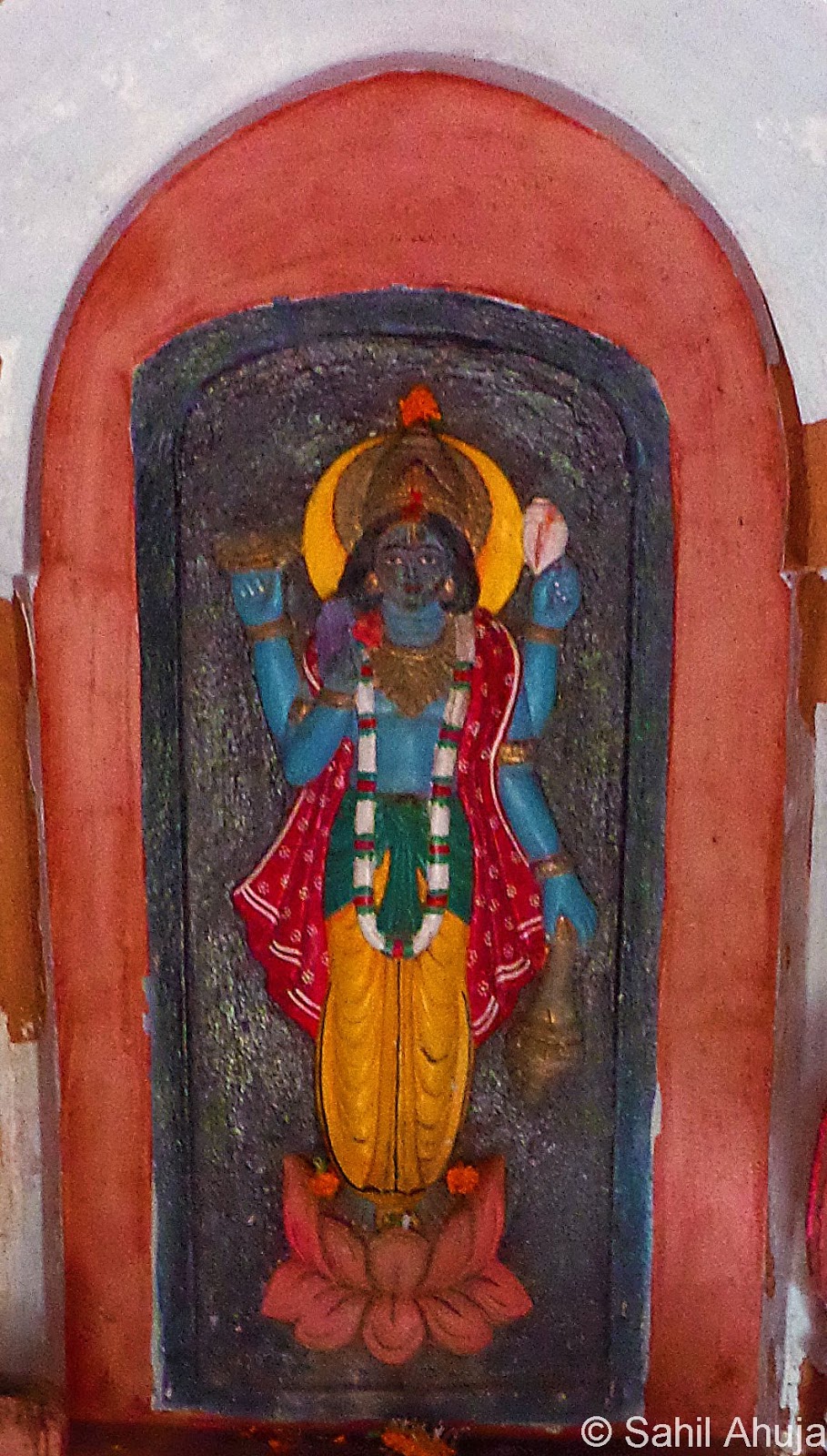
In both the temples, what I found worth-mentioning is that the terracotta panels ornament only the front face of the temple, the embellishments stop as soon as the front wall ends & the other three walls are simply painted over with no decorations but only very small windows breaking the continuity. The single shrine within the Vishnu temple is barred by a grille, the gate of which is locked. I had to be content with photographing the shrine from the outside. The inner entrance too is ornamented with more terracotta panels, though owing to the lack of space there are no other decorations except for three big panels. The shrine consists of a depiction of Vishnu painted on the wall, the offerings are but simply holy water & a few marigold flowers. A few bronze utensils are scattered around the figurine – broken platters, lamps & an elongated spoon for burning clarified butter (“ghee”), thus completing the image of a temple where the same traditions & practices are being followed that were being performed several millennia ago. The paint itself is peeling away & flaking to reveal the temple’s ancient history. In dire need of a restoration, the temple has become blackened with time as a result of the action of the elements. I do hope the managing committee of the Kankal Bari do spare some time & effort for this temple too. 


Vishnu - The master of the universe


As I step outside, I notice an old beggar come & spread his coarse mat expecting visitors to spare him some alms. He told me that if I wait here half an hour, the priest might come & open the grille to the sanctum. However there isn’t anything in the sanctum which I haven’t already seen from between the bars of the grille. I take my leave from the Gods, for the first time I feel sorry for leaving!! The place, remarkable & yet depressingly secluded, makes my heart cry out. The silence & the serenity invoking passive emotions & commanding me to stay some more. I feel bliss, I feel happy for having stepped out & traveled to Bardhaman. Forgetting the travel fatigue that had gripped me a few days back, I feel eager again to travel throughout India to witness these forgotten structures & write their splendid stories. 

Location: Kanchanpara, Bardhaman (aka Burdwan)
How to reach: From the Bardhaman Railway Station, take a bus till Kanchanpara. From there ask for directions to Kankalbari (pronounced "Kon-kol-bari"). You will have to walk a lot from there, it is quite a trek actually (you encounter bridges enroute too!!) away & no rickshaws are available here.
Entrance Fee: Nil
Photography/Video Charges: Nil. But prior permission is required.
Time required for sightseeing: 30 min
Relevant Links - 
  1. Pixelated Memories - Kali Puja