Showing posts with label Domes. Show all posts

May 13, 2015

Begumpur Masjid, Delhi


“A doom-laden place, implacable in its hostility, foreboding, menacing, redolent of death.”
– Alistair Maclean, “Caravan to Vaccares”

The colossal, long abandoned Begumpur Masjid, lying miserably neglected and uncared for in the urban village (an oxymoron of course, but Begumpur cannot possibly be described otherwise!) that lends its name to it, can undeniably be cited as a prominent example of Tughlaq-era’s (AD 1320-98) fortified architecture which inherently favored functional characteristics, including defensive capabilities and fortress-like features, over artistic aesthetics in religious, royal and even funerary structures. Of course, the Tughlaqs were more concerned with commissioning defensive structures which could offer additional protection against pillaging hordes of Mongol invaders from Central Asia, and thus their preferred choice of construction material, the grey Delhi quartzite stone, on account of being extremely capable of withstanding repetitive blows, rendered the same possible but was definitely not an ideal choice for sculptural artwork.


180° panoramic view of Begumpur mosque depicting the primary (eastern) gateway (right) and the thickset pishtaq (left)


The medieval mosque, primarily inspired by Uzbek influence, is exceedingly massive, the second largest in the city after Shahjahan’s graceful Jama Masjid (refer Pixelated Memories - Jama Masjid), and possesses a huge domed gateway, accessible via large ziggurat-like staircases, along the center of each of its northern, southern and eastern sides. Considerably blackened at present owing to the decay of organic materials such as lentils and jaggery that were employed, in accompaniment to plaster, as an external coating for the structure to enable it to easily withstand extreme weather conditions, the gateways and the walls retain occasional remnants of minimal sober ornamentation such as floral medallions conceived of red sandstone and painted blue plasterwork. There are two equally plausible theories under contention amongst historians regarding the construction of the epic mosque. The first states that it was commissioned by Muhammad Juna Tughlaq (reign AD 1325-51) as the “Jami Masjid” (royal congregational mosque) contiguous with his unusual thousand-pillared palace complex “Hazar Sutan” located couple of hundred meters away – this finds collaboration from the fact that the mosque also possesses, adjoining a corner, a distinct smaller square “Mallu Khana” (zenana mosque) that would have been used by the royal ladies for personal private prayers and would have been connected via a passageway to the palace complex so that the ladies could come and go as they pleased without being spotted by outsiders (its outline although can unquestionably be determined from outside where, unlike the rest of the mosque, this spatial square projection displays “jali” (stone filigree screens) set into the wall openings). The second theory, more widely accepted by scholars on account of there being an absence of literary records of the mosque chronicled by Muhammad Tughlaq's contemporaneous historic sources, approximately dates its construction to AD 1375 and credits it to Khan-i-Jahan Juna Shah Telengani, the Wazir (Prime Minister) of Feroz Shah Tughlaq (reign AD 1351-88), who also built several other considerably enormous mosques in Delhi’s then settlement conglomerations, including the interesting Khirki Masjid which I documented here – Pixelated Memories - Khirki Masjid.


Grandeur personified - One of the gateways of the colossal mosque


Incidentally, given that the mosques are built as miniature fortresses, the local population of the surrounding settlements moved into them in AD 1739 to escape rape and execution when the ruthless Iranian Sultan Nadir Shah overran and plundered the city subsequent to the gradual weakening of the Mughal dynasty (reign AD 1526-1857) following court intrigues, filial rivalries, administrative and territorial blunders and power struggles. Afterwards, the people (and their cattle, poultry and donkeys!) never moved out but built living quarters, complete with kitchens and toilets, within the mosques themselves! The Archaeological Survey of India (ASI), soon after it was constituted, managed in 1921 to convince the occupants to move out and establish villages around the heritage structures but already extensive damage, including miserable blackening of walls and ceilings by soot residues deposited from fires, had been heaped. But the story did not end here – centuries later, many of the desperate refugee families from Pakistan who reached Delhi following the horrendous partition of the subcontinent in 1947 amicably resettled in the mosque and continued to live there till as late as a few years back!


A different perspective - The mosque, as spotted from one of the neighborhood buildings


Irrespective of how many times one has read about the mosque or spotted its photographs (which anyway prove to be incapable of conveying the grand magnitude or subdued magnificence of the monument), nothing prepares one for the first visual onslaught that its majestic proportions prove to be as soon as one steps within the gateway – one can never be accused of resorting to hyperbole in stating that the words “gigantic”, “enormous” and “immense” quite simply fail to convey the sense of grandeur under consideration here. The mammoth expanse of the “sehan”, the cobbled stone courtyard (91 X 93 square meters!), further accentuates the distant tapering gateways and the domed passageways that the sides culminate into and outlines the vertical protrusion of the lofty “pishtaq”, the towering structure that serves as an entrance to the mihrab (western wall of a mosque that indicates the direction of Mecca and is faced by the faithful while offering Namaz) and is flanked by two huge tapering pillars that frame it in a fairly masculine and well-proportioned manner. While the skyline is totally dominated by the humongous off-white pishtaq and the gateways, the numerous smaller domes punctuate the otherwise overall uninspiring monotony of the straight lines of the colonnades.


Dominating - The mosque, hemmed in by ramshackle multi-floor apartment buildings


The inner surface of each dome would have originally blossomed into a colorful flourish of floral medallion from whose center would have hung lamps but only traces of the erstwhile decoration survive now underneath a few of the domes; most of the simplistic rectangular stone pillars too have now been carved with names, love letters and uniformly distasteful etchings by vandals and local children who presently utilize the humongous courtyard and the passageways respectively as a cricket pitch and a hangout zone for gossiping, playing cards and alcohol parties. Of all the colonnades, the spellbindingly symmetrical western one, triple-rowed and composed of a line of double pillars facing the courtyard side and two lines of single pillars behind in contrast with the rest of the colonnades which are single-rowed, leads to the mihrabs of which the central is minimally ornamented with just a touch, not very distinguished or striking but not unnoticed either in the otherwise continuous regularity, of red sandstone and white marble, very meticulously but simplistically sculpted. The overall artistic austerity, in addition to the unpunctuated silence and measured intimidating aloofness, multiplies manifolds the bewildering influence endowed to the structure by its gargantuan proportions. One literally feels dwarfed, inconsequential and even slightly scared and disoriented in the face of such unparalleled enormity.


Grace and symmetry - The western colonnade


Helical staircases built into the flanking tapering pillars of the pishtaq lead first to the upper floor where one can walk into a claustrophobia-inducing extremely narrow passageway and witness, quite nerve-rackingly in deed, the courtyard’s immensity, unyielding cobblestone surface and the building’s vertical projection, necessarily in that particular order followed immediately by navigation for asylum back to the staircase’s little safety and later by an obdurate desire to climb even further and check the view from the very roof of the structure – thankfully, the latter is promising and renders the terrifying climb this high worth – besides the village’s chessboard skyline of box-like multicolored buildings occasionally interrupted by a few trees, there is Qutb Minar majestically looming like a beacon in the far distance (refer Pixelated Memories - Qutb Minar) and Muhammad Tughlaq’s “Hazar Sutan” nearby (more on that on a later date). Some of the alcoves and the area around the staircases leading to the gateways and within the courtyard are littered with stone slabs, rubble, plaster and other material to be utilized for the structure’s restoration-conservation, which it undoubtedly direly requires, but except for a few dogs snoozing around and a few locals drinking beer and playing cards in the colonnades, there is not a soul in sight, no laborers at least. Wonder when the restoration begins, if it does at all.


Precious remnants


Location: Begumpur Village, Malviya Nagar
Open: All days, sunrise to sunset
Nearest Metro station: Hauz Khas
Nearest Bus stop: Laxman Public School, Hauz Khas
How to reach: From Laxman Public School/Hauz Khas Metro station Gate 2, proceed for Begumpur village immediately across the arterial Outer Ring Road/Gamal Abdel Nasser Marg. A straight track one kilometer long takes one to Begumpur Masjid past Hazar Sutan/Bijay Mandal ruins.
Entrance fees: Nil
Photography/Video charges: Nil
Time required for sightseeing: 1 hr
Some of the other Tughlaq-era constructions in the city - 
  1. Pixelated Memories - Feroz Shah Kotla
  2. Pixelated Memories - Hauz Khas complex
  3. Pixelated Memories - Hazrat Nizamuddin Dargah
  4. Pixelated Memories - Khirki Masjid
  5. Pixelated Memories - Tughlaqabad - Adilabad - Nai-ka-Kot Fortress complex
Suggested reading - 
  1. Kafila.org - Article "The Khirki and the Begumpur Mosques" (dated Sep 17, 2009) by Sohail Hashmi
  2. Thehindu.com - Article "Preserving “our heritage”" (dated Feb 13, 2013) by Sohail Hashmi

November 15, 2014

Gurudwara Bangla Sahib, Delhi


Regarded as one of the holiest Sikh shrines in the city and one of the prettiest Gurudwara (Sikh temple) in the country, Gurudwara Bangla Sahib, lined with tons of evocative pearlesque-white marble and surmounted by striking gold domes, was originally the regal mansion of Mirza Raja Jai Singh I, the Rajput king of Jaipur (then known as Amber). In fact, it derives its name too from the word “Bangla”, the Hindi/Punjabi translation of “mansion”, even though it has been transformed into a magnificent shrine and today draws thousands of visitors, including hundreds of foreign tourists, from the city and outside everyday. Dedicated to the memory of Guru Harkrishan, the eighth of ten Sikh spiritual leaders, who, upon being summoned to Delhi by the Mughal Emperor Aurangzeb (ruled AD 1657-1707) and following the invitation of Raja Jai Singh I, briefly stayed in this mansion before his untimely demise at the age of eight caused from getting inflicted with smallpox while serving patients of the disease who flocked to his assembly everyday in the hope of solace and treatment.


In Guru's memory - Gurudwara Bangla Sahib


Much to the unabated chagrin of his elder brother Ram Rai who had him summoned to the royal court, Guru Harkrishan was reasonably declared the Sikh spiritual leader by their father Guru Har Rai at the tender age of five and proved his religious understanding and spiritual and mystical capabilities through several inconceivable episodes that occurred during his short lifetime before succumbing to the disease. Ram Rai himself was disowned by their father on account of his hobnobbing to the Mughal Emperor who was a declared political and religious enemy of the Sikhs. It is said that when the Guru first arrived at Raja Jai Singh’s mansion, the latter’s queen, intent on ascertaining the Guru’s mystical powers dressed herself as a handmaid and hid amongst her servants whom she had lavishly attired and adorned with jewelry, but was astonished when the Guru immediately recognized her as queen and thanked her for the hospitality extended by her household. The gorgeous mansion was converted into the prominent Gurudwara following the Sikh warlord Banda Bahadur’s invasion of Delhi (AD 1783) and was one of the nine mesmerizing Gurudwaras he raised; it was renovated and given this present magnificent appearance few years post-1947 when India achieved independence from British colonial rule. It is extremely difficult to believe that such a massive and unbelievably gorgeous structure was once a mere mansion, that too of a vassal sovereign of a small territory!

The Gurudwara is entered via a tall arched gateway surmounted by five onion chattris (domes raised on pillars) and faced with painstakingly polished, glistening white marble inset with colorful stones embedded in numerous floral patterns and Sikh religious motifs. The area around the Gurudwara bears a rushed, crowded look throughout the day since the shrine is extremely popular, especially amongst locals who come from near and far to pay their respects and also to marvel at the majestic regal architecture. The first thing that catches one’s eye, even before the long streaming queues of devotees waiting to enter, are the stunning pointed domes of the structure – the three gold-plated onions surmounting the building and the single superbly crafted marble onion on either side of the entrance. Other prominent architectural features include chattris, pavilions with curved tops lining the roof and exquisitely crafted, multi-arched hanging windows (“jharokhas”). The courtyard surrounding the central building, accessible from the road level by a flight of stairs, is vast and afterwards most devotees prefer to sit along the sides, especially if the purpose for visiting is photography.


A touch of gold!


The interiors are spellbinding – immediately upon stepping within, one is exposed to a large, mesmerizing shrine built entirely from gold and ornamented with a plethora of floral and religious motifs embossed into the gold work; especially intricate are the peacock figurines and the rounded vases from which emerge numerous convoluting, blossoming vines rising vertically upwards; Sikh symbolism, in the form of the recognizable motif of a vertical spear crossed over a pair of curved swords, lines the marble walls and decorates the patterns in gold; the thick rectangular pillars, each covered in layers of gold and also ornamented with the endearing vases overflowing with a vertical expansion of vines and floral blossoms, are especially admirable; lastly, the golden roof, polished to mirror-like perfection and bathed in a orange-gold glow by a large chandelier, reflects all the visitors, but proves frustratingly difficult to photograph. At the end of the elongated area on either side of which sit devotees, underneath an immensely intricately sculpted curved gold shrine is placed a copy of Guru Granth Sahib, the Sikh holy scripture; elderly musicians seated next to the canopied shrine sing melodious sermons and invocations referring to God and the Gurus while a priest continuously fans the hallowed text. The affluent, orange-hued gold extravaganza, rows of flower vases, expensive carpets and the rich canopy overhanging the shrine impart an unbelievably fascinating visual existence that is hard to replicate in photographs and even harder to contemplate in words – it is a sight and an experience that can only be registered on an emotional and visual level – of course, the irrepressible pushing and shoving by other devotees striving unnecessarily urgently to reach the shrine spoils the experience to an extent, but it is nonetheless worth being there.


Music for exhausted souls


A large “langar khana” (“food hall”) behind the Gurudwara accommodates visitors on the floor irrespective of any distinction of economic, social or religious status and daily serves 10,000 meals of simple vegetarian fare free of cost to everyone. Enormous quantities of food, including roti (Indian bread), lentils and vegetables is voluntarily prepared by several devotees themselves as a philanthropic measure from the raw materials charitably contributed by more affluent devotees – the entire idea is that of a large community kitchen where everyone can mingle together with dignity and companionship and partake food free of cost irrespective of any distinction, differences or bitterness. The “karha prasad” (a thick pudding cooked from wheat flour, clarified butter and sugar) served at the gateway of the shrine is blissfully delicious (though my personal favorite remains that served at Gurudwara Sisganj Sahib, Chandni Chowk, refer Pixelated Memories - Gurudwara Sis Ganj Sahib). Across the expansive courtyard extra servings of the savory prasad can also be purchased from a counter near the entrance gateway – a receipt will be generated at the counter which, upon being produced before the person serving the prasad, will be exchanged for a quantity of it – interestingly, after filling up a disposable bowl for a visitor and handing it over, the person serving will retract a small quantity of it and mix it back in the larger vessel as symbolic of a person sharing from his own plate – this, surprising for me since I had seen it for the first time, made me get a second helping since the first proved less than what I desired to have; I also had some packed separately to take home for my cousins with whom I was staying then. From one side of the courtyard, stairs lead downstairs to another courtyard flanked on all sides by Gurudwara managing committee offices and hostels – here, a massive well, canopied by a wide octagonal roof and an onion dome, is especially revered. Legend is that Guru Harkrishan dipped his feet in its water and ordered his followers to give the water to the diseased and pox-inflicted as a cure for their troubles. He earned the title of “Baal Peer” (“Child saint”) due to his ability to cure the sick and the destitute. Even today, the well is manned by numerous devotees who draw the water into large bowls and offer it to hundreds of faithfuls who believe in Guru Harkrishan’s magical and spiritual sanctity and come to the Gurudwara for a sip of the hallowed water. The only difference between then and now being today water is drawn through taps and not pails! The Gurudwara’s charitable acts do not end here – a hospital, a library and a girl’s school are also run in the buildings adjacent which also house a museum and an art gallery.


Sacred water - The canopied well associated with Guru Harkrishan's healing powers


It is the other side of the Gurudwara that is the most famous – a massive “Sarovar” (water tank) with clear blue water and large, colorful fishes exists on this side and reflects a perfect reflection of the Gurudwara building and its golden domes and colonnades. This frame is perhaps the most famous visual composition when photographing the Gurudwara despite the fact that photography from here is prohibited and requires special permission. The caretakers and cleaners of the Gurudwara keep patrolling around the tank, stopping people from clicking and asking swimmers to step out if they have been in too long. A small rectangular changing room for women exists along one of the corners of the tank too. Colonnades surround the courtyard around the water tank and the corners are domed to appear externally like diminutive towers (“burj”).

It is best to visit the Gurudwara at night when it is lit up beautifully and the lights reflect in the black waters of the tank to generate a mesmerizing image imprinted on the overall darkness of the surroundings. The place also wears a festive look on Guru purab, Diwali and Guru Harkrishan’s birth anniversary.

Advisory – Men and women are required to leave their footwear at the shoe counter located outside the Gurudwara complex before entering within and also cover their heads with handkerchiefs or dupattas (long scarves). Being a religious shrine, it is advisable to dress modestly.


Nighttime beauty!

Location: Jaisinghpura, Connaught Place
Nearest metro station: Patel Chowk (1.1 km away)
How to reach: Walk/avail an auto/e-rickshaw from the metro station to the Gurudwara
Open: All days, sunrise to midnight
Entrance fees: Nil
Photography charges: Nil (Permission has to be solicited for clicking around the tank level, but everybody clicks anyway). Videos prohibited.
Relevant Link - 
Suggested reading - 

September 23, 2014

Khirki Masjid, Saket, Delhi


With the singular exception of old Delhi’s ethereally beautiful Jama Masjid, the grand Khirki Masjid, possibly the largest mosque I have ever been to in Delhi, located in a maze of untrodden alleyways and winding narrow lanes immediately opposite the massive MGF Mall at Saket, is also perhaps the most prominent example of the gigantic militaristic architectural scheme that came up during the reign of Tughlaq Dynasty (AD 1320-1414). Despite its simplistic unadorned structure, the mosque nonetheless continues to appear immensely majestic, even more magnificent than its smaller, more splendid cousins like the shimmering white Kalan Masjid at Nizamuddin basti or the vibrant red and gorgeously bedecked Jama Masjid at Hazrat Nizamuddin Dargah complex – it might have something to do with the collective amnesia suffered by the large population of the Khirki village who have literally not the slightest clue that there is such a massive structure located at the periphery of their village – in fact, when Sakshi and I tried locating the ruined mosque by asking for directions from the locals and shopkeepers, none of them had any idea of what we were indicating about, and this is extremely surprising given that the village settlement itself has been christened after the unique mosque which draws its apt nomenclature from the numerous red sandstone “khirkis” (perforated stone lattice windows) that distinctively mark its surface (but are absent in other mosques). Though the continuous going around in circles and walking into cul-de-sacs unexpectedly introduced us to several stunning graffiti panels that adorn the village buildings (perhaps the products of the Delhi Street Art festival that I talked about here – Pixelated Memories - Tihar Jail - Graffiti and Haat), it did eventually get very frustrating and we were on the verge of switching on the Google maps in our phones when an elderly cobbler running his trade from a corner of a footpath, confused at what we were looking for, asked if we wished to visit the “Qila” (“fortress”) and directed us to it – that was it – even Tughlaq-era mosques flaunt a fortress-like appearance, more of a cross between a religious and a militaristic structure, complete with thick, battered rubble walls, tall forbidding gateways, lofty minarets, soaring corner watchtowers and formidable battlements. The sudden appearance of the mosque’s enormous rubble walls between residential buildings and tall trees that conceal it from prying eyes is surprising – past a narrow alley, it grandly and unexpectedly conjures out of thin air and fills the entire landscape with its enormity and characteristic rough appearance. 

Forbidding - The southern gateway (only entrance in use at present) and rows of cells on either side


The nearly 650-year old structure was designed and commissioned by Khan-i-Jahan Malik Juna Shah Telengani, who inherited his title “Khan-i-Jahan” (“Lord of the World”) and his position as the “Wazir” (“Prime Minister”) from his father Khan-i-Jahan Malik Maqbool Telengani who before him was the prime minister to Sultan Feroz Shah Tughlaq (ruled AD 1351-88). Telengani Junior lacked the characteristic interest in administration and warfare that his father was renowned for and his only penchant was for architecture and construction. He raised seven of the finest mosques in Delhi, all of which possessed an unparalleled splendor in their more glorious days and some of which are still unbelievably grand  – interestingly, he himself was only a second generation Muslim – his father was originally known as Kuttu Yugandhar Gannama Nayaka and was the military commander of the Warangal garrison that Feroz Shah’s cousin and predecessor Muhammad Juna Khan Tughlaq (ruled AD 1325-51) had destroyed when he defeated the Kakatiya Dynasty sovereign Prataprudra Deva II. He was captured and brought to Delhi where he converted to Islam and since then efficiently led numerous military campaigns for his new master following which he was bestowed with the titles “Masnad-i-Ali Ulugh Qutlugh Azam-i-Humayun” ("The repository of religion and jurisprudence and the greatest of the blessed lords"). When Feroz Shah Tughlaq ascended the throne of Delhi, he immediately raised Malik Maqbool Telengani to the enviable position of prime minister, entitled him “Khan-i-Jahan” and prompted by his own lack of interest in administration handed over the entire governance and powerful military to the latter along with an annual salary of 1.3 million gold coins (at a time when the entire annual national revenue from all sources was pegged at 65 million gold coins!) besides annually paying a thousand gold coins to each of his sons and a slightly smaller sum to each of his daughters born from the over 2,000 wives he boasted of in his harem (a ridiculously exaggerated tale I believe). Following his  death in AD 1370, his eldest son Malik Juna Shah inherited his position, titles and salary besides the religion and immediately set about constructing the mosques – through religious activities, he might have proved himself to be a devout Muslim but he never inherited his father’s fierce loyalty to the emperor and was disgraced and executed while trying to foment quarrel between the Sultan and his eldest son Muhammad Khan Tughlaq. 


Ghostly! - First impressions as observed from the eastern (primary) gateway that now remains barred and locked. On either side in the foreground are staircases leading to the roof. 


As if the mosque is surrounded by a moat, the lush green square, in which the gigantic structure is located and which demarcates its existence from the thickly-populated village encircling it, is situated on a considerably lower ground level compared to the surroundings and enclosed by means of a high iron wire mesh. A sloping ramp leads downwards to the base of the gigantic gateway set protruding from the mosque’s walls; the solid gateway is flanked by two rounded conical minarets that are garishly obscured at places by overhanging thick electrical wires and bear a fluted appearance at least till the first of their three floors. The mosque itself sits on a high plinth – nearly 3 meters tall – composed of numerous arched chambers that make up the ground floor of the structure; around a score stairs lead up to the rough rectangular entrance composed of trabeates (stone ledges of successively increasing size placed atop each other to span space) that were a favorite of the affluent Tughlaq nobility. But before heading down the ramp and then up the wide staircase, one is tempted to take a walk around the entire wire enclosure and explore the mosque from all sides – the wire effectively shuts out encroachments and vandals but also wretchedly stifles the mosque structure and leaves not a single side from where one can appreciate or photograph the huge structure in its entirety. 


Strikingly symmetrical - 180° panorama looking at the corner tower and the two gateways on either side clicked from a corner of the confined enclosure


We began discussing how splendid the characteristic militaristic structure would have looked like when it was faced with a layer of untainted white plaster and perhaps affixed with marble or red sandstone where the numerous cross-shaped indentations exist in the line of kanguras (battlement-like ornamentation) that runs along the roof – the discussion prompted us to go around the entire structure and if possible observe it from one of the tall buildings in the immediate vicinity – the over 2500 square meter area of the mosque (52 meters X 52 meters) is more than 80% covered by a roof surmounted by numerous domes positioned in a complicated placement plan – the entire roof is divided into a grid of twenty five squares, nine of which (on the corners, immediately adjacent to the gateways and the center) each possess nine slightly conical domes; one relatively larger, ribbed dome also surmounts each of the gateway and the corner turrets culminate into domed conical watchtowers thereby imparting the entire roof a symmetrical but very congested checkered appearance and bringing to mind the enormous dinosaur egg clusters in “Jurassic Park” series. The mosque was the first in India to be shrouded peculiarly by such a massive roof – all other mosques of such grand dimensions usually have open courtyards as congregational areas for the faithful to offer prayers from, or, at the most, colonnades along their peripheries to serve as walkways and shield the visitors from the elements – till date, it is one of the few to display such a markedly distinctive architectural design. The decision made, we began the circumambulation, it was then that we met Komal, a sweet little girl who resides in a small match-box building divided into numerous quarters immediately overlooking the mosque, who led us upstairs to her narrow terrace from where we could click the mosque – discounting my scared apprehensions about traversing almost 30 feet above ground from one rooftop to another located a couple of feet away (my doctor says if I hurt my arm again, it will be permanently damaged!), we did climb up and even try to click the mosque's vast span while standing on a wobbly table, but sadly, the view here was impeded by many other buildings. Komal then took us to one of the highest buildings in the neighborhood and the view from here was, simply put, fascinating – apart from the huge mosque spread majestically below us, we could look over most other rooftops, even see the Saket malls in the background and identify the ancient Satpula dam in a green clearing. 


Where did she learn to pose like that?! - I don't know why I feel shy clicking portraits/candids, but there was something about Komal, her unwavering confidence or her unremitting gaze, or perhaps the fact that Sakshi besides me was doing the same, that prompted me to click her.


Following the descent down the unbelievably dark, narrow and winding staircase of the six-floor building, we traced our way back to the mosque’s entrance – though originally the eastern entrance was the primary gateway to the mosque, now it too is barred by means of a locked iron grille and only the southern entrance, that faces the arterial Press Enclave Road and the malls on the opposite side, is now functioning. There are neither guards nor ticketing officers on duty, the structure is serenely isolated from the population as if it doesn’t even exist in their midst; a few men sat and gossiped near the entrance but none ventured within nor did they stay there very long, probably one of them was the Archaeological Survey of India (ASI) guard since he stayed back even after the others had left. At first appearance, the mosque’s unornamented stark interiors look like most other medieval structures – simplistic arches, unadorned monolithic rectangular pillars and shallow alcoves along the walls make up most of the architectural plan – all features that can also be observed in numerous other structures scattered throughout the city – it is the massiveness of the structure, apparent only once inside since the exteriors have been very successfully bludgeoned into an unflattering confinement by the wire enclosure, that holds one’s amazement. There are rows upon rows of pillars supporting the heavy roof for as far as one can see, the view is regal and spellbinding and it becomes difficult to fathom that even a mosque could be this huge.


Colossal - 180° panorama looking inside from one of the gateways. And this is less than a quarter of the entire area!


The colonnades along the walls are blinding dark since the windows elegantly fail to let in enough sunlight to illuminate even slightly beyond their limited domains – most of the light and ventilation entering the mosque's deeper recesses are facilitated by the four open to sky courtyards near the center. Roosting among the dark and damp colonnades are hundreds of scary bats that chirp and squeal continuously and often dive close to one’s head or shoulders – in fact, there are so many of them that one can spot dark circles of their shit and refuse underneath the individual concave roofs supported by the rectangular double pillars at the very margins, especially in the completely dark portions near the mihrab . The mihrab (a mosque’s western wall indicating the direction of Mecca that is faced by Muslims while offering prayers) lacks the entrance as well as the signature windows, but is otherwise entirely identical in design and execution to the other three walls, even possessing a faux blocked up gateway. But the colonnades flanking each of the four aforementioned courtyards around the center prove an interesting but extremely sharp contrast by facilitating the sudden appearance of shards of blinding sunlight. A few of these colonnades have been recently repaired and replastered, but a major proportion has been left untouched and decrepit, there wasn’t any sign of workers or construction material around either to indicate that the restoration work is in progress – it fills one with a unique joy to imagine how eye-catching the interiors would look when completely leveled with layers of fresh white plaster. Photographing the majestic structure is an issue, one cannot understand how to visualize the compositions so as to make them appealing but also do pictorial justice to the numerous pillars and the immensity of the interiors. The play of light and shadows, though visually spellbinding is difficult to transform into alluring photographs without ignoring the other architectural aspects of the mosque like its striking symmetry or the presence of numerous distinctive stone windows latticed into smaller squares. Eventually, I decided to click panoramas, even though I abhor them for the lack of details they record, in order to include the mosque’s mammoth spread and its enthralling architecture.


Fascinatingly vintage!


The eastern gateway was once embedded by a stone plaque that detailed the mosque’s commissioning and construction, but it is long gone – it would have in all probability read something like “Juna Shah Maqbool Telengani, titled Khan-i-Jahan, son of Khan-i-Jahan, commissioned the mosque in the reign of Saka Lord Sultan Feroz Tughlaq in the pious year 1370-71”, of course along with a few honorifics and hyperboles. Nearby, a portion of the domed roof along the south-eastern corner has collapsed and lets in patches of sunlight incongruous with the light and dark patterns throughout the rest of the interiors, but nonetheless a welcome relief from the extremely dark, bat-infested conditions; pigeons roost here and prove to be considerably more noisome though remarkably less scary than the sneaky bats. Two narrow staircases built on either side of the gateway along its internal surface lead upstairs to the roof where one can observe the numerous domes (and the etchings and graffiti left by vandals on their blackened surfaces) up close and juxtaposed against the spellbindingly uneven skyline of the Khirki village. The cluster of malls with their reflecting glass panels prove to be an eyesore, blocking out much of the view on one side, but nevertheless appear beckoning with the promise of shade and air conditioning that no one could have possibly refused in this sweltering heat. We decide to find shelter from the inconceivably brilliant sunshine underneath one of the domed corner towers before proceeding from one corner to the next to click from each of them even though the view was identically similar – in one of these towers, someone had left their treasured stash of kites, while in another were left a few bone dry but perceptibly fresh chappatis (Indian bread) – indicative that some locals do visit the mosque, even though they might not be aware of its historic or architectural importance. 


Squares and dinosaur eggs - 180° panorama clicked from a high rise overlooking the medieval structure 


The village, though so far kept at bay from the structure by the wire enclosure, has literally choked the well-preserved mosque in clear disregard of an ASI rule stipulating prohibition of construction within 100 meters of any protected monument – the mosque’s encircling and subdual by a wave of urbanization and unplanned construction is most apparent from the rooftop from where one can see how it has been dwarfed and imprisoned by the haphazard outcrop of surrounding buildings. It might perhaps have been a little bearable were the grassy corners of the wire enclosure not brimming with everyday waste discarded by the village inhabitants besides used electrical equipments and glass and plastic wastes, including a broken tube light on which I stepped unknowingly. Telengani Senior’s octagonal tomb (the first of its kind in Delhi, also designed by Telengani Junior) in the densely congested Nizamuddin basti has been so devastatingly encroached upon by the locals that there is no access to it nor any way to observe any of its features except the dome that still remains untouched by the surrounding buildings; a few of Telengani Junior’s mosques have also already been submerged in the deluge of shabby residential quarters and encroachments – will the Khirki mosque also go the same way? Let’s hope not! The thought itself makes one shudder. Perhaps the way out of this stalemate between monument conservation and the pressures of urbanization would be to include the local community in the former by providing them space around the mosque for congregation and physical activities and converting the interiors into a restored recreational zone – as envisaged by an architectural design company, ASI and INTACH have already begun trying to organize student-oriented activities like sketching/painting events, dramas, storytelling sessions and pottery classes in some of the more ventilated portions of the mosque. Plans are on to lend the colossal congregation area for short plays, book fairs and such besides also housing information kiosks and souvenir shops while the cells along the plinth level could be made available to artists to display and merchandise their work.


Looking back - The mosque, as it appears when viewed from the road separating the congested village from the glamorous malls opposite


Though of course all these plans won’t proceed unless the mosque is restored first and the work, which had been begun in anticipation of tourist footfall, came to a standstill soon afterwards after several oversights relating to the use of material and their subsequent effects on the structure were observed. As a beginning, night lightning would go a long way – given that the structure is located just off an important arterial road and immediately opposite some of the most renowned high-end shopping clusters of the city, lightning might even help attract visitors and tourists and who knows, perhaps someday the monument might also host the occasional sound and light shows or plays featuring renowned actors/storytellers. Tourism is definitely going to play a significant role – the more people visit, photograph and write about these forgotten structures, the quicker the archaeological and municipal agencies would be forced to take notice and complete the restoration-conservation work and who knows, perhaps supplement the monument sooner rather than later with a publication/souvenir department. The idea is definitely well thought out – for me at least, even the thought of a monument being put to such wonderful uses instead of being relegated to a forgotten, neglected state fills the heart with an inexplicable fascination! But before we begin to give ourselves to thoughts of fancy that, given the lethargic Indian bureaucracy and administration, might take several years to materialize, the foremost need of the hour is to ensure local awareness, including proper signages and information panels, so at least when in near future two photographers come nosing around looking for the medieval mosque, they won’t draw blanks or have to go around in circles!


Signs of change? - One of the numerous graffiti panels that adorn the otherwise unremarkable streetscape of the village


How to reach: The mosque (coordinates: 28°31'52.3"N, 77°13'11.2"E) is located in Khirki village immediately opposite Select Citywalk/MGF Mall and across the Press Enclave Road. It can be accessed by heading down a short stretch of a narrow uneven lane adjacent a makeshift temple (more of a wall with red painted bricks and a few idols) at the side of the Press Enclave road. Walk from the Khirki village bus stop (couple of hundred meters away from the mosque) or take an auto for Rs 50 from the metro station to the malls and walk from there on.
Open: All days, 10 am - 5 pm
Entrance fees: Nil
Photography/Video charges: Nil
Time required for sightseeing: 1 hr
Advisory - Given the secluded nature of the area and especially the mosque, female visitors should prefer to be accompanied by men and avoid visiting the area after dark.
Relevant Links - 

August 11, 2014

Metropolitan Building, Calcutta


“That magician whom I brought from Rangoon is a clever fellow. He has toured all over India as a circus conjurer. The bullet-proof jackets were bought at Whiteaway & Laidlaw’s stores, one rupee eight annas each. They are costing me a pretty penny, I can tell you.” 
– U Po Kyin, a Burmese character in George Orwell's "Burmese Days"

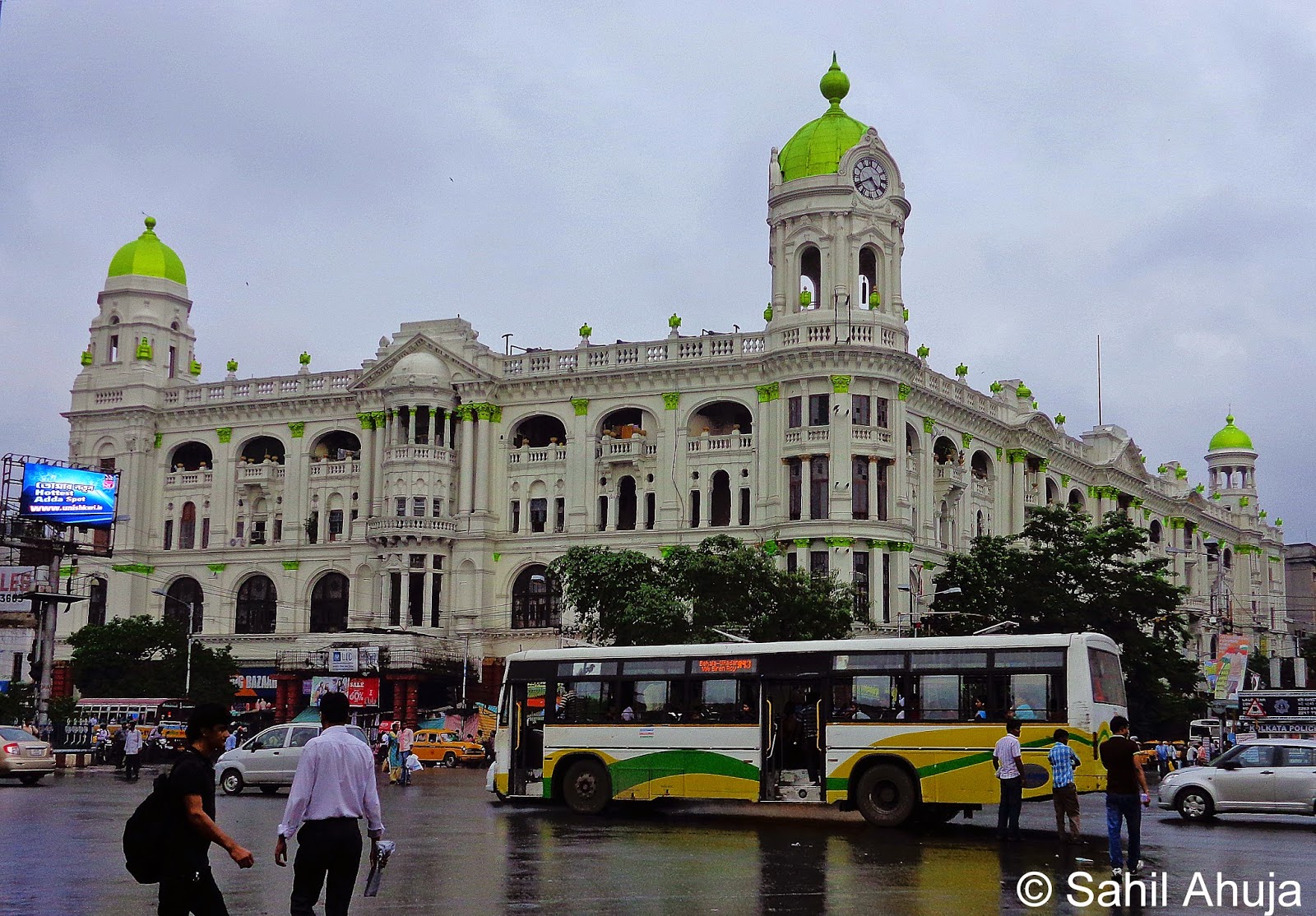
The graceful but poverty-stricken existence and existential conditions of the massive, palatial Metropolitan Building, architecturally and artistically one of the most prominent and underrated of Calcutta’s iconic landmarks, at the corner of Esplanade Square has for the past few years become a concurrent theme for the city’s heritage enthusiasts’ unwavering devoted adoration and unequivocal criticism over lamentable governmental neglect and unsound conservation and maintenance principles – recently given a bright coat of dazzling white paint with glittering golden highlights for its numerous Victorian features, the handsome building that started out as one of the most well-renowned of colonial-era structures in the subcontinent couldn’t have seen worse days – portions of it, including the stained glass atrium, have collapsed and the striking structure has been declared unfit for human occupation while simultaneously being subjected to ever-deteriorating standards of maintenance with the removal of its original exorbitant Italian marble, damage due to water seeping to the expensively replaced woodwork and modifications in the interior layout – the only aspect that has probably remained unchanged in its history thereof is that the majestic structure has always housed a departmental store except for a brief interlude in recent past – it is a little known fact that the building began as Asia’s biggest departmental store in the form of headquarters of the famed Whiteway, Laidlaw and Co., dealers in the latest in English fashion apparel and renowned among the European community of the entire subcontinent (and the Anglicized native population who professed to an unabashed attraction towards European-style fine dressing), today it houses on its huge ground floor the Big Bazaar store, a retail outlet with branches in almost every Indian city promising to inundate the domestic lives of customers with cheap daily-use accessories as well as hundreds of thousands of billboard and print promotional advertisements. 

Regally spread over two massive floors and custom-built by Calcutta-based contractors Mackintosh Burn Ltd. for their clients Whiteway, Laidlaw and Co., the building’s stately Victorian appearance is completed by the presence of three domed cupolas at the corners with clocks embedded in them, tall Corinthian pillars and impressive triangular facades mounted in the center of each face – at present the majestic domes, the ornamental urns that define the rooftop and the Acanthus leaves surmounting the pillar capitals have been drenched in a coat of glistening golden paint that contrasts with the dazzle of the rest of the building’s understated white to create a flamboyant appearance that in no way appears to be unharmonious to my untrained eyes – yet great hue and cry was raised, to no effect, when the visual modification was first perpetrated over the erstwhile all-white color scheme of the structure. Just as it might seem difficult to imagine the Esplanade square without the building majestically seated at its present prominent location, it has become equally difficult to imagine the building now without its glittering highlights. Having glossed over old photographs of the building, I find the present color scheme more heartwarming than the original grey-white monotonous appearance. I just earned several enemies in Calcutta’s heritage circle by confessing so! Nonetheless, as Mr. Ratish Nanda who heads the Aga Khan Trust's much-appreciated conservation-restoration work at Delhi's Humayun's Tomb complex once pointed to me – the purpose of restoration is not to enforce a color scheme or add features that you see fit, but to return to the original design and artwork after removal of such modifications and additions to go back to the artist/architect's original conception. Though I adore the new appearance and find it in general more attractive and eye-catching than the original, I cannot, in any case, support this highlighting on a heritage building since it goes against all laid-down principles of restoration and might well be equivalent to opening a Pandora's box with conservation and landscape architects giving free rein to their own wills of fantasy and beliefs regarding the monument/structure's appearance and layout.


Calcutta's pride


Jocularly christened as “Right-away, Paid-for and Co.” over its principle of not lending credit, Whiteway, Laidlaw and Co. derives its name from the two enterprising Scotsmen who started it in 1882 and ran an impressive business conglomerate with merchandise outlets at Calcutta, Shimla, Madras, Lahore, Burma and Shanghai; the much glossed over Calcutta outlet was the most popular one stop shopping center for British soldiers and administrative officers posted anywhere in south-east Asian colonies and was considered uber-posh and classiest amongst all the centers; the Co. was one of the first pioneers of the concept of "sale days" and introduced "Rupee Friday" in its Indian branches were customers could purchase several items each for one rupee; the accounts however began to dry up after India gained independence following the long and tenuous freedom struggle and the Co. was forced to shut shop and sell the beautiful building to Metropolitan Life Insurance Co. which explains the present nomenclature. At present, the building is owned by the Life Insurance Corporation of India (LIC) and the Big Bazaar operates out of the ground floor and the upper floors, referred to as Victoria Chambers when they housed Whiteway, Laidlaw and Co.’s administrative and official staff, have been quartered and given over to numerous tenants. Imagine my surprise when I first arrived at Calcutta by bus and deboarded at Esplanade (which happens to be one of the largest state bus terminals and an important metro station) and came face-to-face with this striking architectural specimen that most Calcutta residents have come to take for granted – never having read about it since it isn’t generally included in the list of important colonial-era landmarks and not understanding what such a princely structure is doing in the midst of the city, I ended up asking the passer-bys about it, most of whom themselves knew little or nothing! My eyes might have almost popped out of my head due to utter astonishment and surprise on learning that the handsome Victorian building is “just” another Big Bazaar store – thankfully my friends brought me out of my contemplation and we explored the entire area in much detail and observed all the happenings almost all day long. Since then, I have been to Calcutta numerous times and almost every single time end up clicking the building – usually the same shot over and over again – somehow the building, because of its antiquity, gracefulness and immaculately magnificent appearance despite all the loathsome modifications it has been subjected to and the irreverent maintenance conditions that have been heaped on it, attracts me to itself – in its miserably forgotten and ignored state full of gloominess and dejection over its future existence, and yet possessing an air of unparalleled stately splendor and unmatched glamour, the building represents Calcutta – antiquated, much modified from its original pristine state and struggling against its existence in a world that has galloped far ahead in times and yet claiming its fair share of admirers and enthusiasts who are forever willing to wage battles if their beloved is subjected to a single modification – be it the addition of the golden highlights to the building, or the enforcement of the white-blue color scheme for the city. 

Though there isn’t much info available about Mr. Whiteaway, I did chance upon some interesting trivia about Mr. Robert Laidlaw who happened to be a philanthropist and a Member of the British Parliament and donated profusely to charitable establishments and schools throughout the country. He funded and helped maintain numerous World War I relief operations being run by Red Cross and several other charities.

Location: Esplanade (Coordinates: 22°33'48.8"N 88°21'05.9"E)
How to reach: The building is immediately opposite Esplanade bus stop and at a stone's throw from the metro station. Buses and taxis can be availed from different parts of the city.
Timings: Sunrise - 9 pm
Entrance fees: Nil
Photography/Video charges: Nil
Other landmarks located nearby - 

June 13, 2013

Hauz Khas Complex, New Delhi


Though he himself was an illiterate man with unabashed contempt for learning & arts, Alauddin Khilji, Sultan of India from 1296-1316 AD, took it upon himself to convert Delhi into a citadel of intellect & craftsmanship, hiring over 30,000 builders & artists, patronizing 47 of the most gifted men of his time in his court & enabling the acquisition of knowledge & skill from neighboring nations. His work force of builders could raise a fortress in 2-3 days flat!! (I think that is quite exaggerated, but then 30,000 is no small number either). Among his court nobles were the notable poets Amir Khusroe & Amir Hassan, the historians Kabir-ud-din & Amir Arsalan & the theologians Ruknuddin & Qazi Mughlis-ud-din. He was also a devotee of Nizamuddin Auliya, the patron saint of Delhi. Despite these qualities, Alauddin was by heart a military warlord & a clever strategist, who built his city Siri on the lopped-off heads of over 8,000 Mongols who dared attack his capital (read more here - Pixelated Memories - Siri Fort Remains). He consolidated his empire at a time when almost the whole of Asia was reeling under frequent Mongol attacks & raids, he invited talent from the furthest confines of Asia & Africa, turned his court into a refuge of the learned & the talented. It is thus a fitting tribute to Alauddin, the patron of the learned, that Feroz Shah Tughlaq (ruled AD 1351-88), the master builder-architect Sultan of Delhi, constructed a magnificent center of learning next to the hauz (“hauz” is “water tank” in Persian) commissioned by Alauddin to provide water to his subjects residing in Siri. Alauddin had this tank (dimensions 600 X 700 X 4 meter cube) dug up to collect rainwater when his city was being built & christened it Hauz-i-Alai, but over the years the tank had become silted due to lack of maintenance & neglect. An acute water shortage forced Feroz to build a new citadel at Ferozabad at the bank of river Yamuna & he also had the Hauz-i-Alai tank de-silted & repaired. Following this, he undertook extensive construction activity in the area around the tank. Feroz always liked building things, he would build fortresses & hunting lodges, establish cities, repair mosques, tombs & minarets – he left his mark everywhere he visited in the form of sturdy structures crafted with impeccable artistry & fine taste. He too showed a great zeal for the cause of education & it was in his time that “the capital of Delhi, by the presence of unrivalled men of great talents had become the envy of Baghdad, the rival of Cairo & the equal of Constantinople” (Zia-ud-din Barani, traveler-historian).


Alauddin's Tank, now much reduced in size


The newly renovated tank was christened “Hauz Khas” (“Royal Tank”) & Feroz Tughlaq’s double-storied madrasa (institute of Islamic learning) came up next it in AD 1352. Its architects were Malik Ghazi Shahna & Abdul Haq. The large, architecturally impressive madrasa built of rubble was christened Madrasa-i-Feroz Shahi & went on to become one of the foremost institutions of learning in the world. Learned men, theologians & teachers would come from within the country & abroad to the madrasa, large-scale seminars were organized regularly, the esteemed students would learn various subjects including arts, theology, history, philosophy, calligraphy & mathematics. The madrasa had an associated mosque for use by the students, teachers & visitors – though not as large as the mosque Feroz had built in his citadel of Ferozabad/Feroz Shah Kotla (refer Pixelated Memories - Kotla Feroz Shah), it certainly looks distinguished even now despite being in a ruinous state for several centuries. The madrasa was well-funded & well-equipped, its first Director was Jalal-ud-din Rumi, himself a very learned & renowned man. Though now in ruins, the madrasa was originally covered with plaster & brilliant stucco work, the walls were painted in bright colors like red, the domes were painted golden. The vibrant colors were reflected by the water of the tank & the overall effect was that of striking brilliance. The rooms of the madrasa used to be covered with fine Persian rugs, the doors were of sandalwood. Gardens filled with flowering plants & fruit-bearing trees surrounded the complex. Alauddin’s tank was the site where Feroz’s predecessors Ghiyasuddin Tughlaq & Muhammad Juna Tughlaq encamped when they fought against & seized Delhi from Khusrau Khan in AD 1320. Feroz’s madrasa-tank complex became the site where the Mongol invader Timur encamped when he sacked Delhi in AD 1398. Even Timur sings paeans to the glory & affluence of the madrasa & its surrounding village Tarapur (literally "The Abode of Happiness").

Past the streets of the upcoming Hauz Khas Village, lined with high-end boutiques, eateries, coffee houses & showrooms that sell everything from cars to home décor, often hailed as the arrival of Delhi on the stage of luxurious living & Bohemian culture, the entry to the historic site of the madrasa is through a rubble arch that comes as a surprise at the end of the narrow lane teeming with cigarette-smoking youngsters, short skirt wearing girls, English-speaking men & women who would drive a hard bargain unmindful of the wads of cash they carry in their pockets (the place is still referred to as a “Village”, mind you!!). Oh & BMWs zip past kids whose protruding rib bones would put any pulchritudinous model to shame. Perhaps the absence of a ticket counter too contributes to this feeling of surprise. Behind the façade of glamour & wealth, the centuries-old secluded madrasa nestled in a quaint little complex, a symbol of man’s eternal quest for knowledge & education, suddenly finds itself transported into an era where modern-day students throng to its hallowed grounds not for world-class education, but to make out & find an escape from the oppressive burden of socializing & maintaining modesty.

In through the arched entrance, one arrives straight into a small garden, landscaped with grass, dotted with a few tombs - everything cramped into a small area & hemmed in on three of its sides by residential apartments & showrooms. The fourth side overlooks the tank dug up by Alauddin, which even though it has been greatly reduced in its size as a result of the demands of an ever-expanding urban Delhi, is still a vast body of water flanked by lush greens where the ducks waddle by quickly, perhaps afraid that their quacks would disturb your contemplation. The whole tank, visible from the entrance, comes as a surprise to hardcore Delhiites like me who have a hard time imagining a large lake & green lands in the center of Delhi. The larger part of the complex & the lake, including the madrasa’s huge entrances & the associated gardens, have been lost to encroachment, what survives is now being protected by the government by transforming it into a park-cum-tourist spot.

After the lake, the first thing one notices is a cluster of five pavilions, each unique in its own stead, located just across a railing opposite the entrance. Three of these Tughlaq-era pavilions are actually tombs, perhaps belonging to the teachers who taught in the madrasa, a fact that becomes clear as soon as one climbs into one of these pavilions & notices that a shallowly-marked grave rests in the center of the pavilion, merging seamlessly with its bottom. Most historians believe that the simplistic tombs were built in such a fashion to enable pupils to sit & study in the “presence” of their dear departed teachers. Wouldn’t the students be horrified, I wonder??! Of the three tombs, one is four-sided, another six-sided & the last eight-sided, each with a large, simple dome that rests on a drum (base) that is “2n” sided, n being the number of sides of the tomb. Both the roof of the tomb & the drum are decorated with kanguras (battlement-like projection that serve ornamentation purpose). Austere & unornamented, these tombs are charming in their own stead. One thing that they do seem to prove is that teachers are usually relegated to humble lives & simpler farewells in our society – both medieval & modern. The large, hemispherical dome rests on thick pillars & the overall picture is that of striking symmetry. On the inside, the domes have lost most of their ornamentation & are actually falling apart at the places, the only embossment still retained are the bands of calligraphy that mark the base of the dome. Even these bands are discontinuous. Pigeons & parrots – those wanderers whose favorite haunts are tombs & old monuments – nest in the holes in the dome.


The pavilion tombs & the cylindrical pavilion (right)


The other two pavilions are cylindrical in design & are not large enough to accommodate graves within. The purpose of these pavilions is not clear, however it has been argued that these were part of some of the larger structures of the madrasa, now lost, given the presence of heavy projecting stone beams attached to their dome drums. Several men sat in the cylindrical pavilion in the far of corner of the grassy patch, deep in discussion they were. I wondered if the students too would sit here in Tughlaq’s time, a cup of tea or sherbet in their hands, discussing concepts & exams like we now do in our college canteens.

After having photographed the pavilion-tombs I was in a bit dilemma – next to the pavilion-tombs stands the comparatively larger, slightly pinkish tomb of Feroz Shah Tughlaq & next to it stretches a portion of the magnificent madrasa, but on the others side of the entrance were more, smaller, domed pavilions that beckoned me with their colonnades. 


Feroz Shah Tughlaq's Tomb


I decided to see the colonnaded pavilions first as these were relatively smaller & could be photographed quickly. That & the presence of hot girls sitting in the shade of the pavilions!! This particular cluster of pavilions is made up of three interlinked domed-structures that form a T-shaped building, a dome mounted on each corner of the T. The pillared halls of the two arms of the T form a long arcade, the last side actually looks a bit out of place. The entire structure stands on a high platform, there is a small tank (now dry) at the base of the platform & the ruined remains of a staircase with large windows exists close by from where one can descend to the lower levels of the madrasa.


The three-domed pavilion


The roof of the T-cluster is supported by strong square pillars, after all the whole structure has existed for more than 650 years. Though the purpose of this building too is not known, it is conjectured that it was used as a seminar room when the classrooms of the madrasa fell short of accommodating all the students present. Some historians say the structure too housed graves, though none can be seen now. Obvious to all this, the structure is fairly famous with tourists & youngsters trying their hand at modeling & photography which can be gauged by the number of young boys & girls posing & photographing each other here. Interestingly, after the fall of the Tughlaq Dynasty following the death of Feroz in 1388 AD & subsequent raid on Delhi by Mongols led by Timur in 1398 AD, the structures fell in disuse & were used as residential accommodation by the population that settled in the complex.


Colonnades..


Next to the T-cluster are the remains of the in-house mosque of the madrasa that was used by the students & teachers residing here. Led to by a large, domed gateway, the open mosque consists of a Qibla wall (western wall of a mosque that indicates the direction of Mecca, faced by Muslims while praying) fixed with overhanging windows (“jharokhas”/wickets). The windows are unique to this mosque as elsewhere the Qibla/Mihrab walls are continuous structures with no openings & fairly rich in ornamentation & calligraphy. Sadly the gateway to the mosque is barred with iron railing, an ASI-installed board nearby details the mosque’s architectural features but nobody around knows or cares to know why entry to the mosque is disallowed. Perhaps the authorities did not want the couples who frequent the complex to make out in a mosque. A crumbling staircase next to the mosque leads to the lower level of the madrasa, from here one can have an unhindered view of the tank & the jharokhas that ornament the mosque. Small cells line one side of the alley, the other side, now in a totally run-down state, perhaps once had arched openings from where the resident students could enjoy the cold breeze & the whiff of food that would come wafting from around the tank. The cells are now taken up by couples searching for places to get cozy with each other.


The mosque as seen from the tank level


One can see the ducks & the pintails waddle around in the water below, a few capsized boats bob on the surface of the still water that is disturbed only by the ducks & not even ruffled by the wind. At the very end of the alley, one can climb down the stairs to reach the ground floor of the madrasa but the staircases are blocked by means of extremely sharp barbed wires. I tore my jeans trying to navigate myself on the ledge along the wire. Sad & frustrated, I walked back & climbed the stairs leading to the mosque & T-cluster. The small structure in front of the small tank near the T-cluster also does not lead down to the ground floor, though a dark & narrow, downward spiraling staircase leads to the first floor of the madrasa. At least from here the view of the other wing of the madrasa (perpendicular to this wing which consists of T-cluster & the mosque) with the pinkish-creamish tomb on one corner & a domed tower made of black-ish stone on the other is splendid.
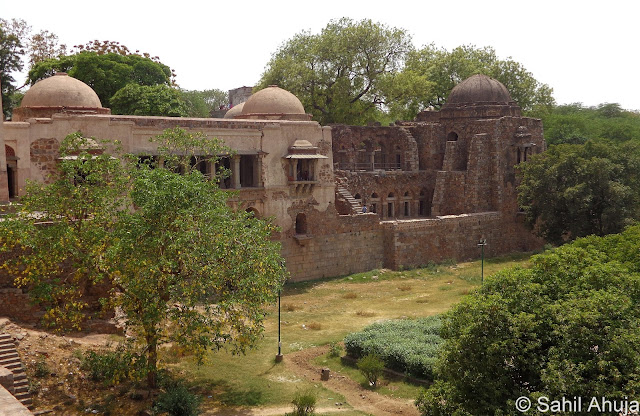

The tombs & one of the wings of the madrasa


Back near the entrance, I head to Feroz’s tomb. I had never actually imagined that the Sultan of India would opt for such a simple resting place for himself. The square tomb, much larger than the rest, is a very simple structure, quite in line with Tughlaq-era structures that were known for their straight, fortified walls & battlement ornamentation. It forms a pivot to which the two perpendicular wings of the madrasa connect to (in effect, the madrasa is L-shaped) & looms above the rest of the structures. The tomb is built with quartzite rubble finished with plaster to give it a smooth, white appearance. The dome rests on an octagonal drum (base), the finial topping it is small & circular. Both the drum & the roof are detailed with a row of red sandstone kanguras (battlement-like ornamentation). Though not built in a defensive pattern, Feroz’s Tomb is only ornamented around the entrance & that too in a very dignified, somber manner – the entrance is set in a larger niche, a small jaali (stone latticework), calligraphic detail & medallions – that’s about it. Interestingly, the entrance is not arched, but trabeate in nature – stone ledges panning the distance between two ends – an architectural style that is very common in Hindu & Buddhist structures (the Muslims employed arches in their palaces, tombs & mosques). Even more interesting is the presence of a small courtyard marked by a stone railing which is reminiscent of Buddhist temples & viharas of that era. Feroz belonged to the line of Qaraunah Turks (as the Tughlaqs were known as) who prided themselves for being born from Hindu mothers & Turkish fathers & therefore “possessing both Hindu modest & Turkish virility”, he was the son of a Rajput Hindu mother, his prime minister Malik Maqbul Telangani was a convert from Hinduism & so was the architect Abdul Haq – perhaps all these factors had a role in influencing Feroz’s choice of a tomb built in Hindu-Buddhist pattern.


The emperor's tomb


Three steps led inside his Tomb, the interiors are vast & better decorated than the exteriors. Feroz’s grave lies in the center, on one side sleep his son & grandsons. In the corners, squinch arches are used to convert the square tomb’s roof into an eight-sided polygon so as to support the dome. This is again a step back in terms of architecture because by Feroz’s time, native Indian artists had mastered Islamic building techniques & knew how to build true arches & domes. Squinch arches were prevalent half a century before Feroz’s time during the reign of Sultan Shamsh-ud-din Iltutmish as is apparent from his tomb (refer Pixelated Memories - Iltutmish's Tomb). The dome rests on a band of calligraphy which further rests on another band with regular geometric patterns. It is marked with medallions in several sizes, each inscribed with calligraphy drawing upon the Quran & the Hadiths, arranged around two concentric stars with a large medallion for their center.


Quranic verses & Hadiths - Feroz's blanket


The particular verses inscribed on the medallions & the arches in Feroz’s tomb make their appearance as architectural additions for the first time here, they weren’t used as part of Sultanate architecture before. They are then seen in structures built during the reign of Sikandar Lodi (ruled AD 1489-1517), another sultan of Delhi who took an active interest in repairing structures built by previous sultans. It is now believed that it was Lodi who added these medallion embellishments to Feroz’s tomb when he had it repaired in the year 1507-08. Among these verses is one of my favorites, Quran Sura 109 –

"Say: O disbelievers!
I worship not that which ye worship; Nor worship ye that which I worship.
And I shall not worship that which ye worship. Nor will ye worship that which I worship.
Unto you your religion, and unto me my religion."


One of the domed entrances of the madrasa close to Feroz's Tomb


Next to Feroz’s Tomb is another domed structure that is part of the second wing of the madrasa & leads into it. Yet another domed chamber exists close to Feroz’s Tomb near the edge of the madrasa’s wing, this one however is barred by an iron door. Another portion of the madrasa, separated from the rest of the complex by a wall with a break for an entrance, has been converted into the office of the Archaeological Survey of India (A.S.I.), this is the only place in the complex where a water cooler dispensing cold water has been installed. This wing of the madrasa has several interconnected chambers & a number of overhanging windows (jharokhas) overlooking the tank – couples can be found sitting in these deep windows arm-in-arm, cooing into each other’s ears & glossing over their sweet dreams. This invasion of the medieval-structure by couples seems traumatic at first, tragic afterwards, acceptable later. Unmindful of the history of the structures or the scorching heat of Delhi’s summers, they would sit here in each other’s laps for hours. Some would also scratch their names on the walls, others resent the presence of photographers. An hour into the complex, one’s thoughts range from feeling sympathetic towards the couples who too need space to meet each other, hold hands & kiss, away from the eyes of unrelenting parents, gossiping relatives & those members of our society who proclaim themselves guardians of modesty & culture to feeling frustrated with them for looking at any history-loving &/or camera-toting person with distrust. Seriously, people if you want some privacy, get a room!!


Teeming with couples!!


The lower level of the madrasa can be reached by a staircase, the double colonnades here are in a better preserved condition, the pillars are all intact & so are the medallions. Most of the chambers on this level are only dimly illuminated by sunlight & the passageways that connect these chambers are totally dark. Consequentially, the passages are infested with bats & it is actually better to not make any noises when traversing these passages. The dark is so bad that you can’t even make where you are headed & might have a jolt or two when you encounter a step in the passage (It is better to pretend that the bats aren’t there, I was fine till someone pointed them out to me!!).


I found this pavilion tomb the most striking


After much asking around & consulting guards, I finally found a way to the tank. The route takes you out of the complex from the entrance you came in from, then across a series of shops in a narrow side lane that leads to more shops. At the end of these shops there is an even narrower lane that opens into a makeshift dump yard for electronic goods & construction material. The place has been marked as their territory by some of the best graffiti artists in Delhi – Daku, Iron Curtain, 156. Then guided by a few of the shopkeepers, I headed towards the right on another narrow lane that finally terminated into what looked like an entrance to a park (this point connects the nearby Deer Park to the Hauz Khas Park, I later found out. I shall be writing about the structures within Deer Park soon). Off a bridge, I finally reached the tank & saw the madrasa spread out in front of me.


Graffiti "Delhi style"


The lake is still, the partially submerged dead trees & capsized boats bob up & down. Ducks swim from one side to the other effortlessly. Colorful birds appear once in a while, only to disappear even quickly. Visitors to the complex, sitting in the large overhanging windows, glance down my way only to go back to their conversations & gossips. A few impoverished kids run around, unmindful of the history of the ruins that surround them. Ignorance they say is bliss. If the kids knew the stones they are playing with were laid on the orders of the sultan of the entire country, powerful enough to have their whole city destroyed & charred, would they still play here with the same enthusiasm??


Lucky to live alongside centuries-old heritage!!


A high & sharply inclined staircase can lead one up to the mosque, but the entrance from here too is barred by barbed wires. That did not deter some of our monument-spoilers to deface the mosque – they simply scribbled names & love letters on the exterior walls of the mosque. @$%^%^& (had a run in with some of those vandals at Deer Park too earlier that day, nasty creatures). On the other side, one can go around the madrasa & the black dome tower. The dome tower formed one of the original entries to the complex from the tank level, however now the staircases that led up are gone & the dome tower can only be reached by climbing through uneven land layered with thorny vegetation interspersed with glass shards from beer bottles. A small hovel exists close by & as with all slums, there are no sanitation facilities & the stink is simply gross. I did however climb through the slope & have photographs to prove it too. For those not so eager to see these structures from different sides, all entrances to the madrasa from the tank have been blocked, but one can go around the structures, sit on the tall grass, look at the ducks, feed them with tidbits, enjoy the cool breeze or simply contemplate how those boats in the tank capsized. The madrasa & the tombs present a magnificent picture, providing numerous point of views & different perspectives to a photographer’s delight. & while you are at it, don’t forget to check out the Munda Gumbad (“Bald Dome”), a double-storied structure that once was in the center of the tank but now stands away from it directly opposite Feroz’s Tomb but on the other side of the tank (thus giving us an estimate of the original size of the tank). I forgot that this structure exists too & will now have to go all the way to the complex (a good 2 hour journey by auto & metro from my home) just to see this one structure. But it would be worth it!!


Plan of the complex (Photo copyright - Anthony Welch)


The tank had dried up several years back as the sources that fed it were diverted for other uses. In 2005, Indian National Trust for Art & Cultural Heritage (INTACH) & Delhi Development Association (DDA) launched an extensive program to develop the lake again using treated sewage water. The program has been a huge success & now the water level of the tank is maintained constant with the aid of treated water & feed from nearby storm water drains. Several steps were also taken up to maintain the continuity of an active ecosystem around the lake including introduction of several fish species & regular cleaning of the tank to remove debris & decaying organic matter. The area around the complex was developed as a residential & commercial zone catering to the city’s wealthy. The market is one of the most expensive in all of Delhi & there are numerous art galleries, upscale boutiques, showrooms & restaurants.


Exquisite!! - A gift from Sultan Sikandar Lodi to Sultan Feroz Tughlaq


You have several options at your disposal once you are done with photographing monuments - visit one of the many eateries in the area & pleasure your taste buds, collect your thoughts sitting in one of the overhanging window of the madrasa (do this only if you can be cautious, there are no barricades to prevent you from falling), sit down near the tank with a cigarette (or a joint!!) between your fingers, or befriend some girls there like I did & let small talk relax you after a long day.

Open: 10 am – 6 pm
Nearest Metro Station: Green Park, however it’s quite a walk away (2.5 km) & it’s better to take an auto from the metro station.
How to reach: Take an auto or walk from the Green Park Metro Station. Ask the locals for directions. If going by car, keep in mind that parking inside the Hauz Khas “Village” is only allowed for the “villagers” & the rest have to park their cars at a parking lot near the village entrance.
Entrance fee: Nil
Photography/Video charges: Nil
Relevant Links -
  1. Pixelated Memories - Amir Khusro & his Tomb
  2. Pixelated Memories - Feroz Shah Kotla
  3. Pixelated Memories - Hazrat Nizamuddin Dargah
  4. Pixelated Memories - Iltutmish's Tomb
  5. Pixelated Memories - Siri Fort Remains
Suggested Reading -