Showing posts with label Garbage. Show all posts

August 05, 2014

Deer Park, Delhi


Teeming with a much admired variety of flora and fauna , one of Delhi’s largest green lungs and a delight for nature enthusiasts and joggers alike, the aptly named Deer Park in Hauz Khas has endeared itself amongst heritage lovers for another reason – the thickly forested, almost pristine grounds present to visitors a feast of monuments that remains hidden behind multiple layers of foliage and is reached by following a labyrinthine trail convoluting and turning over itself throughout the massive park – in fact, it is the sheer frustration at being repeatedly brought back to the same point by the slithering, sneaking maze-like pathway and the mind-boggling confusion about finding the correct way in the vast, unmanageable park that might prove a hindrance (if you do consider these one) to locating all three medieval tombs within the complex – but then it is the thrill of discovering these forgotten beautiful structures through veils of vegetation and a complexity of trails that drives the enthusiasts and the curious to explore this hidden magical nook in the heart of the city. The park promises to present to visitors the momentary surreal feeling of awestruck surprise at the sight of a marvelous centuries-old structure that just might peep out all of a sudden through thick layers of vegetation and a tangle of branches and vines or behind vibrantly colorful swings or even amidst unbelievably large mounds of dead and dry gnarled wood! For couples, the park is a heaven, one of the last remaining bastions where young lovers can meet without being judged, disturbed or subjected to moral policing by the older generations and right-wing brigades, though of course, there might be a few lonely, frustrated guys lurking behind a tomb or a tree and sneaking up on couples and clicking them while they get physical.


At Deer Park


It was a particularly sunny summer afternoon when I visited the park and the adjacent Hauz Khas complex (check Pixelated Memories - Hauz Khas Complex) – the trees seemed parched, the concrete felt as if it would melt under the fiery onslaught and the air itself struggled to escape the scorching clutch of the sun – the park’s huge trees, with their wide spread of branches and dense foliage, conspired to keep the sun from showing its dreaded face to those who were seeking asylum under their wild expanse, thereby providing much appreciated relief to humanity and wildlife. But as evidenced by the presence of scores of couples who throng to the park at all times of the day irrespective of blistering sun or drenching rain, love knows no bounds! It has been often observed that all medieval structures – be they tombs, mosques, pavilions or palaces – tend to be considerably cooler than the surrounding environments as a result of location-specific architectural practices, honed over centuries of construction, employed in their building – it is therefore no surprise that the tombs within the park become a refuge during the daytime for dreary visitors, tired couples, heat-struck rodents and hassled birds. Though at all times the park remains threatened by vandals and deranged lovers who take to monuments to vent their emotions, be it love or anger or frustration, and often leave behind irritatingly disgusting love letters or abuses, such elements are more active during the day when the crowd is relatively less and thoroughly dispersed and there is little suspicion that anyone can go about such anti-social, anti-heritage activities diurnally – the few guards on duty have it real rough, having to patrol such vast space and managing undisciplined, and in all probability uneducated, louts and vandals who are adept at badmouthing and harassing at the slightest pretext – despite my rants against the poor state that the government has subjected the monuments to, I do feel bad for the guards. 


Nothing stimulates an adrenaline rush like a friendly fight!


True to its name, the park has enclosures that house rabbits and deer and there are ponds where duck and geese waddle about in enjoyment. The deer are a real delight (probably apparent from the large number of photos I clicked), there are so many of them, and a few look suberbly majestic with their striking horns and chiseled bodies. Incidentally, it was much later that I found out about the monuments in the park, it was the deer I first read about it in a newspaper article, that’s what piqued my interest – who would have thought there are deer roaming about in a public park in Delhi! One can also spot rare avian visitors if one is observant enough – there are lapwings, peacocks, parrots, pigeons, mynas and occasional terns.

Of the three tombs within the park premises, the largest is Bagh-i-Alam ka Gumbad (“Tomb within the garden of the world”), a beautifully adorned, medium-sized tomb that seems to be a favorite with visitors, enchanting them with its modest blue tile work and exquisite multicolored medallion art on the interiors, and also attracting couples to its deep recessed alcoves where one can hope to shut out the world while embracing one’s beloved. Along the tomb is a beautiful rubble masonry wall mosque with thick turrets and a leaf-covered and bird dropping-drenched cemetery – look out for more couples in the hollow turrets, I found it amazing how people can clamber into such narrow spaces! Nearby stand the Tohfewala Gumbad (“Gifted tomb”), an unidentified tomb whose interiors are exceptionally well maintained even though the exteriors appear all run-down and crumbling, and Kali Gumti (“Little black domed structure”), another unidentified structure whose purpose for construction is unclear but whose nomenclature is arrived at after considering the organic mortar finish applied to its round dome that has taken a blackish hue over time. You can look up these structures here – Pixelated Memories - Bagh-i-Alam ka GumbadPixelated Memories - Kali Gumti and Pixelated Memories - Tohfewala Gumbad.


Majestic - Bagh-i-Alam ka Gumbad


The park has been modeled by the Delhi Development Authority (DDA) into creating a space to keep the local residents physically fit through the utilization of several simple exercise regimes along a fitness trail and the employment of info boards to guide and explain exercises to the visitors – the exercises are numerous and jocularly interesting, thanks in part to their naming and also to the strange set of accompanying instructions, take for instance “Jumping Jack”, “Balancing Beam”, “Straddle Walk”, “Spinal Exercise”, “Knee Bend” – it is another matter that rarely do people follow these instructions, nor are there many visitors, except couples, to the park except during early morning and evening.

Over the past few years, the park has been in the news for all the wrong reasons – official apathy, poor conservation-restoration of monuments, poor horticultural maintenance, lack of control over vandals and unruly elements, unclean animal enclosures straddled with garbage and polybags, maintenance-related issues and garbage dumping – at least the park was actually clean the day I was there – there weren’t any heaps of garbage, nor any disturbing elements, though yes, the issue of defacement and spoiling of public property, monuments especially, is glaringly rampant in the park premises; the park trails were being relaid with brick red soil and the guards were actually going about and looking after the property. Public facilities are another issue – though there are water coolers near the entrance gate, they seemed to be in a disgusting state of maintenance (the basin hasn’t been cleaned in ages, the taps do not close properly and are forever dripping thereby leading to moss deposits along the basin walls and overspill along the tiled walkways, the perennially filled basins have been taken over by hornets and one has to hope for their mercy while edging closer for a sip). It would take some time for Delhi to get its act together, the city is after all aiming for a UNESCO World Heritage City status, but at least it’s a start – in a city where parks, wetlands and forest covers are rapidly diminishing and children have to come out to play on streets for lack of proper parks and sporting facilities, such a vast green space is truly an unexpected delight! 


Look at those horns!


Location: Hauz Khas
Nearest Metro station: Green Park
How to reach: Walk/take an auto from the metro station to the park.
Entrance fees: Nil
Photography/Video charges: Nil
Time required for sightseeing: 45 min
Relevant Links - 

December 13, 2013

Lodi-era Canopy Tomb, Mehrauli Archaeological Park, New Delhi


Mehrauli, which is the oldest continuously inhabited area in Delhi (it was apparently named “Mihroli” after King Mihr Bhoj who reigned several millennia back), is nowadays famous for the largest archaeological space in the city – the Mehrauli Archaeological Park. More of a necropolis spread over several acres that boasts of tombs, baolis (“step wells”) & wall mosques, the Archaeological Park also houses a lone canopy tomb not unlike many others seen in different parts of the city. Blackish in hue & retaining much of its original ornamentation, the canopy tomb dates back to the reign of the Lodi Dynasty (AD 1451-1526) & consists of a umbrella dome resting on twelve pillars. It stands next to Rajon ki Baoli, one of the finest step-wells that exists in the city; but sadly the local population, possessing but little education & being largely unaware of the heritage spreading over several millennia strewn around them, have condemned both the baoli & the tomb to the fate of a pig sty – filth (black as tar & equally thick), thorny outgrowth dense enough to prove non-negotiable & a large population of four-legged beings comprising equally of dogs & pigs & consisting of a few cows too that call this sewage & polythene filled pit their dear home are what lie in store for a visitor curious enough to brave the curving track of the Archaeological Park to reach this particular point.

Shrouded by foliage


If you still haven’t got the bigger picture, let me assure you that the path leading to the tomb is perfectly fine – a simple mud track cleared of debris & vegetation; in fact even on nearing to a certain extent the scene is pristine – the ruins of the semi-octagonal bastions at the corners of the wall that makes up the perimeter around the plinth on which the tomb stands give the appearance of a miniature fortress, a stone stronghold forgotten in this dense vegetation meant to guard the graves assigned to it for safe keep. The honks of cars & the chatter of humanity is lost on the way to this virgin corner; modernity is left behind; brilliant red birds, big black ants & vividly-colored butterflies are company here. Occasionally one might come across another person who would be as surprised on seeing you as you are on seeing them in this distant corner...
It is the stench that first reaches the visitor - the decay around cannot be ignored, not even if you put all your attention into photographing the structure!! Next comes the sight & sound – pigs grunting at you would not have been so terrifying if they were not so large & not accompanied by dogs that bared their teeth at the slightest pretext!! The pristine, virgin monument turns out to be part of a desolate, forsaken corner. Rubble from collapsed & collapsing structures is strewn around the tomb; the double staircase leading up to the plinth level is surrounded by this downpour of debris - at some places, the only way to reach the plinth is to leap over heaps of rubble collected on/around the stairs.


Protected by bastions


The dome of the tomb rests on an eight-sided drum (base) & is ornamented with leaf motif emerging from the lotus finial. The drum too displays leaf motif though of a different design while the roof of the tomb is marked by a row of kanguras (battlement-like decorative pattern). The pillars that support the dome are simplistic rough, rectangular blocks possessing ornamentation only along their top where they mutate into four-pronged brackets to support the weight of the dome. The inside of the dome reveals floral artwork in incised plaster directly underneath the finial – it appears that once the design must have encompassed most of the dome but it was lost with time & subsequent restoration work limited it to the present state. At each point where the pillars meet the dome, the brackets take a decorative form resembling a lotus bud with more curves sprouting out of it topped by an intricate design; a row of ornamental arched alcoves inlaid within rectangular niches & flanked by floral plasterwork moves around the inside of the dome dividing it into two halves horizontally - but not all the alcoves & lotus brackets are the same - many are simply shorn of all decorative features that their counterparts proudly flaunt, perhaps some conservation artist thought its better to have a plain plaster surface than display remnants of the original artwork.


Adorned by lotus brackets


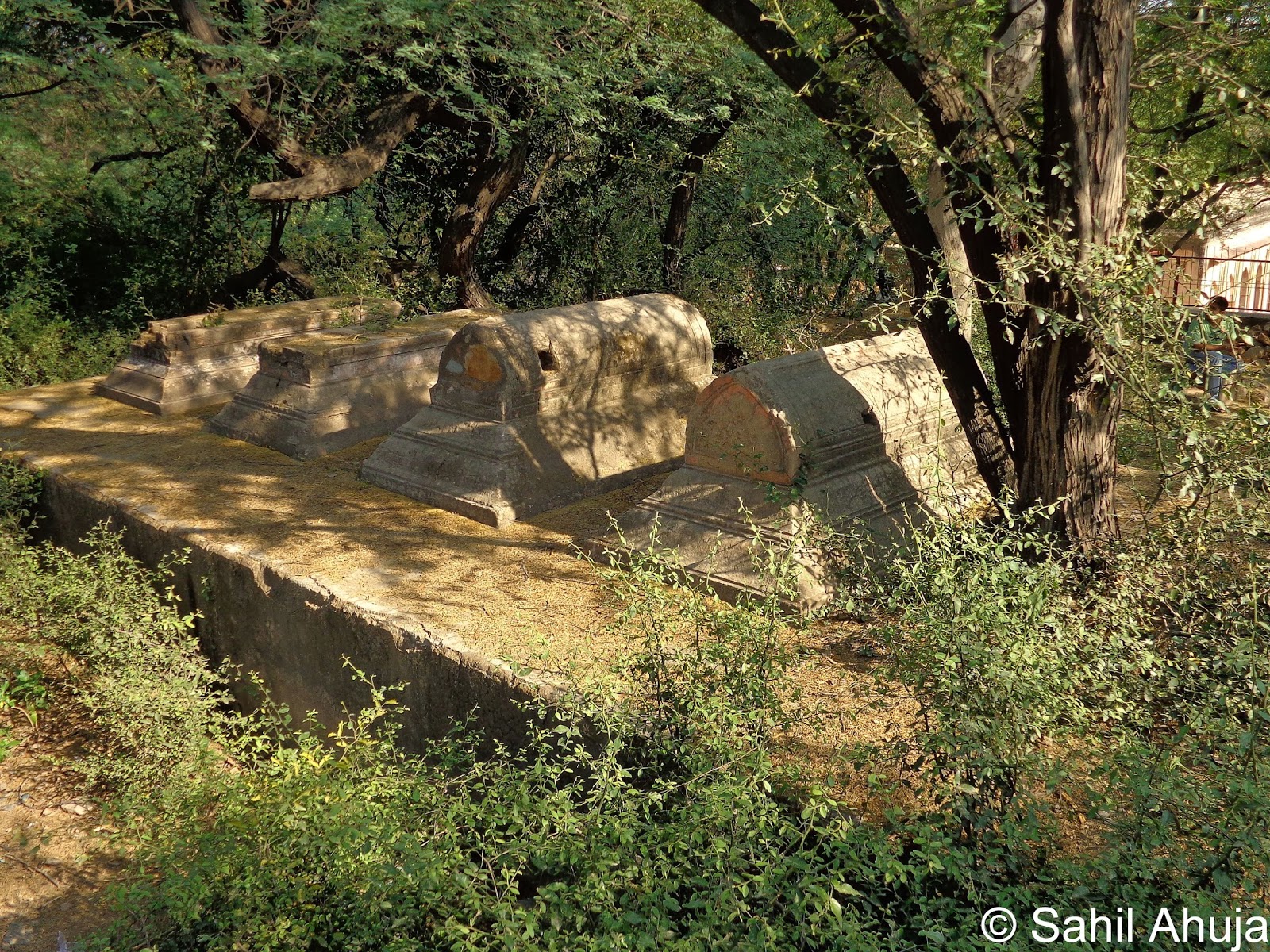
Several graves are scattered underneath the canopy, more surround it, covering both the plinth & the ground around the tomb with a carpet of dead & their mausoleums – some of these are in perfect conditions with their rounded tops & sharply-defined edges, others are broken & crumbling, some even have grass sprouting through their broken faces. There must be at least a score graves here – the canopy seems to be a favorite burial spot at the time!!


Surrounded by graves


The red-sandstone plaque installed by INTACH (Indian National Trust for Art and Cultural Heritage) close to the tomb reads –
“The colonnaded tomb stands on a rather large plinth over which are several graves. In a ruinous condition, the staircase to the plinth leads from each side of an arched opening that leads to a flat domed chamber. The corners of the plinth are emphasized by semi-octagonal bastions. Towards the east of the tomb canopy are remnants of another similar building.”

I assume it’s not just me but every heritage enthusiast-photographer who feels a strange thrill, a sudden rush of adrenaline at discovering a hitherto hidden & largely forgotten structure such as this tomb. No matter how debilitating the stench around it is, or how dangerous those big, bad dogs appear, there is a beauty in such structures that defies their surrounding & the condition they have been subjected to. If only the whole of the Archaeological Park is landscaped & beautified (much like the unbelievable conversion by Lady Willingdon of the erstwhile Khairpur Village to the splendid stretch now known as Lodi Gardens) so that more people can behold the architectural gems that the Park houses.


Framed by ruins


Some heaps of debris scattered right & left only adds to the charm of these centuries-old monuments!! Be there to see for yourself! (& while you are at it, you can also spare some time for the other monuments in the park, am adding the links at the end of this post)

Location: Mehrauli Archaeological Park
Open: All days, Sunrise to Sunset
Nearest Metro Station: Saket
Entrance Fee: Nil
Photography/Video charges: Nil
How to Reach: After getting down at Saket Station, one can walk to Lado Serai bus stop. Buses are available from different parts of the city for Mehrauli & one can alight from the bus at Lado Serai stop itself. The unmarked entrance to the Archaeological Park is through an iron gate opposite Ahinsa Sthal (situated couple of hundred meters away from Lado Serai, refer Pixelated Memories - Ahinsa Sthal)
Time required for sightseeing: 20 min
Note – There are no facilities (toilets, food & drinking water) available within the Archaeological Park. While you can avail food & refreshments at one of the restaurants at Lado Serai, you can only find toilets at the shopping malls close to Saket Metro Station, almost a kilometer away.
Other monuments within the Archaeological Park -  
  1. Pixelated Memories - Balban's Tomb
  2. Pixelated Memories - Jamali Kamali Complex
  3. Pixelated Memories - Khan Shahid's Tomb
  4. Pixelated Memories - Metcalfe's Chattri
  5. Pixelated Memories - Metcalfe's Ziggurats
  6. Pixelated Memories - Ruins, Mehrauli Archaeological Park
  7. Pixelated Memories - Quli Khan's Tomb