Showing posts with label Akbar. Show all posts

November 07, 2014

The Gandhi mural and Abdul Nabi's mosque, ITO Crossing, Delhi


Invisible to the steady stream of pedestrians and motorists alike who whirl around it in uncoordinated patterns, an almost unheard of little gem that retains inappreciably little of its original characteristics to reveal its enviable antiquity and modest beauty to the undiscerning is tucked in at the intersection of two of the busiest roads in Delhi and close to one of the most important landmarks in the city’s geography. Ignored by heritage and history enthusiasts who seem to have irrevocably forgotten of its modest existence, Sheikh Abdul Nabi’s mosque, located at the indisputably well-known ITO intersection and shadowed by the towering buildings that house the headquarters of Delhi Police, Income Tax Department and the Central Public Works Department (CPWD), was commissioned and christened as his namesake in AD 1575-76 by the "Diwan" (“Supervisor of Accounts”) in the court of Emperor Akbar (ruled AD 1556-1605). The gorgeous mosque, seated with its back to the traffic intersection that is famed for its traffic jams as well as for being a geographical link between different medieval cities of Delhi, has been transformed into one of the prettiest oases that could ever exist in such close vicinity to the bustling intersection indescribably dominated by pollution, noise and an unabated deluge of humanity by Jamiat Ulema-i-Hind ("Organization of Indian Islamic scholars"), one of the oldest and most peaceful Muslim organizations in the country, headquartered in the splendid structure.


Courtyard view, Abdul Nabi's mosque


In the history of Indian freedom struggle, the Jamiat, established in 1919 by some of the most influential Islamic scholars of the subcontinent, was the only Muslim organization that did not align itself with the Muslim League and its unrelenting demand for a separate nation for the Muslim population of the country (later recognized as Pakistan) – following independence too, the Jamiat propounded the theory that by signing the Constitution of India, Muslim elected representatives have entered an agreement (“mu’ahadah”) with the majority Hindu population of the country to establish a secular state and it is the responsibility of all Muslims in the country to honor the agreement. The simplistic, rubble-built mosque of Abdul Nabi, consisting of a large rectangular structure surmounted by a single, plastered over, unproportionally large dome rising from a sixteen-sided drum (base), has been expanded into a massive structure by the Jamiat who have added three wings of triple-floor hostel-like accommodations in front of the mosque creating an enclosed courtyard space in the center. The courtyard, superbly landscaped into a small garden area complete with numerous potted plants, grass-lined cobblestone walkways and fountains brimming with clear water, can be accessed by a flight of stairs emanating from the mosque’s huge front edifice. A gigantic, strikingly handsome screen, composed of stone lattice work (“jaali”) and vibrantly colorful tiles, with three huge arched openings mirroring the considerably smaller arched entrances of the mosque, exists in front of the latter as a modern extension; two sets of thick, towering pillars exist near the older structure supporting the immensely high roof that encompasses the area between the older mosque’s exterior walls and the majestic screens; seminary offices exist along the ground floor.


Unbelievable tranquility in the throbbing heart of the city


The numerous rooms in the wings around the courtyard are sparse and accommodate bespectacled religious scholars with flowing white beards and cataract-veiled eyes – eager to welcome in visitors, they must be at least in their sixties and yet retain jovial smiles, generous talkative attitudes and twinkling eyes. The interiors of the mosque are exceedingly simplistic compared to the modernized exteriors and, except for the marble wall claddings along the base, are close to what Abdul Nabi would have envisioned them as – the large prayer chamber, painted white throughout, has been partitioned into three interconnected sections by means of walls pierced by large arched openings; the central chamber displays squinches along the roof (architectural bridging elements spanning a square chamber’s top corners so as to convert it into an octagonal entity capable of supporting the mass of a giant dome) while the side chambers still retain small, meager floral medallions composed of colorful glazed tiles which, despite their brilliance, appear to be half-hearted attempts at beautification of an otherwise bare structure; a bare line of ornamental arched niches each embedded in shallow individualized rectangular depressions also runs just below the squinches in the central chamber while the squinches themselves are adorned with meager arched patterns and small six-pointed star embossments crafted from stucco.


Clash of eras - The mosque and (background) the headquarters of Delhi Police and CPWD


Abdul Nabi enjoyed Emperor Akbar’s confidence and was sent by him to Mecca in AD 1584-85 to distribute the Emperor’s charity among the poor there, but upon his return he failed to account for the money properly and was imprisoned and executed on charges of corruption and embezzlement of state funds. It struck me interesting that in an unanticipated and unintended artistic decision which would perhaps have been darkly humorous had the correlation between Mahatma Gandhi, the “Messiah of Truthfulness”, and a medieval administrative officer executed for corruption not been subjected to the collective amnesia suffered by citizens of a city that has altogether relegated its intricate history and unsurpassable architectural heritage to a forgotten corner, the recently concluded 2014 Street Art Delhi Festival saw the Delhi Police Headquarters, located immediately opposite and overshadowing the mosque, etched with an impressive, realistic mural of Gandhi, the icon of truth, honesty, non-violence and peaceful coexistence between peoples of different nationalities, religions, creeds, genders and economic realities.


Impressive, right?! All I could say was "Wow"!


The 150 feet high X 38 feet wide imposing mural, dedicated to the city by Lieutenant-Governor Najeeb Jung who inaugurated it, was completed in mere 5 days by Indian graffiti artist Anpu Varkey and German artist ECB Hendrik Beikirch and has since been lauded as a remarkable exemplar of art and a brilliant addition to the city’s streetscape which saw numerous vibrantly-colored and creatively-conceived graffiti patterns and textual messages being painted and splattered in numerous locations, most notably the urban villages of Shahpur Jat, Hauz Khas and Khirki (see links in the end), besides the inconceivably poignant notes blossoming on the walls of the dreaded Tihar jail!

For me, the day wasn’t really going well – a dear friend I just met revealed her plans to shift to Russia permanently and besides the disappointment I did not have a plan on how to spend the rest of the day except roam around in the streets and look at people, buildings and monuments without very much photographing anything in particular – the mosque, with its joyous old men, and the colossal mural opposite, does help uplift the spirits once one decides to just sit down on the stairs and let all worries go and simply adore the artwork and the efforts that must have gone into completing it. For a change, the juxtaposition of the modern and the medieval and the intermingling of the two doesn’t appall me but makes me love this beautiful city just a little more, if that is even possible.


Gandhi


Location: ITO Crossing
Open: All days, sunrise to sunset
Nearest Metro station: Pragati Maidan
Nearest Bus stop: ITO Crossing/Lala R.C. Agarwal Chowk
Nearest Railway station: Tilak Bridge 
How to reach: Buses and trains are available from different parts of the city – the bus and train stations are just a stone's throw away from the mosque and Delhi Police headquarters. If coming by metro, one can avail a bus/auto plying towards ITO.
Entrance fees: Nil
Photography/Video charges: Nil. It is advisable to take permission first before photographing the mosque interiors since it is a seminary's headquarters.
Other graffitis in the city - 

August 07, 2013

Atgah Khan's Tomb, New Delhi


It is not difficult to imagine strikingly impressive monuments could be concealed within the folds of the lanes & by-lanes of Nizamuddin Basti area which hides within its bosom several jewels that glitter with their stupendous architectural magnificence & heritage antiquity. One such ornate structure, hidden pretty nicely in plain sight, is the tomb of Atgah Khan, foster-father to the Mughal Emperor Akbar (ruled AD 1556-1605) & a powerful noble in the court of both Humayun (ruled AD 1530-40 & 1555-56) & Akbar. Interestingly, the mausoleum stands next to the Dargah (Tomb) of Hazrat Nizamuddin, the patron saint of Delhi & can be seen from different points within the Dargah complex (refer Pixelated Memories - Hazrat Nizamuddin Dargah), & yet it is one of the least visited & least known structures in all of Delhi – the reasons for this second-class status being the greed of the citizens of Delhi who are ever so ready to encroach upon such structures & convert them into residential/commercial spaces & the apathy of the Government agencies who turn a blind eye to the atrocities committed upon these centuries-old monuments & indeed even permit further construction/vandalism in return for a few green-colored pieces of paper.


Strikingly symmetrical!!


Khan-i-Kalan Shamsh-ud-din Muhammad Khan was the son of a simple farmer in Ghazni (modern-day Afghanistan). He joined the army of Emperor Humayun & rose to become one of his close confidantes & administrators. When Humayun was overthrown by Sher Shah Suri, the Governor of Bihar, in the year 1530, Shamsh-ud-din stood by his lord through thick & thin. Humayun went through several difficulties, faced many struggles, conflicts & rebellions while he was out of power, his own brothers betrayed him & tried to arrest him. Crossing over the dreadful Thar Desert that marks parts of Rajasthan & Pakistan, Humayun’s wife Hamida Begum’s horse died & she being pregnant at that time, Humayun had to lend her his own horse. Nobody offered Humayun their camel or horse; he walked through the scorching heat & sand of the desert in what he described in his memoirs as the lowest point in his life while his courtiers & ministers rode their stallions. Through all this Shamsh-ud-din stood firmly by Humayun’s side. Pleased with his steadfastness & loyalty, Humayun declared Shamsh-ud-din the foster-father (“Atgah”) of his new-born son Akbar & Shamsh-ud-din’s wife Jiji came to be known as Anga (“Foster-mother”). They looked after the young prince like their own son while Humayun was seeking asylum & military assistance from the Shah of Persia.


Details of the marble & stone work at the lower half of the tomb


Akbar grew up with Mirza Aziz, Shamsh-ud-din’s son & Quli Khan & Adham Khan , the sons of Akbar’s other foster-mother Maham. When Humayun returned to power in the year 1555, he elevated Shamsh-ud-din “Atgah” Khan to the position of general of his army. Atgah Khan retained his position when Akbar ascended the throne in AD 1556 & also held immense power & influence over the royal court. Mirza Aziz Kokaltash (“Koka” = “foster-brother”) too rose to become an army general, & so did the brothers Adham & Quli. Atgah Khan also married his daughter Mah Banu to Abdul Rahim Khan-i-Khanan, another powerful general & one of Akbar's "Navratnas" ("Nine Jewels") (Both Mah Banu & Abdul Rahim were also later buried close to Atgah Khan's Tomb, refer Pixelated Memories - Abdul Rahim Khan-i-Khanan's Tomb). Much to the chagrin of Maham Anga who wanted all the power to be consolidated in the hands of her own sons, Akbar immensely respected Atgah Khan & sought his opinion in all important decisions. In 1561, Akbar raised Atgah Khan to the coveted position of “Wakil” (“Minister”), a step that greatly displeased Maham Anga & Adham Khan & finally culminated in the murder of Atgah Khan at the hands of Adham Khan when he was investigating some of the corruption charges against the latter (the views of Adham’s brother Quli about Atgah Khan are not known, history is silent about his life & actions though his tomb still exists in the far-off corner of Mehrauli Archaeological Complex, refer Pixelated Memories - Quli Khan's Tomb). Blinded alike with fury & fear of the consequences of his actions, Adham then burst upon Akbar with his sword unsheathed. Infuriated, Akbar had Adham Khan arrested & thrown down the ramparts of his fortress in Agra, twice for good measure – many scholars believe that it was Akbar himself who threw Adham down. Atgah Khan was given the honour of being called a martyr & his death is so recorded as martyrdom in “Akbarnama” (“Chronicles of Akbar”) by Akbar’s court chronicler-historian Abu Fazl.


The striking sandstone & marble ornamentation at the upper half of the tomb


A magnificent mausoleum was commissioned within the complex of the Dargah of Sheikh Nizamuddin for Atgah Khan by his son Mirza Kokaltash on the orders of the Emperor who was aggrieved by the heinous murder of his most trusted lieutenant & minister. The tomb’s architect was Ustad Khuda Quli who presided over its construction; Ustad Baqi Muhammad was entrusted with sculpting the marble slabs that were to be laid on the sandstone walls with intricate calligraphy drawing upon Quranic verses.

The strikingly symmetrical medium-sized square tomb, built of red sandstone, ornamented with decorated slabs of white marble, & completed in the year 1566-67 is splendidly ornamented with medallions, tessellation art & calligraphy. It is surmounted by a high dome & is decorated in several different patterns, each adding to its charm & further adding a layer of admiration for Mughal art & architecture in the eyes & mind of the visitor. The marble that covers the tomb’s exteriors is inlaid with red & blue-hued stone, painstakingly chiseled in several patterns. The inlay work is more profuse near the base of the tomb. The most admirable feature of the tomb that catches the eye of anyone aware of Islamic art are the two hexagonal medallions that flank the arched niche that marks each side of the tomb – the symmetrical pattern laid on the medallion is a classic example of the tessellation art practiced throughout Islamic world by skilled artists & craftsmen – the word “Ali” has been repeated six times in each medallion. One of the sides has an entrance built into it with a wooden door that has been locked perennially by the Archaeological Survey of India (A.S.I); the rest of the niches are marked with intricately designed latticework (“jali”). Speaking tomes about the time & effort that went into designing & crafting this piece of architectural delight, even the red sandstone that covers the exteriors is patterned & chiseled throughout with amazing dexterity – the repeating floral motifs appear flawless to my eye & the introduction of inlaid marble slabs to break the monotony of the sandstone works wonders & adds a graceful flamboyance to the otherwise subdued mausoleum.


Jewel Box!!


Since going inside the tomb is not possible, I could only peep through these jalis & look at the sarcophagi that line the interiors of the mausoleum (there are five or six graves in there), the interiors are said to possess excellent designs done in blue paint, however the same could not be seen from the outside. The tomb still retains much of its original decorative elements, though much of it has been spoiled by vandals – now there are just gaping holes & crevices at places where once was a smattering of stone inlaid in marble. The tomb stands in a small patterned courtyard that separates it from the matchbox-like, shabby houses that have mushroomed all around it. The courtyard was once pretty large, the architects had intended it to stand in a large open ground so the visitors can take in its sheer beauty & magnificence, but has been encroached upon on all sides leaving only a couple of feet on each side of the tomb. The present size of the enclosing courtyard makes it difficult to photograph the tomb fully & as naturally as one would like to, on many occasions I had to step through debris & piles of construction & animal waste in order to get a vantage view of the structure. The courtyard is laid with red sandstone & inlaid with marble, but is filled with rubbish & garbage, small mountains of daily waste mark each of its corner, the problem of waterlogging is extensive & three of its four sides of the courtyard had large puddles of muddy, brackish water accumulating alongside. The surrounding houses have come right up to the level of the surrounding walls, in certain places one can even see the original, small decorative windows that must once have added grace to the enclosure, now embedded into the walls of the houses & filled with cement & dust.


Archive image of the tomb. On the right are the Dargah of Hazrat Nizamuddin & the Jamaat Khana Mosque. The graves visible in the foreground have no doubt been lost to the rapidly expanding basti (settlement), since now only houses surround the tomb in all directions (Photo courtesy - Facebook.com/Humayun's Tomb - Nizamuddin Basti Urban Renewal Initiative)


A small, roofed pavilion stands within the courtyard, next to one of the enclosing walls – the eight pillars still retain much of their original artwork, the walls too display traces of artwork around the shallow niches that ornament them, however the damage wrought on it by the residents of this neighbourhood is intense – a small room next to the pavilion has been broken into, part of the wall that surrounded it has been demolished & the room converted into a makeshift incinerator for burning paper & wood, the walls are all blackened with soot, the pavilion itself reeks of melancholy & a sorrow bordering on desperation, crying out for protection from this fate that it does not deserve.


I can still smell the putrid smoke. The pavilion is being subjected to a treatment that is disgusting, to say the least.


Perhaps expounding on the once glorious days that the mausoleum & the associated structures around it enjoyed, a wall next to the pavilion still retains much of its original tile work – the simplistic designs that mark the wall consist of three ornamental arches crafted out of red, plaster bricks that have been embossed on the underlying rubble wall. The arches are surrounded by intricate floral & geometrical patterns done with yellow & blue glazed tiles. Perhaps this wall acted as a Qibla (an open wall that points to Mecca (West) & is faced by Muslims for the purpose of prayer), indeed the wall is parallel to the Jamaat Khana mosque which is the principal mosque of Nizamuddin Dargah complex & is visible from Atgah Khan's Tomb. One can even climb over some portions that have caved in close to the Qibla wall & step onto the roof of the adjoining house to get an “aerial” view of the Nizamuddin Dargah complex & the Jamaat Khana mosque.


The Qibla wall - Notice the patterns & the floral design above the central arch


Opposite the aforementioned pavilion is a domed structure, however this one has been encroached upon to such an extent that nothing except the blue-ish dome is visible now. I could not even fathom a way to reach the structure. Perhaps somebody lives inside it now, it certainly looks like it has been included within the plan of the houses that have sprung up around it. This structure is close to where the archival image I posted above must have been taken from.


What's that blue-domed structure in the background?? Can someone enlighten me?


Astonishingly, though the mausoleum is now locked for visitor entry, the crypt below it where the bodies of Atgah Khan & his family are actually buried has been occupied by several families for the past several years (decades if they are to be heeded). Perhaps that explains the glares & the watchful eyes that I encountered when I made my way to the mausoleum, I was led by the neighbourhood kids but the elders who sat gosipping around the tomb courtyard, looked shocked & anguished as if I have stepped in their courtyard. Somehow the municipal corporations even issued permissions & bills to retrofit the tomb to fix electrical & water connections inside it. The crypt chamber itself has been modified to make way for closets & doorways, the walls & the floor are now lined with ceramic tiles, the foundations have been demolished to make way for additional rooms. One would have thought it couldn’t get any worse than this, but the surprising thing is that one of the families that inhabit this burial chamber is that of the watchman employed by the ASI to safeguard this medieval-era jewel from encroachers!! Despite the numerous articles that have been published about the condition of the tomb in leading newspapers since way back in 2009 (see links below), the ASI has failed to evict one of their own who has taken to damaging this stunning structure instead of protecting it. ASI has not yet responded to my mail to them regarding this whole scenario & it was actually Ratish Nanda of the Aga Khan Trust for Culture (AKTC) who told me about this watchman connection when I talked to him about the plight of the structure (AKTC has been entrusted with the restoration & conservation of the monuments falling within the Humayun’s Tomb Complex-Nizamuddin Basti-Sunder Nagar Area. Hopefully they would soon take up structural conservation of the mausoleum as part of its ongoing projects). I had to resort to posting my original mail to ASI here with the hope that they would be jolted into taking some action about it –


Don't say I did not tell you!!


Interestingly enough, the ASI Director-General replied to me rather quickly when I wrote to him several months back about an internship in monument conservation with them, wish the staff at ASI were as quick in their response when it came to monuments & heritage structures which are supposed to be their prime concern. Sad times that we live in, a lone structure that once stood within the Nizamuddin Dargah Complex has been separated from it by upcoming houses, taken to the verge of a catatonic shift in terms of plan & layout by the encroachments, & yet the authorities fail to wake up. & I thought my blog could make a difference by educating ordinary folk about our cultural & architectural heritage, I’m disappointed in you ASI!! I always thought you people were the real heroes – maintaining thousands of forgotten structures & excavation sites throughout the country, often with the meager resources that are allocated to you & in the face of civic/police inaction & incompetence in providing you assistance, but the recent actions of your own men should be enough to put you to shame.


The Mughals & their pavilions - I am reminded of Hira Mahal in Red Fort Complex after looking at this one.


Location: Nizamuddin Basti Area, very close to the Dargah of Hazrat Nizamuddin (refer Pixelated Memories - Hazrat Nizamuddin Dargah)
How to reach: There are two ways leading to the tomb – the first is from the Dargah itself, the second is through the labyrinthine maze of narrow lanes that fold upon themselves around the Dargah. Either case, it is better to ask for directions & guidance from the locals – the shopkeepers or the kids in & around the Dargah.
Open: All days, Sunrise to sunset
Entrance fee: Nil
Photography/Video Charges: Nil
Advice: Since you might have to cross through the Dargah area, it is better to take off one’s footwear & carry them in your hand/bagpacks. You have the option of depositing them with any of the numerous shops that line the lanes outside the Dargah, however you will need them in case you are visiting the mausoleum on a scorching summer day since the stone & marble floor of the tomb courtyard would be simmering like a frying pan. It is also advisable to be dressed modestly & keep one’s head covered with skullcap/dupatta (cloth used by Indian women to cover their head).
Relevant Links -
  1. Pixelated Memories - Abdul Rahim Khan-i-Khanan's Tomb
  2. Pixelated Memories - Hazrat Nizamuddin Dargah
  3. Pixelated Memories - Hira Mahal, Red Fort
  4. Pixelated Memories - Humayun's Tomb Complex
  5. Pixelated Memories - Quli Khan's Tomb
  6. Pixelated Memories - Red Fort Complex
Suggested Reading -
  1. Business-standard.com - Article "A tomb in today's times" (dated September 15, 2007) by Gargi Gupta
  2. Hindustantimes.com - Article "Digging next to Atgah Khan’s tomb" (dated October 09, 2011) by Nivedita Khandekar
  3. Indianexpress.com - Article "Akbar-era monument suffers neglect" (dated April 05, 2011) by Sweta Dutta
  4. The MIT Press - (pdf download) Tessellations in Islamic Calligraphy by Mangho Ahuja & A.L. Loeb
  5. Theglobeandmail.com - Article "India's ancient mausoleums are home sweet home to some" (dated June 08, 2009) by Stephanie Nolen
  6. Timesofindia.indiatimes.com - Article "Illegal stay hits Mughal tomb" (dated May 16, 2011)
  7. Timesofindia.com - (pdf download) Article "At home in Akbar-era ASI 'protected' tomb" (dated March 5, 2009) by Richi Verma & Neha Lalchandani
  8. Wikipedia.org - Tessellation (Ornamentation art involving the use of Glazed Tiles to cover a plane)

July 13, 2013

Abdul Rahim Khan-i-Khanan's Tomb, New Delhi


A prominent military general once said -

 “Kheera mukh te katiye, maliyat loon lagaye/ Rahiman kadve mukh ko, chahiyat ihi sazaye” ("To cure a bitter cucumber, we cut its head off and rub in salt/ Says Rahim that to cure a bitter mouth we should apply the same remedy")

But then the same man also exclaimed - 

“Rahiman te nar mar chuke, je kahun mangat jahin/ Unte pehle ve muye, jin mukh niksat nahi” (“Says Rahim, he who has to beg ceases to be a man/but he who refuses to help another was never a man to begin with”)

One might ask how is it that a man could also talk about helping others while being an army general & promoting the use of sword against those whose only fault is their employment of rude words against their opponents. But that is how Rahim Khan-i-Khanan was. Rahim who??

Though Khanzadah Mirza Khan Abdul Rahim Khan-i-Khanan lived from 1556-1626 AD, he remains a hated figure among school children throughout much of India till date. That too, not for any particular fault of his but for the sole reason that his couplets ("Dohe") about worldly knowledge & behavior are so impressive that the Education Ministry of the Government of India decided to incorporate them in Hindi syllabus throughout the country (CBSE Board). Children studying in classes 9-10 have to read, memorize & expound upon many of his couplets, which if you ask me is an easy but monotonously boring task, especially the way education is imparted in Indian schools. Sadly, no efforts are made to explain to the kids the worth of these couplets written in archaic Hindi & they are fed these as a chore suitable for rote learning, made relatively easy by the presence of so many cheat books & exam guides. Interestingly, Rahim’s couplets are quoted by grownups with much passion & often as a means to set an erring individual right. Indeed my father’s favorite couplet is “Bada hua to kya hua, jaise ped khajoor/Panchi ko chaya nahi, fal lagat ati dur” (“What’s the point in being big (tall, literally) like a date palm/ It doesn’t give shade to even a bird & the fruit grows so far”), to be used every time I tell my sister that she is younger & hence less experienced than me. Very few people are actually aware of Rahim’s history, even few know that he was buried in Delhi after his death. His tomb in Delhi’s Nizamuddin Area is a short walk away from the majestic Humayun’s Tomb complex (refer Pixelated Memories - Humayun's Tomb Complex), sadly the latter overshadows its presence & ensures that very few visitors ever set foot in Rahim’s Tomb complex. Before I embark upon a detailed discussion of his tomb & its architecture, here is a primer about Rahim’s life for those who are interested in knowing more about this poet-composer who joins the list of many others who called Delhi their home & were buried here (most prominently Ghalib & Amir Khusro about whom I have previously written here - Pixelated Memories - Amir Khusro's Tomb & Pixelated Memories - Ghalib's Tomb).


Rahim's Tomb - First view


Abdul Rahim was one of the most accomplished ministers in the court of the Mughal Emperor Akbar (ruled AD 1556-1605), he was one of the “Navaratnas” (“Nine jewels”) who graced Akbar’s court & entertained the Emperor as well as the masses with his skills & knowledge. Very few people are actually aware today that besides being a renowned poet & composer, Rahim was also a powerful army general & commanded Akbar’s armies in many battles. He was given the province of Ahmedabad by the Emperor & his palace & surrounding gardens still exist there on the banks of the river Sabarmati, though in a much dilapidated & ruinous state. On his father’s side, Abdul Rahim belonged to the Turkish Kara Koyunlu tribe of Afghanistan which had ruled over large territories in Central Asia for several decades before being supplanted by their arch-rivals, the Ak Koyunlu tribe. Rahim’s ancestors then joined service under Zahir-ud-din Muhammad Babur (ruled AD 1526-30), Emperor Akbar’s grandfather. Rahim’s father Bairam Khan was a mighty general, close confidante & clever statesman in Akbar’s father Humayun’s court. He was also counted in the circle of Humayun’s dearest friends & asswociates. During a brief period from AD 1540-55, the Mughal administration was destroyed by the renegade Governor of Bihar Sher Shah Suri who defeated & chased Humayun & his commanders out of the country. Humayun was forced to seek asylum & military assistance from Shah Tahmasp, the Sultan of Persia & embarked on a bid to re-conquer the country when Sikandar Suri (ruled AD 1555-56), one of Sher Shah’s descendants & the then Sultan of India, proved to be a weak administrator. Bairam Khan commanded Humayun’s army to victory several times, most notably in Benaras, Bengal, Kandahar & Gujarat & helped re-establish the Mughal rule firmly in the subcontinent. After the siege & capture of Kandahar, Bairam Khan was given its governorship by Humayun, a position he held for over nine years. As a means to win over the local Khanzada lords & chieftains who were originally the enemies of the Mughals (“Khanzadah”, literally “The son of Khan” was the Persian form of the Hindi word “Rajput” or “The son of Raja (King)”. Khanzadahs were originally Rajputs who accepted Islam after coming in contact with the Sufi sheikhs. They belonged to royal Yaduvanshi family who traced their lineage back to the mythical statesman-warrior Krishna, supposedly an incarnation of Vishnu (the Hindu God of life & nourishment). Humayun decided to forge matrimonial alliances with them & asked his nobles to do the same. Humayun & Bairam Khan respectively married the elder & the younger daughter of the Khanzadah chief Jamal Khan of Mewat (Haryana) (the names of the two ladies I could not find). Thus, on his maternal side, Abdul Rahim traced his ancestry to Krishna who is considered a God by the Hindus. Bairam Khan also had a second wife named Salima Begum. 


Intricate - A medallion ornamenting one of the arched cells that mark the plinth


After Humayun’s sudden death in an accident in his fortress Dinpanah/Old Fort (refer Pixelated Memories - Old Fort), Akbar had to ascend throne at the tender age of 14 years. The boy was too young to take over the reins of the vast Indian subcontinent that he was betrothed & so Bairam Khan acted as his military & administrative regent & tutor till the Emperor came of age. Bairam Khan helped consolidate the vast empire till the Emperor grew up to take charge, he cruelly subdued many of the empire’s enemies & renegade generals & was also responsible for the victory of the Mughal forces in the II Battle of Panipat (AD 1556) over the Hindu king Hemu Vikramaditya who had taken advantage of Humayun’s demise & overrun much of North India & declared himself the Samrat (“Emperor”) of India. However, when Akbar grew up, he could not put up with Bairam Khan’s fiery temperament & had him dismissed from the army in 1560 AD (Akbar was 18 now & Bairam no longer called the shots as regent). Bairam chose to leave India & go on the Hajj pilgrimage to Mecca, however it was not to be as he was identified & assassinated in Gujarat by Hazi Khan Mewati, a General & friend of Hemu. It has been contested whether it was Akbar himself who had his erstwhile tutor & the powerful commander assassinated. Hazi Khan spared Bairam’s wife & the four-year old toddler Abdul Rahim & had them sent back to North India where they were received by the emperor. Akbar decided to repay Bairam’s favour by becoming the guardian to the young Abdul Rahim. A few years later, the emperor married Bairam’s widow Salima & thus Rahim became his step-son. 


Even the mold & the seepage could not put a dent on the charm of these patterns!!


Growing up, Rahim proved to be a brilliant scholar, soon mastering Sanskrit, Arabic, Persian, Turkish & Hindi. He also achieved excellence in the techniques of warfare & was accorded the position of a general in Akbar’s army. An able poet & a powerful commander, he soon found himself in the Emperor’s close circle & became an integral part of his court. Rahim was made the governor of Burhanpur (in Madhya Pradesh) where he initiated several public works & commissioned several civic structures. Burhanpur was an important Mughal outpost from where they controlled Central & South India & it was here that Akbar confined his son Daniyal under the tutelage (& arrest) of Rahim. Akbar also had the titles of “Mirza” (“Gentleman”) & Khan-i-Khanan (“Khan amongst Khans”) bestowed on him. Despite being a Muslim by birth, Rahim was a firm devotee of Krishna to whom he claimed descent from. Mah Banu who was the daughter of Atgah Khan, Akbar’s foster father & an even superior general, was betrothed to Abdul Rahim. He rose the ladders of success, soon finding his way into the list of the literary geniuses of his time. His knowledge of philosophy, literature & astrology far exceeded that of his contemporaries & he went on to write several major literary works, including several “dohas” (“couplets”) written in Hindi & Braj Bhasha (a local dialect of Hindi, most commonly used in parts of Uttar Pradesh), devotional songs dedicated to Krishna & books on astrology, besides translating Baburnama from the original Chaghtai language to Persian (Baburnama (“Babur’s memoirs”) remains till date one of the most authentic & widely referred source of medieval Indian history & the personalities involved, especially the phase where Babur invaded India & defeated the seven major kings who lorded over the territories - five Muslims & two Hindus. Rahim finished his translation of Baburnama in AD 1589–90). Later, Rahim married his daughter to Prince Daniyal Mirza, the third son of Akbar.


Delicate - Another medallion


Rahim believed in making the world a better place for everyone, his philanthropic acts were derived from both the Hindu & Muslim tenets of charity (most educated people, including my father who is a doctor by profession, I talked to about Rahim were shocked when I told them he was pretty rich, powerful & militarily efficient. They had always believed he must have been a mendicant or a poor poet singing his verses while begging for alms – another reason why the way his compositions are taught in schools needs to be revamped), but he was always very humble about it & would never look at the face of the person who came asking for alms but instead looked at their feet. In a bid to emphasize Rahim’s kind-heartedness & modesty, his contemporary Hindi poet-composer Goswami Tulsidas questioned him thus in these words -

“Aisi deni den jyun, kit seekhe ho sain/ Jyon jyon kar unchaya karo, tyon tyon neeche nain”
(“Why do you give alms like this Sir?? Where did you learn it?? Your hands are high, but your eyes so low”)

Touched by Tulsidas’s words, Rahim immediately answered with a verse full of respect & humility -

“Denhaar koi or hai, bhejat jo din rain/ Log bhram hum par kare, taso neeche nain”

(“It isn’t me who gives day & night but someone else (God), I lower my eyes so the people do not give me credit for the acts of charity”)
Sadly, Rahim could not immediately reap the rewards of his philosophical knowledge & charitable acts, he died a broken man, without any financial backing or administrative power. In his lifetime, Akbar had appointed Abdul Rahim the tutor of his son Prince Salim. Though Salim was a favourite of Akbar’s queens & the nobility for succession to India’s throne, he was disliked by both Akbar & Abdul Rahim. When Akbar passed away in 1605 AD, Rahim opposed Salim’s ascension to Akbar’s throne, but the opposition proved to be futile & Salim was crowned emperor with the title of Jahangir (ruled AD 1605-27). To set an example of the power he wielded over his subjects, Jahangir had Rahim stripped of his powers & expelled from the royal court, his two sons (that is, Jahangir’s nephews) were executed & their bodies were left to rot at Delhi’s Khooni Darwaza (“Bloodied Gate”, refer Pixelated Memories - Khooni Darwaza). Rahim’s other sons did make up with Jahangir later, his son Feroz Khan even fought alongside Jahangir against the renegade commander Mahabat Khan in AD 1626 & gave his life for the emperor. Rahim built a splendid mausoleum ornamented with colorful tiles & plaster patterns, & referred to as Nila Gumbad (“Blue-domed tower”, refer Pixelated Memories - Nila Gumbad), for his favourite slave Fahim Khan who died alongside Feroz in the battle. However, it is not known if Rahim built a mausoleum for Feroz & if he did if it has survived or what its location is (Perhaps it is one of the numerous domed towers that dot Delhi’s cityscape, popping out in posh colonies, school playgrounds & hospital complexes, or perhaps it is in some other city, like Lahore where Rahim was born & died). Rahim's eldest son Shah Nawaz Khan is buried in Burhanpur.


Nila Gumbad - Commemorating a faithful servant


Rahim had also built a tomb for his wife when she passed away in AD 1598. Rahim spared no expense in having the tomb ornamented – set in a large garden, except for a few modifications it is architecturally a replica of the tomb of Humayun that exists very close to it. Perhaps Rahim was guided by the same reason & belief that guided Hamida Begum (Humayun’s wife) when she commissioned her husband’s tomb – the presence of the tomb of Sheikh Nizamuddin Auliya close by which is said to sanctify the entire area around it for several kilometers (refer Pixelated Memories - Hazrat Nizamuddin Dargah). When he died in AD 1627, stripped of his power & authority, Rahim, the builder of magnificent mausoleums even for slain servants, did not have enough to build a separate tomb for himself. Although he died in Lahore, his body was brought to Delhi & buried in the tomb intended solely for his wife. Since then the structure is referred to as Khan-i-Khanan’s Tomb. The beautiful square tomb, built of red sandstone & grey Delhi quartzite interspersed by marble, is an epitome of striking symmetry & craftsmanship despite being ravaged by later Mughal nobles. The marble & the sandstone slabs that once covered its exteriors were stripped from its surface in AD 1754, more than a century after it was built, to provide building material for the tomb of Abul Mansur Safdarjung – the ruler of Awadh (western Uttar Pradesh) & the last of the powerful Mughal viziers (“Wazir”). By the time of Safdarjung’s death, the Dynasty had weakened so much that not even the emperors, leave alone the viziers, could afford to build magnificent tombs & mosques. But then Safdarjung was a powerful man, a vizier only in name, in reality all the administrative & military power lay in his hands, he had to have a splendid tomb complex to commemorate his life & the power he wielded. Unable to source raw material to furnish Safdarjung’s tomb due to the paucity of funds, the officials simply decided to plunder the construction material used in Rahim’s Tomb (or perhaps they believed in the 3 R’s necessary for environmental conservation – Reduce, Reuse & Recycle!!). After all Rahim had been disgraced from the court, he was an emperor’s step-son, his tomb could be given a step-motherly treatment. Only fragments of quartzite & sandstone remain on Rahim’s tomb now, even the medallions were not spared & pulled down, the dome & the chattris (dome-like structures surmounted on thin pillars) that surround it were completely shaved of their marble cladding, the rubble masonry underneath the dome remains exposed now. But even then, the tomb, like Rahim’s works, remains dignified despite the humiliation & disgrace meted out to it. It is still one of the most striking structures in all of Delhi, preserved in the state it was left in 1754. A major reason for its better-off condition is that the complex lies in Nizamuddin West, a posh colony close to the World Heritage Site of Humayun’s Tomb Complex (refer Pixelated Memories - Humayun's Tomb Complex) & hence the threat of vandalism & encroachment is negligible (though a major portion of the garden that once surrounded the complex has been sacrificed at the altar of urbanization, what remains now is a much curtailed piece of land conserved for posterity & also to serve the joggers & walkers who come here for their daily dose of exercise morning & evening) 


Dignified & humble


Standing on a very high square plinth, the tomb looks impressive but dauntingly massive – the plinth itself is so huge that it has arched cells running along all its sides. Despite its size, the tomb looks delicate, a gentle mausoleum built by a fiercely powerful but wise man. The first thing I did when I visited the tomb complex was to go along the periphery of the well-maintained garden & photograph the tomb from different angles. One realizes how the tomb appears different with each glance - grand & yet very subtle about Rahim’s aesthetic tastes. A walk along the plinth proves the first assumption wrong – the tomb has been decorated profusely enough to make visitors stop & take notice – the arched openings of the cells that mark the plinth are each flanked by medallions, the designs are so varied & such intricate – there are several floral & geometric patterns, medallions embossed with peacocks, & such on display. The rooms that exist directly underneath the mausoleum, the ones containing the actual graves of Rahim & his wife, have been grilled & locked, certainly a disappointment (strange tradition right?? Because of the same, in half of the tombs around Delhi with no graves in the mausoleum, it cannot even be ascertained if the graves were above ground & have been destroyed or if the bodies were actually buried deep underground the structure!!).

From the plinth, one can look around the complex - the guard sits quietly in his corner, nothing much to do as visitors are few & far, dogs stroll in the complex, mynas flutter around, landing in the grass & taking flight soon again, the flyover passing close to the tomb is choked with vehicles, do the people take notice of this silent bystander?? I did, I first saw the tomb when passing over the flyover enroute to the nearby Old Fort, Humayun’s citadel (refer Pixelated Memories - Old Fort). Then I did not know anything about this tomb, did not even know that Rahim, the guy I read in school lived in Delhi & was buried here too. Why did not the school authorities think of a trip to this complex, it would have helped the children understand Rahim, the man, better. But then perhaps my teachers too would not have been aware of Rahim’s history, maybe they too thought that he was some kind of mendicant-poet who was out of job & whiled away his time by begging & composing couplets, after all they too are the product of the fairly-outdated, rote learning-based Indian education system.

The plinth is marked with several small tanks, perhaps there were once fountains installed here, similar to the ones in Humayun’s Tomb Complex, or perhaps the tanks housed lotuses & water lilies. Now they run dry, the only thing they reflect back is desolation & melancholy. There is silence all around which is not even pierced by the traffic that goes in circles around the complex, the birds nesting in the trees that flank the mausoleum too appear far off. Perhaps Rahim had intended the place to be silent so it could prove conducive to generating his memories & his verses in the mind of enlightened visitors. 


A lily pad?? A fountain??


Immediately on entering the structure, the first thing one notices are the brilliantly executed star-shaped patterns on the inside of the arched entrances that mark each of its side. The ornamentation is impressive, the patterns carved in stone appear to be done on wax, I doubt if I can even replicate them on paper, such was the prowess of the artists that Rahim employed. There are medallions as well as geometric & floral patterns carved on the entrance. Inside lies a single large cuboidal tombstone under which are buried Mr & Mrs Abdul Rahim. There are no separate graves, not even any ornamentation or calligraphy or embossment on the cuboid, just a plain monolith. Rahim would have agreed to this simplicity, here is what he had to say about fame & greatness –

“Bade badai na kare, bade na bole bol/ Rahiman hira kab kahe, lakh taka mera mol”
(“Great men/women never reveal their influence. Nor do the praiseworthy praise themselves. Says Rahim that a diamond does not have to say how much it is worth”)


An epitome of craftsmanship


But with the exception of the tombstone, the dark grave chamber is splendidly decorated with plaster work – both incised & painted. The most prominent feature is the domed roof – there is a large circular medallion in the center surrounded by eight radially placed smaller medallions. Interestingly the designs are very similar to the patterns carved inside the dome of Nila Gumbad!! On the inside, the corners of the mausoleum are designed in an arched manner – this is the use of a squinch arch (meant to bridge the upper corners of a structure in order to support the weight of the dome), masked so brilliantly by the use of arches, recessed niches & ornamental patterns that one does not even think of it on the lines of architectural necessity – certainly art & architecture reached a new paradigm during the time of the Mughals. The walls are also marked by medallions in several different designs – the calligraphy on these medallions is unique in that there are verses inscribed such that there are only straight lines (& no curves) employed in their execution, at other places the verses are aligned along designs such as they become part of floral patterns. Though much of the paintwork has since peeled away & deteriorated, the complex patterns in plaster, ingeniously thought of & dexterously designed, reflect upon the skills of the craftsmen who, though themselves unknown & unremembered, left behind a wonderful mark in Indian art & architecture through their creations. 
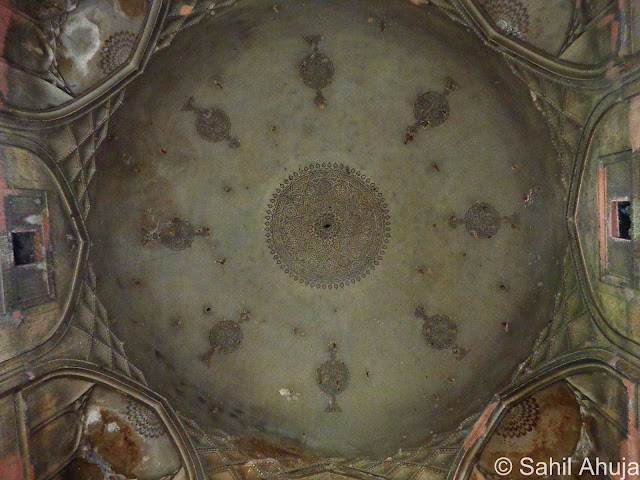

The dome - Rahim's blanket


Slightly above the entrance, a band of calligraphy runs horizontally along the length of the wall. The four sides are also pierced by arched windows & small square ventilators located just below the room. All in all, the chamber presents a picture of subdued magnificence, artistic excellence as well as knowledge of functional aesthetics – somehow the Mughals innovated with arches, domes & openings to ensure that the structures they built remained considerably cooler than their surroundings – a feature observable inside this mausoleum. In complete contrast to the heat outside that threatened to set ablaze trees, stone & beings alike, in here it was cooler, I could have sit down & stayed there all day long. That & the presence of the big cuboid tombstone that covers much of the area within the chamber – doesn’t it look like a king-size bed?? I’m getting ideas in my head, it is said that you should not step on graves for fear of waking the sleeping spirits, what about sleeping on one?? Are there any rules regarding it?? Metcalfe stayed in Quli Khan’s Tomb, if you ignore the fact that he died of poisoning, nothing much happened to him, at least not on account of the spirits (refer Pixelated Memories - Quli Khan's Tomb). 


No curves!!


Would Rahim have been angry if I fell asleep here?? What if I just pretend to be sleeping while I collect my thoughts?? Would he be appeased if I think of his couplets once in a while?? I bet there are hundreds of homeless in Delhi who turn the unmaintained tombs into their night shelters. & then there are the tombs that people have encroached upon & turned into their houses & offices. I guess Rahim has better things to take care of. He has to take cudgels with Safdarjung for the pilferage of construction material from his tomb. He must also be pissed at the Indian education system for not giving him enough credit & recognition for the couplets they use. At least he can find solace in the fact that his name & couplets are still known & understood by the majority of Hindi-speakers in the country whereas almost nobody remembers the mighty commander Safdarjung, even though an entire area in Delhi (Safdarjung Enclave) derives its name from him. 


Ahh..the sophistication!!


Location: Nizamuddin West, close to Humayun’s Tomb Complex
How to reach: Travelling on Mathura Road from Sabz Burj (refer Pixelated Memories - Sabz Burj for identification) to Ashram Crossing, Khan-i-Khanan’s Tomb is located a couple of hundred meters away from Sabz Burj & can be accessed via a lane going into the Nizamuddin West area.
Nearest Metro Station: Jorbagh (which is quite a walk away, so you will have to take auto if coming by metro)
Open: Seven days a week, Sunrise to Sunset
Entrance fee: Rs 5 for citizens of India, SAARC Countries, Thailand & Myanamar. Rs 100 for the rest. Free entry for children below the age of 15 years. (Local residents can have passes made for free entry to the complex for the purpose of jogging/exercise/yoga)
Photography/Video Charges: Nil
Relevant Links - 

May 31, 2013

Quli Khan's Tomb, New Delhi


History is a strange subject – it deals with myriads of personalities, millions of events & thousands of ifs. Shades of grey intersperse its extremes time & again – there is no such thing as a good or bad person, the only thing that matters to history is perspective & outcome. Such is the fickle nature of history & historians that often a powerful character is lost in the reams of pages, other times even a minor character is exposed to the scrutiny of the future generations due to the flick of a single action or event. There is perhaps not an iota of doubt that Mohammad Quli Khan, the subject of this article, perhaps never did anything that warranted his exclusion from the layers of history – he was not your ordinary guy next door, but a powerful general in the army of the Mughal emperor Jalal-ud-din Muhammad Akbar (ruled AD 1556-1605), at one time his powers must have been vast considering he was the foster brother of the emperor himself. & yet, nobody knows who our hero was, what his capabilities & achievements were, if he ever fought in any major battle to win territories for the emperor, if he ever vanquished the enemies of the land or if he was a beloved of the people. On the outset of this article, one can also debate if he passed on to the dark side & was corrupted by power, if the people disliked him & wanted him dislodged from his position of authority. We do not know that either. Did he fall out with the emperor & the latter had him killed?? After all, history does remember his blood brother Adham Khan, that powerful general whose very name brought terror to the hearts of his enemies, who brought rape & plunder to the territories he was asked to subdue,& who was finally brought to his end by the orders of the very emperor he had grown up with & pledged his unflinching loyalty to.

Growing up as a child, Akbar did not stay much with his father Emperor Humayun (ruled AD 1530-40 & 1555-56). Humayun was defeated by the armies led by the Afghan warlord & Governor of Bihar Sher Shah Suri in AD 1540. As a precaution against future complications, Sher Shah chased Humayun out of the country & the latter was forced to seek asylum with Shah Tahmasp, the Sultan of Persia. During this period, Akbar was raised by his wet nurses Jiji Anga & Maham Anga – the two brought him up like their own child, Jiji’s husband Atgah Khan became a second father to the young prince, Maham Anga’s sons Adham & Quli became Akbar’s playmates & brothers. In 1555, Humayun returned to India assisted by the Persian forces & displaced Sikandar Suri, the last of the Sur Dynasty rulers & the then emperor of India. Humayun passed away a year later as a result of injuries suffered in a fall & the young prince was crowned emperor at the tender age of 14. He elevated Quli Khan, Adham Khan & Atgah Khan to the position of army generals & they rose further on account of their unflinching loyalty to the empire & battle worthiness.


Mohammad Quli Khan's Tomb


Sadly, there are no records to tell us anything about Mohammad Quli Khan. His mere existence would have been lost to the tricks of history were it not for one single structure that refuses to cease to exist almost 400 years after his death – his tomb, built somewhere in early 17th century. The structure, relegated to a pristine, forgotten corner of Mehrauli Archaeological Park, is one of the most stunning tombs in the entire city of Delhi. Its magnificence is matched only by its seclusion, its brilliant stucco work & vibrantly-colored tiles that could have been the treat of the city hide their secrets well. The tomb, part of a larger complex, is built in a splendid manner with great effort having been taken for landscaping – it stands on a high plinth while the entire complex is built in a multi-layered manner, the lowest level being that of the Archaeological Park where it shares space with scores of other tombs & mosques, including that of the mighty emperor Ghiyasuddin Balban & the mystic Sufis Jamali & Kamali. It is not known who built the tomb – it could have been commissioned by Quli Khan himself, or emperor Akbar (provided Quli died before Akbar’s demise in AD 1605) or his successor Jahangir (ruled AD 1605-28), or even by his mother Maham Anga who possessed great power & command on account of being a second mother to the emperor.

As one follows the trail within the Archaeological Park & traces one’s steps towards Quli Khan’s tomb, one reaches the first level of the complex which is defined by a raised path snaking its way through dense vegetation, the stone margins that flank it interrupted b hexagonal bastions at regular intervals. One comes across a small irregular structure, built in such a manner that it looks as if several rectangular boxes of different sizes are stacked against each other – this is the entrance to the tomb complex that was added by Sir Thomas Metcalfe, a British officer of Scottish descent who acted as the British Agent (negotiator) at the court of the Mughal emperor Bahadur Shah “Zafar” II from 1835-53 & had bought the entire complex from the emperor, had it remodeled & converted into his country estate for use during the monsoon season & christened “Dilkhusha” (“Delighter of the heart”). It has often been claimed that Metcalfe removed Quli’s sarcophagus from the tomb & had it replaced by a billiards table, but it can be dismissed as a myth & an exaggeration of the amount of change that Metcalfe wreaked on the tomb complex – in all probability, Quli was buried deep underneath his tomb’s central chamber. Metcalfe did of course make several additions to the octagonal tomb & its surroundings – large cells (annexes) were built on two of its sides to accommodate him & his guests (it is said that he rented the place to honeymooning British & Anglo-Indian couples, what did they feel like sharing their “honeymoon suite” with a dead general??), he had canals dug around the complex & a Lodi-era dove coat near the above mentioned entrance to the estate was converted into a boat house, servants were hired for the upkeep of the place, a large stable was built close to a large rubble wall that is said to be the original boundary of Lal Kot/Qila Rai Pithora (the original citadel of Delhi) on the other side of the tomb. & then there are the most impressive additions that Metcalfe did to Mehrauli landscape – his quintessential ziggurats (stepped pyramids) & chattris (large hemispherical domes surmounted on thin pillars) where he would sit for hours & adore the towering Qutb Minar in the background. The reason usually given to explain Metcalfe’s refurbishing this tomb is not so exciting & romantic however – he wanted to keep an eye on Zafar when he visited his summer palace Zafar Mahal nearby. I have previously written posts about another of Metcalfe’s chattris that graces a small hillock opposite the Jamali – Kamali Complex & his ziggurats which you can access from here – Pixelated Memories - Metcalfe's Chattri & Pixelated Memories - Metcalfe's Ziggurats.


Metcalfe's Chattri (foreground), Quli Khan's Tomb & Azim Khan's Tomb (right side, background)


The entrance Metcalfe built now opens up to a large compound so thickly covered with vegetation that you almost expect a dinosaur to jump out from amongst the trees, little blue flowers sparkle with the rain drops that just fell, green grass beckons a visitor to come lie in its soft embrace, a few puppies loiter around with not a care for the world. The places is beautiful, so are the ladybugs that come flying out of nowhere & land suddenly on dead logs waiting to decay & mix with the dark wet soil, & so too are the white flowers that have sprung up in the bosom of shadows & in the thick of decay to prove that life always finds a way. The boat house is medium-sized & composed of two concentric cylindrical structures – the outer one is slightly shorter in height & consists of several arched entrances & small square holes on its inside surface to house pigeons, the inner cylinder has square entrances & square alcoves built into its walls – the only thing common to the two is the scribbling that they have been subjected to, apparently some youngsters decided to celebrate the birthday of the singer Bohemia & release of Akon’s new album here. It’s a pity that a singer today has become more important than our country’s architectural heritage dating back several centuries. The streams & canals that Metcalfe built are gone now, buried under layers of earth & overgrown with vegetation. In fact, it comes as a surprise now that this boat house was used for the purpose of keeping boats & swimming – the area is totally landlocked & it is a bit difficult to imagine that at one point in time, someone could have swum here!!


The first level & the abundant vegetation around it


Up the staircase that leads to the tomb, the strikingly peaceful & enchanting tomb comes as a surprise, it stands in a sprawling open ground, once a garden but now covered with dry grass & wild bushes. College kids were practicing a play they are supposed to enact in their college’s drama event next to the tomb’s entrance, on the expanse next to the tomb another group of local kids were busy at a game of cricket with stone blocks as wickets. The tomb stands on a high plinth & its yellowish walls seem inviting enough. Each side of the tomb is inset with an arched niche, alternate sides have an entrance built into the niche. Exquisite bands of calligraphy border the niche, the medallions are either inscribed with Quranic calligraphy or floral patterns, the entrances are surrounded by a profuse tile work in blue & yellow, while the non-entrance niches are surrounded by intricate stucco work mirroring complex floral patterns. Both the roof of the tomb & the drum (base) of the dome is ornamented with a row of kanguras (leaf-motif supposed to look like battlements but purely for ornamental purpose). The dome is topped by a lotus finial which is surmounted by a lightning conductor that looks more like a cracker rocket & lends a unique character to the entire structure. The tomb has been recently restored as part of the run up to Commonwealth Games 2010 which were hosted in Delhi, it is stunning enough to blow one away, its seclusion & quiet charm guarantees to impress one into believing that this is one of the most charming, if not the most charming, tomb in Delhi. In fact, this is one of those few structures where words failed me in describing the wonderful monument that now stood in front of me. As part of the tomb’s restoration, most of the additions made by Metcalfe were removed, ruins of a single arched chamber stands next to the structure now, perhaps to give an estimate of what the tomb looked like with the additions. Metcalfe was so impressed with the structure & the surroundings that he wanted his daughter Emily to come stay with him here & had built a room for her too. It is said that one of the extensions was furnished with cupboards & housed Metcalfe’s personal library. During the 40 years he spent in Delhi (“Dehlie” as he would have called the city), he preferred to spend most of his time here. Sadly, most of the treasures housed here were either moved to other places following Metcalfe’s death in 1853 (apparently as a result of being poisoned by Zafar’s senior queen Zeenat Mahal) or were lost in the revolt of 1857 (were Metcalfe alive in 1857, he would have been heartbroken at the plight of his beloved city). After the British takeover of Delhi, Mehrauli was relegated to the background & this whole area, teeming with medieval tombs, mosques & baolis (stepped wells), was reclaimed by nature & dense vegetation & only a monument or two that would bob up from amidst the tree cover were spared the ignonimous fate of being lost & forgotten. It is only recently that the presence of so many of these structures came to light, & as the present condition of the park illustrates – most of the structures are still in different stages of excavation & conservation. Quli Khan’s Tomb is no exception. From close to the ruins of Metcalfe’s additions, one can climb down a flight of stairs to reach the lower levels where a few chambers exist, but these have been barred & locked with iron grilles, rightly so to keep out vandals & inebriated fellows in this mostly lawless park complex.


The tomb & the ruins of Metcalfe's annexes - View from Metcalfe's stable


Towards the top on the inside, the corners of the octagonal structure are lopped off to convert it into a sixteen-sided structure on which the dome rests. The base of the dome is marked by arched niches, all decorated in brilliant blue & red paint work that guarantees to dazzle visitors. Similar art work is used to embellish the arched windows, the recessed corners & the roof too, though much of the central artwork on the dome is now gone & only the medallions remain. Pigeons flutter about in the place, the whole structure resonating with their coos which are magnified several times by the silence the place affords.


The profuse paint work inside the tomb


A quick run around the complex promises to yield even more treasures, photographing the chattri against the tomb or the Qutb Minar that never seems to take its eyes off you is exhilarating. So is chasing butterflies in the large complex in a bid to photograph them. Through the vegetation, one can see Azim Khan’s Tomb peeping down from the high hill it sits upon (refer Pixelated Memories - Azim Khan's Tomb). Azim was apparently the guy who helped Akbar defeat & subdue Quli’s brother Adham after the latter went on a rampage in Malwa, the kingdom in central India that he besieged & conquered on Akbar’s orders. Sadly, contemporary documents are also silent on Azim’s history & credentials – why is that Adham, who was corrupted by power still finds mention in history books, but the (apparently) good guys Quli & Azim are forgotten?? That’s a question that would always haunt visitors to the tomb of Quli Khan.


Once a Lodhi dove coat, then Metcalfe's boat house, now its just another set of graffiti-covered ruin


Next I headed to the stable where Metcalfe housed his prized horses, a large rectangular structure complete with arched entrances & divided into inner & outer chambers. There is a small tank towards the back which too was once perhaps used for swimming purposes, given the presence of stairs leading down near one of its corners. Another set of stairs close by (beware of the cobwebs) lead up to the upper levels of the stable from where one can have an unhindered view of Quli’s Tomb as well as look at visitors going past Smith’s cupola or the small wall mosque in the Qutb Complex next door that is separated by just a rubble wall. The Alai Darwaza appears quashed from this point, the Qutb Minar seems even thicker & mightier, one begins to appreciate the proportions & design of the wall mosque. From here, you can also see the tank behind the stable which was perhaps once filled by Metcalfe’s retinue of servants for his horses. They must have thought their boss (“Matka” as they pronounced his name) was mad to live next to ruins & tombs while his spatial mansion in Old Delhi’s Civil Lines area gathered dust (The city house is now under the auspices of the Defence Research & Development Organisation (DRDO) & remains out of bounds for visitors).


Metcalfe's stable


After the more famous structures, you can have a peek at the Lal Kot wall & be amazed by the fact that it has been standing here for more than a thousand years, watching dynasties come & go, contemplating upon the development of newer & finer techniques of art & architecture, observing humans at close & feeling them betray their kindness & barbarianism by turns. A small gap in the corner where the wall comes in contact with the enclosing wall of the Qutb Complex (built recently, but made to look like the older wall) is from where you can cross over to the outside of the Archaeological Park & observe modern settlements coming up close by. One wonders if these settlements too would encroach upon these lands & destroy these wall fragments & tombs like it has been done elsewhere in Delhi, most notably the destruction of the fortress of Siri to make way for newer cities to come up (refer Pixelated Memories - Siri Fort Remains). Close by, another gap in the complex wall leads one out on a cemented road that is flanked by a small dump yard. There are a few structures standing here too – a bastion that could be an addition to the original Lal Kot wall at a much later stage, a large trapezoid gateway with thick tapering walls & arched openings on all its sides, thick lamp posts that were definitely added by Metcalfe given their odd shapes & apparently ornamental function. Trucks & tractors make a beeline for this extended compound, dumping & carrying away debris & construction material at regular intervals, the juice cartons, polythene bags, water bottles & potato chips wrappers come as a bit of a shock since very few tourists, if any, would come in this corner of the complex. Does this mean that the Govt. agencies in-charge of the adjoining Qutb Complex, a World Heritage Site, are responsible for this mess (refer Pixelated Memories - Qutb Complex)?? Thankfully, residents of the area around the park have taken it upon themselves to keep the park clean & free from encroachments – a daunting task given that the complex is almost 100 acres with numerous entry & exit points, an open drain running through it & the amount of waste that is being generated & dumped here is humongous. But then they say, a spark is all that is needed!!


An ornamental lamp post, in all probability built by Metcalfe


In case you are interested, you can pay a visit to the tomb where Quli Khan’s brother Adham Khan & mother Maham Anga were laid to rest by emperor Akbar. It stands close to the bus terminus, in another part of Mehrauli but very close to the Archaeological Park & can be reached by flagging down a bus or an auto going to the bus terminus & asking your way to Bhool Bhulaiya (as it is locally called). Adham’s Tomb is not as eye-opening as Quli’s Tomb considering the emperor was pissed at him for having murdered Atgah Khan in a fit of rage & jealousy & had him thrown off the ramparts of his fortress in Agra. One can also visit the Old Fort of Delhi which was the citadel of Akbar’s father Humayun & where Maham Anga commissioned one of the most magnificent mosques of Delhi, Khair-ul-Manazil (refer Pixelated Memories - Khair-ul-Manazil Mosque). The whole family’s history could be traced through the streets of Delhi, wish the books were not so silent on Quli’s life & times!!


Fluttering around


Location: Mehrauli Archaeological Park
Open: All days, Sunrise to Sunset
Nearest Metro Station: Saket
Entrance Fee: Nil
Photography/Video charges: Nil
How to Reach: After getting down at Saket Station, one can walk to Lado Serai Bus Stop. Buses are available from different parts of the city for Mehrauli & one can alight from the bus at Lado Serai stop itself. The Lado Serai stop is situated at a crossroad & at one side, one can see a large domed-structure seated on a high hill (Azim Khan’s Tomb) rising high behind the trees & the traffic. Walking towards this structure, one comes to a recreational park called Ahinsa Sthal (“Abode of Non-Violence”), marked with a large signboard (or simply ask for Ahinsa Sthal from the locals & shopkeepers, check if they are aware of its location - they weren’t when I visited the area in December 2012). The unmarked entrance to Mehrauli Archaeological Park is through an iron gate opposite the Ahinsa Sthal, a few metres back in the direction of the bus stop.
Time required for sightseeing: About 1 hr
Note – There are no facilities (toilets, food & drinking water) available within the Archaeological Park. While you can avail food & refreshments at one of the restaurants at Lado Serai, you can only find toilets at the shopping malls close to Saket Metro Station, almost a kilometer away.
Relevant Links -
  1. Pixelated Memories - Ahinsa Sthal
  2. Pixelated Memories - Alai Darwaza
  3. Pixelated Memories - Azim Khan's Tomb
  4. Pixelated Memories - Balban's Tomb
  5. Pixelated Memories - Jamali Kamali Complex
  6. Pixelated Memories - Khair-ul-Manazil Mosque
  7. Pixelated Memories - Metcalfe's Chattri
  8. Pixelated Memories - Metcalfe's Ziggurats
  9. Pixelated Memories - Old Fort
  10. Pixelated Memories - Qutb Complex
  11. Pixelated Memories - Qutb Minar
  12. Pixelated Memories - Siri Fort Remains