Showing posts with label Garden. Show all posts

November 07, 2014

The Gandhi mural and Abdul Nabi's mosque, ITO Crossing, Delhi


Invisible to the steady stream of pedestrians and motorists alike who whirl around it in uncoordinated patterns, an almost unheard of little gem that retains inappreciably little of its original characteristics to reveal its enviable antiquity and modest beauty to the undiscerning is tucked in at the intersection of two of the busiest roads in Delhi and close to one of the most important landmarks in the city’s geography. Ignored by heritage and history enthusiasts who seem to have irrevocably forgotten of its modest existence, Sheikh Abdul Nabi’s mosque, located at the indisputably well-known ITO intersection and shadowed by the towering buildings that house the headquarters of Delhi Police, Income Tax Department and the Central Public Works Department (CPWD), was commissioned and christened as his namesake in AD 1575-76 by the "Diwan" (“Supervisor of Accounts”) in the court of Emperor Akbar (ruled AD 1556-1605). The gorgeous mosque, seated with its back to the traffic intersection that is famed for its traffic jams as well as for being a geographical link between different medieval cities of Delhi, has been transformed into one of the prettiest oases that could ever exist in such close vicinity to the bustling intersection indescribably dominated by pollution, noise and an unabated deluge of humanity by Jamiat Ulema-i-Hind ("Organization of Indian Islamic scholars"), one of the oldest and most peaceful Muslim organizations in the country, headquartered in the splendid structure.


Courtyard view, Abdul Nabi's mosque


In the history of Indian freedom struggle, the Jamiat, established in 1919 by some of the most influential Islamic scholars of the subcontinent, was the only Muslim organization that did not align itself with the Muslim League and its unrelenting demand for a separate nation for the Muslim population of the country (later recognized as Pakistan) – following independence too, the Jamiat propounded the theory that by signing the Constitution of India, Muslim elected representatives have entered an agreement (“mu’ahadah”) with the majority Hindu population of the country to establish a secular state and it is the responsibility of all Muslims in the country to honor the agreement. The simplistic, rubble-built mosque of Abdul Nabi, consisting of a large rectangular structure surmounted by a single, plastered over, unproportionally large dome rising from a sixteen-sided drum (base), has been expanded into a massive structure by the Jamiat who have added three wings of triple-floor hostel-like accommodations in front of the mosque creating an enclosed courtyard space in the center. The courtyard, superbly landscaped into a small garden area complete with numerous potted plants, grass-lined cobblestone walkways and fountains brimming with clear water, can be accessed by a flight of stairs emanating from the mosque’s huge front edifice. A gigantic, strikingly handsome screen, composed of stone lattice work (“jaali”) and vibrantly colorful tiles, with three huge arched openings mirroring the considerably smaller arched entrances of the mosque, exists in front of the latter as a modern extension; two sets of thick, towering pillars exist near the older structure supporting the immensely high roof that encompasses the area between the older mosque’s exterior walls and the majestic screens; seminary offices exist along the ground floor.


Unbelievable tranquility in the throbbing heart of the city


The numerous rooms in the wings around the courtyard are sparse and accommodate bespectacled religious scholars with flowing white beards and cataract-veiled eyes – eager to welcome in visitors, they must be at least in their sixties and yet retain jovial smiles, generous talkative attitudes and twinkling eyes. The interiors of the mosque are exceedingly simplistic compared to the modernized exteriors and, except for the marble wall claddings along the base, are close to what Abdul Nabi would have envisioned them as – the large prayer chamber, painted white throughout, has been partitioned into three interconnected sections by means of walls pierced by large arched openings; the central chamber displays squinches along the roof (architectural bridging elements spanning a square chamber’s top corners so as to convert it into an octagonal entity capable of supporting the mass of a giant dome) while the side chambers still retain small, meager floral medallions composed of colorful glazed tiles which, despite their brilliance, appear to be half-hearted attempts at beautification of an otherwise bare structure; a bare line of ornamental arched niches each embedded in shallow individualized rectangular depressions also runs just below the squinches in the central chamber while the squinches themselves are adorned with meager arched patterns and small six-pointed star embossments crafted from stucco.


Clash of eras - The mosque and (background) the headquarters of Delhi Police and CPWD


Abdul Nabi enjoyed Emperor Akbar’s confidence and was sent by him to Mecca in AD 1584-85 to distribute the Emperor’s charity among the poor there, but upon his return he failed to account for the money properly and was imprisoned and executed on charges of corruption and embezzlement of state funds. It struck me interesting that in an unanticipated and unintended artistic decision which would perhaps have been darkly humorous had the correlation between Mahatma Gandhi, the “Messiah of Truthfulness”, and a medieval administrative officer executed for corruption not been subjected to the collective amnesia suffered by citizens of a city that has altogether relegated its intricate history and unsurpassable architectural heritage to a forgotten corner, the recently concluded 2014 Street Art Delhi Festival saw the Delhi Police Headquarters, located immediately opposite and overshadowing the mosque, etched with an impressive, realistic mural of Gandhi, the icon of truth, honesty, non-violence and peaceful coexistence between peoples of different nationalities, religions, creeds, genders and economic realities.


Impressive, right?! All I could say was "Wow"!


The 150 feet high X 38 feet wide imposing mural, dedicated to the city by Lieutenant-Governor Najeeb Jung who inaugurated it, was completed in mere 5 days by Indian graffiti artist Anpu Varkey and German artist ECB Hendrik Beikirch and has since been lauded as a remarkable exemplar of art and a brilliant addition to the city’s streetscape which saw numerous vibrantly-colored and creatively-conceived graffiti patterns and textual messages being painted and splattered in numerous locations, most notably the urban villages of Shahpur Jat, Hauz Khas and Khirki (see links in the end), besides the inconceivably poignant notes blossoming on the walls of the dreaded Tihar jail!

For me, the day wasn’t really going well – a dear friend I just met revealed her plans to shift to Russia permanently and besides the disappointment I did not have a plan on how to spend the rest of the day except roam around in the streets and look at people, buildings and monuments without very much photographing anything in particular – the mosque, with its joyous old men, and the colossal mural opposite, does help uplift the spirits once one decides to just sit down on the stairs and let all worries go and simply adore the artwork and the efforts that must have gone into completing it. For a change, the juxtaposition of the modern and the medieval and the intermingling of the two doesn’t appall me but makes me love this beautiful city just a little more, if that is even possible.


Gandhi


Location: ITO Crossing
Open: All days, sunrise to sunset
Nearest Metro station: Pragati Maidan
Nearest Bus stop: ITO Crossing/Lala R.C. Agarwal Chowk
Nearest Railway station: Tilak Bridge 
How to reach: Buses and trains are available from different parts of the city – the bus and train stations are just a stone's throw away from the mosque and Delhi Police headquarters. If coming by metro, one can avail a bus/auto plying towards ITO.
Entrance fees: Nil
Photography/Video charges: Nil. It is advisable to take permission first before photographing the mosque interiors since it is a seminary's headquarters.
Other graffitis in the city - 

July 13, 2013

Abdul Rahim Khan-i-Khanan's Tomb, New Delhi


A prominent military general once said -

 “Kheera mukh te katiye, maliyat loon lagaye/ Rahiman kadve mukh ko, chahiyat ihi sazaye” ("To cure a bitter cucumber, we cut its head off and rub in salt/ Says Rahim that to cure a bitter mouth we should apply the same remedy")

But then the same man also exclaimed - 

“Rahiman te nar mar chuke, je kahun mangat jahin/ Unte pehle ve muye, jin mukh niksat nahi” (“Says Rahim, he who has to beg ceases to be a man/but he who refuses to help another was never a man to begin with”)

One might ask how is it that a man could also talk about helping others while being an army general & promoting the use of sword against those whose only fault is their employment of rude words against their opponents. But that is how Rahim Khan-i-Khanan was. Rahim who??

Though Khanzadah Mirza Khan Abdul Rahim Khan-i-Khanan lived from 1556-1626 AD, he remains a hated figure among school children throughout much of India till date. That too, not for any particular fault of his but for the sole reason that his couplets ("Dohe") about worldly knowledge & behavior are so impressive that the Education Ministry of the Government of India decided to incorporate them in Hindi syllabus throughout the country (CBSE Board). Children studying in classes 9-10 have to read, memorize & expound upon many of his couplets, which if you ask me is an easy but monotonously boring task, especially the way education is imparted in Indian schools. Sadly, no efforts are made to explain to the kids the worth of these couplets written in archaic Hindi & they are fed these as a chore suitable for rote learning, made relatively easy by the presence of so many cheat books & exam guides. Interestingly, Rahim’s couplets are quoted by grownups with much passion & often as a means to set an erring individual right. Indeed my father’s favorite couplet is “Bada hua to kya hua, jaise ped khajoor/Panchi ko chaya nahi, fal lagat ati dur” (“What’s the point in being big (tall, literally) like a date palm/ It doesn’t give shade to even a bird & the fruit grows so far”), to be used every time I tell my sister that she is younger & hence less experienced than me. Very few people are actually aware of Rahim’s history, even few know that he was buried in Delhi after his death. His tomb in Delhi’s Nizamuddin Area is a short walk away from the majestic Humayun’s Tomb complex (refer Pixelated Memories - Humayun's Tomb Complex), sadly the latter overshadows its presence & ensures that very few visitors ever set foot in Rahim’s Tomb complex. Before I embark upon a detailed discussion of his tomb & its architecture, here is a primer about Rahim’s life for those who are interested in knowing more about this poet-composer who joins the list of many others who called Delhi their home & were buried here (most prominently Ghalib & Amir Khusro about whom I have previously written here - Pixelated Memories - Amir Khusro's Tomb & Pixelated Memories - Ghalib's Tomb).


Rahim's Tomb - First view


Abdul Rahim was one of the most accomplished ministers in the court of the Mughal Emperor Akbar (ruled AD 1556-1605), he was one of the “Navaratnas” (“Nine jewels”) who graced Akbar’s court & entertained the Emperor as well as the masses with his skills & knowledge. Very few people are actually aware today that besides being a renowned poet & composer, Rahim was also a powerful army general & commanded Akbar’s armies in many battles. He was given the province of Ahmedabad by the Emperor & his palace & surrounding gardens still exist there on the banks of the river Sabarmati, though in a much dilapidated & ruinous state. On his father’s side, Abdul Rahim belonged to the Turkish Kara Koyunlu tribe of Afghanistan which had ruled over large territories in Central Asia for several decades before being supplanted by their arch-rivals, the Ak Koyunlu tribe. Rahim’s ancestors then joined service under Zahir-ud-din Muhammad Babur (ruled AD 1526-30), Emperor Akbar’s grandfather. Rahim’s father Bairam Khan was a mighty general, close confidante & clever statesman in Akbar’s father Humayun’s court. He was also counted in the circle of Humayun’s dearest friends & asswociates. During a brief period from AD 1540-55, the Mughal administration was destroyed by the renegade Governor of Bihar Sher Shah Suri who defeated & chased Humayun & his commanders out of the country. Humayun was forced to seek asylum & military assistance from Shah Tahmasp, the Sultan of Persia & embarked on a bid to re-conquer the country when Sikandar Suri (ruled AD 1555-56), one of Sher Shah’s descendants & the then Sultan of India, proved to be a weak administrator. Bairam Khan commanded Humayun’s army to victory several times, most notably in Benaras, Bengal, Kandahar & Gujarat & helped re-establish the Mughal rule firmly in the subcontinent. After the siege & capture of Kandahar, Bairam Khan was given its governorship by Humayun, a position he held for over nine years. As a means to win over the local Khanzada lords & chieftains who were originally the enemies of the Mughals (“Khanzadah”, literally “The son of Khan” was the Persian form of the Hindi word “Rajput” or “The son of Raja (King)”. Khanzadahs were originally Rajputs who accepted Islam after coming in contact with the Sufi sheikhs. They belonged to royal Yaduvanshi family who traced their lineage back to the mythical statesman-warrior Krishna, supposedly an incarnation of Vishnu (the Hindu God of life & nourishment). Humayun decided to forge matrimonial alliances with them & asked his nobles to do the same. Humayun & Bairam Khan respectively married the elder & the younger daughter of the Khanzadah chief Jamal Khan of Mewat (Haryana) (the names of the two ladies I could not find). Thus, on his maternal side, Abdul Rahim traced his ancestry to Krishna who is considered a God by the Hindus. Bairam Khan also had a second wife named Salima Begum. 


Intricate - A medallion ornamenting one of the arched cells that mark the plinth


After Humayun’s sudden death in an accident in his fortress Dinpanah/Old Fort (refer Pixelated Memories - Old Fort), Akbar had to ascend throne at the tender age of 14 years. The boy was too young to take over the reins of the vast Indian subcontinent that he was betrothed & so Bairam Khan acted as his military & administrative regent & tutor till the Emperor came of age. Bairam Khan helped consolidate the vast empire till the Emperor grew up to take charge, he cruelly subdued many of the empire’s enemies & renegade generals & was also responsible for the victory of the Mughal forces in the II Battle of Panipat (AD 1556) over the Hindu king Hemu Vikramaditya who had taken advantage of Humayun’s demise & overrun much of North India & declared himself the Samrat (“Emperor”) of India. However, when Akbar grew up, he could not put up with Bairam Khan’s fiery temperament & had him dismissed from the army in 1560 AD (Akbar was 18 now & Bairam no longer called the shots as regent). Bairam chose to leave India & go on the Hajj pilgrimage to Mecca, however it was not to be as he was identified & assassinated in Gujarat by Hazi Khan Mewati, a General & friend of Hemu. It has been contested whether it was Akbar himself who had his erstwhile tutor & the powerful commander assassinated. Hazi Khan spared Bairam’s wife & the four-year old toddler Abdul Rahim & had them sent back to North India where they were received by the emperor. Akbar decided to repay Bairam’s favour by becoming the guardian to the young Abdul Rahim. A few years later, the emperor married Bairam’s widow Salima & thus Rahim became his step-son. 


Even the mold & the seepage could not put a dent on the charm of these patterns!!


Growing up, Rahim proved to be a brilliant scholar, soon mastering Sanskrit, Arabic, Persian, Turkish & Hindi. He also achieved excellence in the techniques of warfare & was accorded the position of a general in Akbar’s army. An able poet & a powerful commander, he soon found himself in the Emperor’s close circle & became an integral part of his court. Rahim was made the governor of Burhanpur (in Madhya Pradesh) where he initiated several public works & commissioned several civic structures. Burhanpur was an important Mughal outpost from where they controlled Central & South India & it was here that Akbar confined his son Daniyal under the tutelage (& arrest) of Rahim. Akbar also had the titles of “Mirza” (“Gentleman”) & Khan-i-Khanan (“Khan amongst Khans”) bestowed on him. Despite being a Muslim by birth, Rahim was a firm devotee of Krishna to whom he claimed descent from. Mah Banu who was the daughter of Atgah Khan, Akbar’s foster father & an even superior general, was betrothed to Abdul Rahim. He rose the ladders of success, soon finding his way into the list of the literary geniuses of his time. His knowledge of philosophy, literature & astrology far exceeded that of his contemporaries & he went on to write several major literary works, including several “dohas” (“couplets”) written in Hindi & Braj Bhasha (a local dialect of Hindi, most commonly used in parts of Uttar Pradesh), devotional songs dedicated to Krishna & books on astrology, besides translating Baburnama from the original Chaghtai language to Persian (Baburnama (“Babur’s memoirs”) remains till date one of the most authentic & widely referred source of medieval Indian history & the personalities involved, especially the phase where Babur invaded India & defeated the seven major kings who lorded over the territories - five Muslims & two Hindus. Rahim finished his translation of Baburnama in AD 1589–90). Later, Rahim married his daughter to Prince Daniyal Mirza, the third son of Akbar.


Delicate - Another medallion


Rahim believed in making the world a better place for everyone, his philanthropic acts were derived from both the Hindu & Muslim tenets of charity (most educated people, including my father who is a doctor by profession, I talked to about Rahim were shocked when I told them he was pretty rich, powerful & militarily efficient. They had always believed he must have been a mendicant or a poor poet singing his verses while begging for alms – another reason why the way his compositions are taught in schools needs to be revamped), but he was always very humble about it & would never look at the face of the person who came asking for alms but instead looked at their feet. In a bid to emphasize Rahim’s kind-heartedness & modesty, his contemporary Hindi poet-composer Goswami Tulsidas questioned him thus in these words -

“Aisi deni den jyun, kit seekhe ho sain/ Jyon jyon kar unchaya karo, tyon tyon neeche nain”
(“Why do you give alms like this Sir?? Where did you learn it?? Your hands are high, but your eyes so low”)

Touched by Tulsidas’s words, Rahim immediately answered with a verse full of respect & humility -

“Denhaar koi or hai, bhejat jo din rain/ Log bhram hum par kare, taso neeche nain”

(“It isn’t me who gives day & night but someone else (God), I lower my eyes so the people do not give me credit for the acts of charity”)
Sadly, Rahim could not immediately reap the rewards of his philosophical knowledge & charitable acts, he died a broken man, without any financial backing or administrative power. In his lifetime, Akbar had appointed Abdul Rahim the tutor of his son Prince Salim. Though Salim was a favourite of Akbar’s queens & the nobility for succession to India’s throne, he was disliked by both Akbar & Abdul Rahim. When Akbar passed away in 1605 AD, Rahim opposed Salim’s ascension to Akbar’s throne, but the opposition proved to be futile & Salim was crowned emperor with the title of Jahangir (ruled AD 1605-27). To set an example of the power he wielded over his subjects, Jahangir had Rahim stripped of his powers & expelled from the royal court, his two sons (that is, Jahangir’s nephews) were executed & their bodies were left to rot at Delhi’s Khooni Darwaza (“Bloodied Gate”, refer Pixelated Memories - Khooni Darwaza). Rahim’s other sons did make up with Jahangir later, his son Feroz Khan even fought alongside Jahangir against the renegade commander Mahabat Khan in AD 1626 & gave his life for the emperor. Rahim built a splendid mausoleum ornamented with colorful tiles & plaster patterns, & referred to as Nila Gumbad (“Blue-domed tower”, refer Pixelated Memories - Nila Gumbad), for his favourite slave Fahim Khan who died alongside Feroz in the battle. However, it is not known if Rahim built a mausoleum for Feroz & if he did if it has survived or what its location is (Perhaps it is one of the numerous domed towers that dot Delhi’s cityscape, popping out in posh colonies, school playgrounds & hospital complexes, or perhaps it is in some other city, like Lahore where Rahim was born & died). Rahim's eldest son Shah Nawaz Khan is buried in Burhanpur.


Nila Gumbad - Commemorating a faithful servant


Rahim had also built a tomb for his wife when she passed away in AD 1598. Rahim spared no expense in having the tomb ornamented – set in a large garden, except for a few modifications it is architecturally a replica of the tomb of Humayun that exists very close to it. Perhaps Rahim was guided by the same reason & belief that guided Hamida Begum (Humayun’s wife) when she commissioned her husband’s tomb – the presence of the tomb of Sheikh Nizamuddin Auliya close by which is said to sanctify the entire area around it for several kilometers (refer Pixelated Memories - Hazrat Nizamuddin Dargah). When he died in AD 1627, stripped of his power & authority, Rahim, the builder of magnificent mausoleums even for slain servants, did not have enough to build a separate tomb for himself. Although he died in Lahore, his body was brought to Delhi & buried in the tomb intended solely for his wife. Since then the structure is referred to as Khan-i-Khanan’s Tomb. The beautiful square tomb, built of red sandstone & grey Delhi quartzite interspersed by marble, is an epitome of striking symmetry & craftsmanship despite being ravaged by later Mughal nobles. The marble & the sandstone slabs that once covered its exteriors were stripped from its surface in AD 1754, more than a century after it was built, to provide building material for the tomb of Abul Mansur Safdarjung – the ruler of Awadh (western Uttar Pradesh) & the last of the powerful Mughal viziers (“Wazir”). By the time of Safdarjung’s death, the Dynasty had weakened so much that not even the emperors, leave alone the viziers, could afford to build magnificent tombs & mosques. But then Safdarjung was a powerful man, a vizier only in name, in reality all the administrative & military power lay in his hands, he had to have a splendid tomb complex to commemorate his life & the power he wielded. Unable to source raw material to furnish Safdarjung’s tomb due to the paucity of funds, the officials simply decided to plunder the construction material used in Rahim’s Tomb (or perhaps they believed in the 3 R’s necessary for environmental conservation – Reduce, Reuse & Recycle!!). After all Rahim had been disgraced from the court, he was an emperor’s step-son, his tomb could be given a step-motherly treatment. Only fragments of quartzite & sandstone remain on Rahim’s tomb now, even the medallions were not spared & pulled down, the dome & the chattris (dome-like structures surmounted on thin pillars) that surround it were completely shaved of their marble cladding, the rubble masonry underneath the dome remains exposed now. But even then, the tomb, like Rahim’s works, remains dignified despite the humiliation & disgrace meted out to it. It is still one of the most striking structures in all of Delhi, preserved in the state it was left in 1754. A major reason for its better-off condition is that the complex lies in Nizamuddin West, a posh colony close to the World Heritage Site of Humayun’s Tomb Complex (refer Pixelated Memories - Humayun's Tomb Complex) & hence the threat of vandalism & encroachment is negligible (though a major portion of the garden that once surrounded the complex has been sacrificed at the altar of urbanization, what remains now is a much curtailed piece of land conserved for posterity & also to serve the joggers & walkers who come here for their daily dose of exercise morning & evening) 


Dignified & humble


Standing on a very high square plinth, the tomb looks impressive but dauntingly massive – the plinth itself is so huge that it has arched cells running along all its sides. Despite its size, the tomb looks delicate, a gentle mausoleum built by a fiercely powerful but wise man. The first thing I did when I visited the tomb complex was to go along the periphery of the well-maintained garden & photograph the tomb from different angles. One realizes how the tomb appears different with each glance - grand & yet very subtle about Rahim’s aesthetic tastes. A walk along the plinth proves the first assumption wrong – the tomb has been decorated profusely enough to make visitors stop & take notice – the arched openings of the cells that mark the plinth are each flanked by medallions, the designs are so varied & such intricate – there are several floral & geometric patterns, medallions embossed with peacocks, & such on display. The rooms that exist directly underneath the mausoleum, the ones containing the actual graves of Rahim & his wife, have been grilled & locked, certainly a disappointment (strange tradition right?? Because of the same, in half of the tombs around Delhi with no graves in the mausoleum, it cannot even be ascertained if the graves were above ground & have been destroyed or if the bodies were actually buried deep underground the structure!!).

From the plinth, one can look around the complex - the guard sits quietly in his corner, nothing much to do as visitors are few & far, dogs stroll in the complex, mynas flutter around, landing in the grass & taking flight soon again, the flyover passing close to the tomb is choked with vehicles, do the people take notice of this silent bystander?? I did, I first saw the tomb when passing over the flyover enroute to the nearby Old Fort, Humayun’s citadel (refer Pixelated Memories - Old Fort). Then I did not know anything about this tomb, did not even know that Rahim, the guy I read in school lived in Delhi & was buried here too. Why did not the school authorities think of a trip to this complex, it would have helped the children understand Rahim, the man, better. But then perhaps my teachers too would not have been aware of Rahim’s history, maybe they too thought that he was some kind of mendicant-poet who was out of job & whiled away his time by begging & composing couplets, after all they too are the product of the fairly-outdated, rote learning-based Indian education system.

The plinth is marked with several small tanks, perhaps there were once fountains installed here, similar to the ones in Humayun’s Tomb Complex, or perhaps the tanks housed lotuses & water lilies. Now they run dry, the only thing they reflect back is desolation & melancholy. There is silence all around which is not even pierced by the traffic that goes in circles around the complex, the birds nesting in the trees that flank the mausoleum too appear far off. Perhaps Rahim had intended the place to be silent so it could prove conducive to generating his memories & his verses in the mind of enlightened visitors. 


A lily pad?? A fountain??


Immediately on entering the structure, the first thing one notices are the brilliantly executed star-shaped patterns on the inside of the arched entrances that mark each of its side. The ornamentation is impressive, the patterns carved in stone appear to be done on wax, I doubt if I can even replicate them on paper, such was the prowess of the artists that Rahim employed. There are medallions as well as geometric & floral patterns carved on the entrance. Inside lies a single large cuboidal tombstone under which are buried Mr & Mrs Abdul Rahim. There are no separate graves, not even any ornamentation or calligraphy or embossment on the cuboid, just a plain monolith. Rahim would have agreed to this simplicity, here is what he had to say about fame & greatness –

“Bade badai na kare, bade na bole bol/ Rahiman hira kab kahe, lakh taka mera mol”
(“Great men/women never reveal their influence. Nor do the praiseworthy praise themselves. Says Rahim that a diamond does not have to say how much it is worth”)


An epitome of craftsmanship


But with the exception of the tombstone, the dark grave chamber is splendidly decorated with plaster work – both incised & painted. The most prominent feature is the domed roof – there is a large circular medallion in the center surrounded by eight radially placed smaller medallions. Interestingly the designs are very similar to the patterns carved inside the dome of Nila Gumbad!! On the inside, the corners of the mausoleum are designed in an arched manner – this is the use of a squinch arch (meant to bridge the upper corners of a structure in order to support the weight of the dome), masked so brilliantly by the use of arches, recessed niches & ornamental patterns that one does not even think of it on the lines of architectural necessity – certainly art & architecture reached a new paradigm during the time of the Mughals. The walls are also marked by medallions in several different designs – the calligraphy on these medallions is unique in that there are verses inscribed such that there are only straight lines (& no curves) employed in their execution, at other places the verses are aligned along designs such as they become part of floral patterns. Though much of the paintwork has since peeled away & deteriorated, the complex patterns in plaster, ingeniously thought of & dexterously designed, reflect upon the skills of the craftsmen who, though themselves unknown & unremembered, left behind a wonderful mark in Indian art & architecture through their creations. 
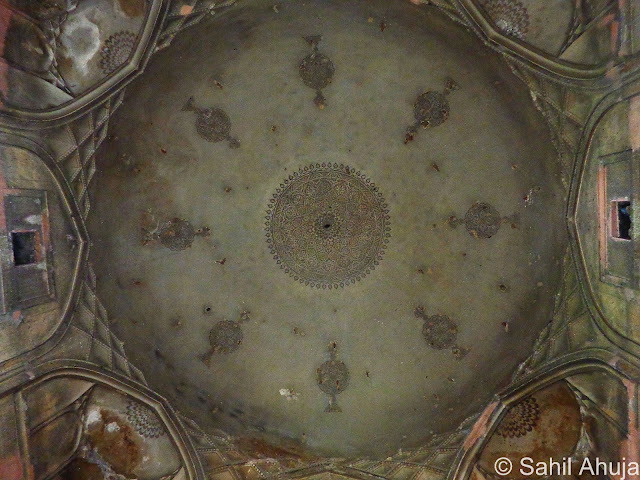

The dome - Rahim's blanket


Slightly above the entrance, a band of calligraphy runs horizontally along the length of the wall. The four sides are also pierced by arched windows & small square ventilators located just below the room. All in all, the chamber presents a picture of subdued magnificence, artistic excellence as well as knowledge of functional aesthetics – somehow the Mughals innovated with arches, domes & openings to ensure that the structures they built remained considerably cooler than their surroundings – a feature observable inside this mausoleum. In complete contrast to the heat outside that threatened to set ablaze trees, stone & beings alike, in here it was cooler, I could have sit down & stayed there all day long. That & the presence of the big cuboid tombstone that covers much of the area within the chamber – doesn’t it look like a king-size bed?? I’m getting ideas in my head, it is said that you should not step on graves for fear of waking the sleeping spirits, what about sleeping on one?? Are there any rules regarding it?? Metcalfe stayed in Quli Khan’s Tomb, if you ignore the fact that he died of poisoning, nothing much happened to him, at least not on account of the spirits (refer Pixelated Memories - Quli Khan's Tomb). 


No curves!!


Would Rahim have been angry if I fell asleep here?? What if I just pretend to be sleeping while I collect my thoughts?? Would he be appeased if I think of his couplets once in a while?? I bet there are hundreds of homeless in Delhi who turn the unmaintained tombs into their night shelters. & then there are the tombs that people have encroached upon & turned into their houses & offices. I guess Rahim has better things to take care of. He has to take cudgels with Safdarjung for the pilferage of construction material from his tomb. He must also be pissed at the Indian education system for not giving him enough credit & recognition for the couplets they use. At least he can find solace in the fact that his name & couplets are still known & understood by the majority of Hindi-speakers in the country whereas almost nobody remembers the mighty commander Safdarjung, even though an entire area in Delhi (Safdarjung Enclave) derives its name from him. 


Ahh..the sophistication!!


Location: Nizamuddin West, close to Humayun’s Tomb Complex
How to reach: Travelling on Mathura Road from Sabz Burj (refer Pixelated Memories - Sabz Burj for identification) to Ashram Crossing, Khan-i-Khanan’s Tomb is located a couple of hundred meters away from Sabz Burj & can be accessed via a lane going into the Nizamuddin West area.
Nearest Metro Station: Jorbagh (which is quite a walk away, so you will have to take auto if coming by metro)
Open: Seven days a week, Sunrise to Sunset
Entrance fee: Rs 5 for citizens of India, SAARC Countries, Thailand & Myanamar. Rs 100 for the rest. Free entry for children below the age of 15 years. (Local residents can have passes made for free entry to the complex for the purpose of jogging/exercise/yoga)
Photography/Video Charges: Nil
Relevant Links - 

January 01, 2013

Ahinsa Sthal, New Delhi


Some 800 years ago, when Islamic armies led by Shihab-ud-din Muhammad Muizuddin bin Sam (Muhammad Ghuri) first appeared at Indian borders threatening to conquer the country, the Hindu Rajput ruler Prithviraj Chauhan assembled a huge army to face this new challenge. Valiant & indefatigable, he defeated Muhammad’s forces, administering them a crushing blow in the First Battle of Tarain (1191 AD) & even capturing Muhammad himself. Magnanimous in his victory, Prithviraj treated Muhammad with all respect due to a king, & against the advice of his foreseeing ministers freed him & gave him safe passage to return to his kingdom in Afghanistan. A year later, Muhammad again amassed an even mightier army & marched once again against Prithviraj. This time around, he vanquished & chased the army of Prithviraj & his 150 brethren Rajput rulers. Prithviraj himself was captured & later killed. One by one, all the provinces in India including Tibet, Bengal, Bihar & Deccan (Central India) fell to Muhammad’s marauding army looking for loot & treasure. The entire country was ravaged, its wealth & women carried away by the Afghans, a large part of the population either killed or converted to slaves, its foundations demolished & rulers humiliated. Prithviraj himself was immortalized & lionized in folklore & bardic tradition. But the country he left behind bore the brunt of the war. After converting India into his fief, Muhammad retired to his kingdom leaving his favourite slave & army commander Qutbuddin Aibak in-charge of the unruly lands of India. A fanatic Muslim & a loyal slave, Qutbuddin decided to forward the name of his master & his religion in this new land by constructing mosques & felling temples that already existed here. He fell 27 Hindu & Jain temples in Mehrauli in South Delhi & established the gigantic mosque Quwwat-ul-Islam (“the Might of Islam”). 800 years later, though the scars of this temple destruction & religious bickering are yet to heal completely, most of the citizens of this holy land have accepted, although uneasily, a life of mutual understanding & co-existence. The Jains, believers in peace & non-violence, instead of demanding that the Quwwat mosque be fell to make way for a temple of their denomination like some Hindus did, built a temple for themselves nearby. The Ahinsa Sthal (“Abode of Non-Violence”) was established in 1980 close to the Qutb Complex (where the Quwwat Mosque is situated).


To peace & tolerance..


Boasting of a large statue of Mahavira (599-27 BC), the last Tirthankar (spiritual guide) of the Jain faith, seated atop a high hill & surrounded by landscaped gardens, Ahinsa Sthal comes as close to a peaceful & uninterrupted spot in Delhi as possible. The stone statue, 14 feet tall, seated on a lotus placed on a pedestal & flanked by statues of lions & ornaments-clad attendants, presents a glorious picture. Glimmering in the bright sunshine, Mahavira sits meditating about the human life & preaches a lesson of religious tolerance & universal brotherhood (Ironic after Qutbuddin’s actions, right??). As one enters the compound, the guards motion one to take off their shoes & place them underneath any of the several benches placed within the garden complex. Though a notice board proclaimed that “Photography is prohibited”, the guards said one can take photos as long as they do not disturb anyone else in the park. I wasn’t there to disturb anyone!! Perambulating the lawns of this not-so-large garden, I noticed statues of apsaras (divine maidens) placed underneath trees & among bushes, many of them holding musical instruments, others offering tributes to Mahavira. Large painted boards, arranged alongside the larger trees along the walkways, threw light on Mahavira’s life & teachings, & also the tenets & ethics of the Jain faith. I also noticed a few couples engrossed in talking to their partners seated close to the edge of the park, of course maintain their distance from each other. It is the first time I saw couples flocking to a religious spot in search of isolation & privacy. A few families, apparently in picnic mood, sat sprawled in the lawns, chatting & sharing light snacks. Eating & running about the lawns is prohibited. In the centre is the hill, visible from some distance outside the complex, but more or less hidden behind the surroundings. Of course, I saw the statue already from the heights of the adjacent tomb of Azim Khan. I climbed up the stone stairs, again marveling at the clever placement of the apsara statues (& a small, white marble cow too!!) to blend them with the flora.


Goddess amongst the bushes


The green cover is very well maintained here – ancient Indians believed that the presence of holy men could induce fertility to everything around them & make even barren land & rocky plateaus lush with plants, many people still believe that it was the Mahavira statue that actually made the hill sides go green. On the first level of the hill, one faces a clearing, stairs projecting upwards on either side & the Jain flags visible fluttering towards the top. The portion towards the opposite side of the hill (behind the stairs) is forbidden for tourists. A large bell hung from a blue nylon rope in front of a cavity in the opposite wall where a huge stone monolith & a photograph of some man were placed. The man gazes sideways as people kept coming to ring the bell. Its loud sound actually hurts the ears if one stands as close as I did!!


Level 1


The monolith was sculpted to show a lioness & a cow drinking from the same vessel, while the lioness fed its milk to a calf & the cow fed a lion cub. It must have been representing justice (the weak & the strong existing together & partaking the same resources) & equality (both feeding each other’s kids) - again an irony in the country. Lions were also part of the insignia of the royal family to which Mahavira belonged. He took the pledge of a solitary existence & gave up his kingdom & all his comforts when he began on the path to seek enlightenment  I climbed up the stairs to reach the summit where the Mahavira statue was kept. There wasn’t much to do here – a few families sat on the mats placed near the statue, again chewing chips & snacks, a few Jain pilgrims prayed near the statue, a few lighted incense sticks. More lions in the form of stone statues, & a lion head carved out into the plinth over which the Mahavira idol rested. The plinth itself is carved with certain couplets describing Mahavira’s ideology. The thing that certainly put me off were the names of the patrons who contributed financially for the erection of this statue inscribed on Mahavira's seat. Seriously, why do you have to be such a show-off??


Stunning, right??


A guard looked bored sitting in the small compartment built near the rear of the level. I spent some time around, thinking what to do, photographing the statues, the people, the environs & of course standing near the railing & gazing down at the visitors coming & going. Nah, there wasn’t anything much to do. I left, sort of bored & disappointed. This is a charming place no doubt, perfect for contemplation. The Jains were successful in creating a place, silent, tranquil & sacred, where meditation is possible despite the noise & fumes from the highway that passes next to it. But if you are not one up for meditation or sitting around idly, this isn’t the place for you. It is more like a normal park where people go in the evenings for walk, except that there is a huge idol instead of the swings & the merry go-rounds. Off I go somewhere else then..


In service of the Lord..


Location: Mehrauli
Open: All days, Sunrise to Sunset
Nearest Metro Station: Saket
How to Reach: After getting down at Saket Station, one can walk to Lado Serai Bus Stop. Buses are available from different parts of the city for Mehrauli & one can alight from the bus at Lado Serai stop itself. The Lado Serai stop is situated at a crossroad & at one side, one can see a large domed-structure seated on a high hill (Azim Khan’s Tomb) rising high behind the trees & the traffic. Walk towards the tomb. Ahinsa Sthal is enroute & marked with large signboards & a huge gate.
Entrance Fee: Nil
Photography/Video charges: Nil
Time required for sightseeing: About 30 min
Relevant Links -

December 13, 2012

Mughal Serai, New Delhi


This post is part of series about Qutb Complex, Mehrauli, Delhi. The integrated post about the complex and the structures within can be accessed from here – Pixelated Memories - Qutb Complex.

XXXXXXXXXXXXXXXXXXXXXXXXXXXXXXXXXXXXXXXXXXXXXXXXXXXXXXXXXXXXXX

Beginning with the victorious invasion led by Zahiruddin Babur in AD 1526 to AD 1857 when they were vanquished and exiled by British East India Company colonialists, the Mughal Empire had been reigning over the vast subcontinent for more than 300 years. During this immense period, the empire reached its zenith under the reign of Emperors Akbar (ruled AD 1556-1605) and Shahjahan (ruled AD 1605-27), but began collapsing under its own unmanageable enormity following the demise of Emperor Aurangzeb Alamgir in AD 1707. Successive rulers after Aurangzeb proved to be weak administrators, squabbling with their own siblings and nobility, often administering the disintegrating empire under fear of the rapidly amassing uncontrollable regional/religious forces (Marathas of Maharashtra, Sikhs of Punjab, Rohillas of western Uttar Pradesh, Jats of Haryana-Rajasthan, Nawabs of Hyderabad and several other fringe enemies), unapologetic bandits, corrupt bureaucracy and unruffled European colonialists and mercenaries. Nonetheless, each of them continued with the tradition of commissioning comfortable inns, consisting of several chambers, gardens and wells, for travelers along arterial highways throughout the country – these buildings, usually reserved for foreign dignitaries, ambassadors, travelling retinues of nobles, military commanders, skilled artists and poets who could afford to shell out some cash, were funded directly by the Emperor or one of his high officials and were equipped with all the material comforts that a person could ask for in medieval India. Travelers who happened to fall in lower economic strata had to make do with accommodations provided by local merchants and headmen.


Entirely forgotten - The late Mughal-era Serai within Qutb complex


The word “Serai”, Hindi for “inn”, is known throughout the country, though not used as often now since the advent of English language to the country’s shores has ensured that travelers, both foreigners and local, request accommodation by referring to it as “guesthouse” or “hotel”. Most of the larger inns which catered to high-ranking diplomats and military officers have totally disappeared and only the smaller ones, either catering to people traveling on shoestring budgets or belonging to a particular community, remain now. When even the ordinary folk of the country go by the saying “Atithi Devo Bhava” ("Guest is God"), keeping the contentment of foreigners and guests above their own, how could the Mughals, mighty and tenacious rulers that they were, have stayed behind??


Peeping through - One of the chattris accessible from a small grassy square towards the back of the decrepit Mughal mosque adjacent the Serai garden


Thus we find several Mughal-era serais scattered throughout the northern part of the country, especially in unheard of villages and townships that once lined the arterial routes and trade highways. A few that still exist in Delhi and are relatively well known are Arab Serai (Built by Emperor Humayun’s widow Hamida Banu Begum in a corner of his sprawling tomb-garden complex to house hundreds of artists she brought with her from Persia to work on the magnificent tomb), Badarpur Serai (once a massive inn on one of the arterial routes connecting Delhi and Central Asia, now only a cluster of ruined chambers and huge gateways survive) and Serai Shahji (a small inn turned into a massive graveyard, famed for its distinctive towers). Many of these, especially the historical ones or those associated with royalty and high aristocracy, were destroyed in their entirety following the 1857 War of Independence in which Indian soldiers, warlords, provincial kings and commonfolk clashed with the organized armies of the East India Co.


The same chattri, as seen from the other side of the enclosure wall


It is sad that even after independence several more have totally disappeared physically as a consequence of direct effects of urbanization and rapidly multiplying population and now exist only as the names that they have lend to colonies, landmarks, bus stops and urban villages – thus there are Neb Serai, Kalu Serai, Katwaria Serai, Sheikh Serai, Serai Kale Khan, Yussuf Serai, Begu Serai, Serai Khwaja etc. The later Mughals too, though distressed by their waning glory and emptying coffers, did not leave a stone upturned to appease state visitors. Perhaps inspired to impress guests by showing off the architectural marvels that previous Sultans and Emperors had commissioned, a serai-garden complex was constructed immediately next to the renowned Qutb complex along a medieval highway that connected Delhi and Gurgaon. No match for the spectacles offered by the Qutb complex, the serai, now reduced only to its enclosure walls interspersed on the bends by a few majestic chattris (domes surmounted on pillars), is a miserable corner set towards the right of the complex’s entrance – in fact, visitors enter Qutb complex via two collinear arched gateways of the Serai that are mirror images of each other and composed of random rubble masonry ornamented with brickwork and plaster patterns conforming to decorative pillars and flourishes. Completing the C-shape and complementing the L-shaped structure of the serai is an equally pathetic and ignored mosque, formally christened as Masjid Tarikh-ul-Islam, but officially known within the administration circles as Mughal Mosque (refer Pixelated Memories - Tarikh-ul-Islam Mosque (Mughal Mosque)).


Notice the unique designs! - The second gateway, conjectured to be an organ of the larger Serai complex


No visitors grace the garden, nor does the serai retain any alluring structure that might tempt a visitor to explore further – sensing this, the authorities have locked away the enclosure’s iron gate (accessible past the mosque) and shamelessly decided to utilize the arched alcoves and the corners culminating in chattris as storerooms for iron grilles, cement and other construction material. The square garden hemmed in by these dilapidated walls is still not forsaken though – verdant green grass gives it the appearance of an upmarket lawn; caretakers and gardeners ensure it is swept regularly for leaves and waste left behind by tourists ignorant of its antiquity visiting the rest of the complex. Adjacent to the second of the arched gateways (notice the cusped arches that have been plastered over recently and the tell-tale signs of erstwhile ornamental stucco work that still is visible in some sections) exists a high rectangular platform graced on its western side by a simplistic Bengali-style pavilion possessing three arched entrances and a curved roof very reminiscent of the highly decorated temples that I witness in unheard of villages and suburban areas of Bengal on a regular basis. The platform is dominated by four graves and could have perhaps once functioned as a small mosque – given its proximity to the serai, I wonder if any of the graves belong to the person who commissioned the serai or perhaps its caretaker or his/her family – did they hail from Bengal? What business brought them to Delhi? Though in an unbearably decrepit condition, the Mughal mosque, standing detached from the hordes of astonished visitors and overlooking these minor graves and later structures, has persisted in its will to neither get reduced to a skeleton, nor disappear altogether from the face of earth. A will that the serai seems to have lost a long time ago!


A touch of Bengali architecture


Location: Qutb Complex, Mehrauli, New Delhi
Open: Sunrise to Sunset
Nearest Metro Station: Saket and Qutb Minar stations are equidistant.
How to reach: Taxis, buses and autos can be availed from different parts of the city. Avail a bus/auto from the metro station (approx. 2 km either).
Entrance fees: Indians: Rs 10; Foreigners: Rs 250; Free for children up to 15 years of age.
Photography charges: Nil
Video charges: Rs 25
Time required for sightseeing: 30 min
Facilities available: Wheelchair access, Audio guides.
Relevant Links -
  1. Pixelated Memories - Qutb Complex
  2. Pixelated Memories - Tarikh-ul-Islam Mosque (Mughal Mosque)
Another Serai in Delhi - Pixelated Memories - Arab serai, Humayun's Tomb complex

June 09, 2012

Bi Halima's Enclosure, Delhi


This post is part of the larger series about Humayun’s Tomb complex, Delhi. The composite article can be accessed from here – Pixelated Memories - Humayun’s Tomb complex.

XXXXXXXXXXXXXXXXXXXXXXXXXXXXXXXXXXXXXXXXXXXXXXXXXXXXXXXXX

“All that is gold does not glitter,
Not all those who wander are lost;
The old that is strong does not wither,
Deep roots are not reached by the frost.”
– J.R.R. Tolkien, “The Lord of the Rings"

With their dilapidated, weather-scarred structure and exceedingly simplistic yet elegantly beautiful artworks, Bi Halima’s mausoleum and gateway welcome enthralled visitors to the World Heritage Site of Humayun's Tomb complex. The exact identity of Bi Halima is lost in the pages of contemporaneous historical records, but it is contended that she was a part of the Mughal Emperor Zahiruddin Babur's entourage to India and occupied an important place in his harem. Probably a Mughal noble woman, she is also said to have been a wet nurse of Babur’s son and successor Nasiruddin Humayun (reign AD 1530-40 and 1555-56).


A gateway withered and decayed


Her tomb, a straightforward, rubble-built diminutive rectangular structure housing the grave in the central chamber surrounded by passages, is not symmetrically aligned with the cream-white gateway but is significantly offset from it towards one of the sides of the rectangular garden. The moderately-proportioned garden surrounding it comprises one of the numerous components of the larger irregularly-shaped garden complex that exists as an appendage to the beautifully landscaped, painstakingly manicured enormity that is Humayun’s Tomb complex. It is said that her handsome pleasure garden, which is sadly no more in existence, had been envisioned and constructed long before she was interred here. Later, the ethereally magnificent Humayun’s Tomb complex was fashioned on the established axis of this existing garden complex and thus the latter came to be incorporated in the larger scheme of things and became a subsidiary entrance to the colossal complex. That of course explains why visitors presently have to traverse her tomb enclosure’s imposing gateway in reverse order while entering the spectacular gardens surrounding Humayun's mausoleum – accessing its less ornamented side first and later reaching the more gorgeously decorated facade adorned with regally vibrant, bewilderingly striking floral medallions crafted from brilliant colorful blue, yellow and green tiles.


Flamboyance!


The impressive gateway displays some of the most recurring Mughal artistic motifs such as perfectly aligned arched entrances and windows, exquisitely carved red sandstone lattice screens, protruding windows (“jharokha”) and plasterwork geometric patterns framing the arched outlines of the numerous recesses. Though dishearteningly little of the original decoration has survived the relentless ravages of time and nature, whatever does remain is so very intricate that one cannot help being fascinated by their sophistication and wonder how did those dexterous craftsmen conceive and execute such elaborate patterns. One begins to rue the fact that most of the ornamentation, like her identity, has disappeared.


Simplicity


The Archaeological Survey of India’s (ASI) website as well as the red sandstone signage affixed by them throughout the enormous complex refer to the garden-mausoleum complex as “Bu Halima’s Gate”, however, as has been pointed out to me, the word "Bu" does not exist in Persian and Arabic languages and it should instead be "Bi" which translates to “Elder sister” – hence, I have preferred to use the same here.


The intended first impressions


Location: Humayun's Tomb Complex, Nizamuddin, New Delhi
Nearest Metro Station: JLN Stadium
Nearest Bus stop/Railway station: Hazrat Nizamuddin Dargah
How to reach: The mausoleum complex is located immediately across Hazrat Nizamuddin Dargah bus stop. Buses are available from different parts of the city. The metro station and railway station are both approximately 2 kilometers away on either side of the complex and one can walk or avail a bus/auto from either.
Open: All days, 8 am - 6 pm
Entrance Fees: Citizens of India and SAARC countries: Rs 10/person; Others: Rs 250/person; Free entry for children up to 15 years of age
Photography charges: Nil
Time required for sightseeing: 20 min
Relevant Links –
Articles pertaining to other monuments that compose Humayun’s Tomb complex –
  1. Pixelated Memories - Afsarwala Mosque & Tomb Complex
  2. Pixelated Memories - Arab Serai
  3. Pixelated Memories - Barber's Tomb
  4. Pixelated Memories - Humayun’s Tomb complex
  5. Pixelated Memories - Isa Khan's Tomb Complex
Other monuments/landmarks located in the vicinity –
  1. Pixelated Memories - Abdul Rahim Khan-i-Khanan's Tomb
  2. Pixelated Memories - Amir Khusro's Tomb
  3. Pixelated Memories - Atgah Khan's Tomb
  4. Pixelated Memories - Chausath Khamba
  5. Pixelated Memories - Chilla-Khanqah Nizamuddin
  6. Pixelated Memories - Ghalib's Tomb
  7. Pixelated Memories - Hazrat Nizamuddin Dargah
  8. Pixelated Memories - Lodi Road - Jawahar Lal Nehru Stadium Trail
  9. Pixelated Memories - Nila Gumbad
  10. Pixelated Memories - Sabz Burj